The story
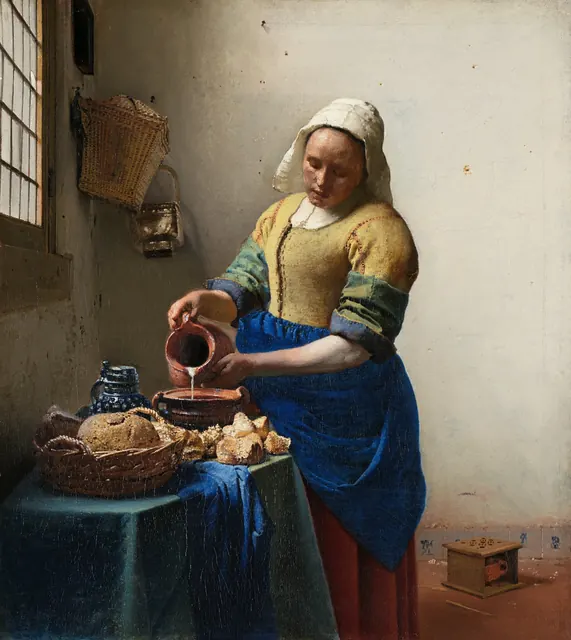
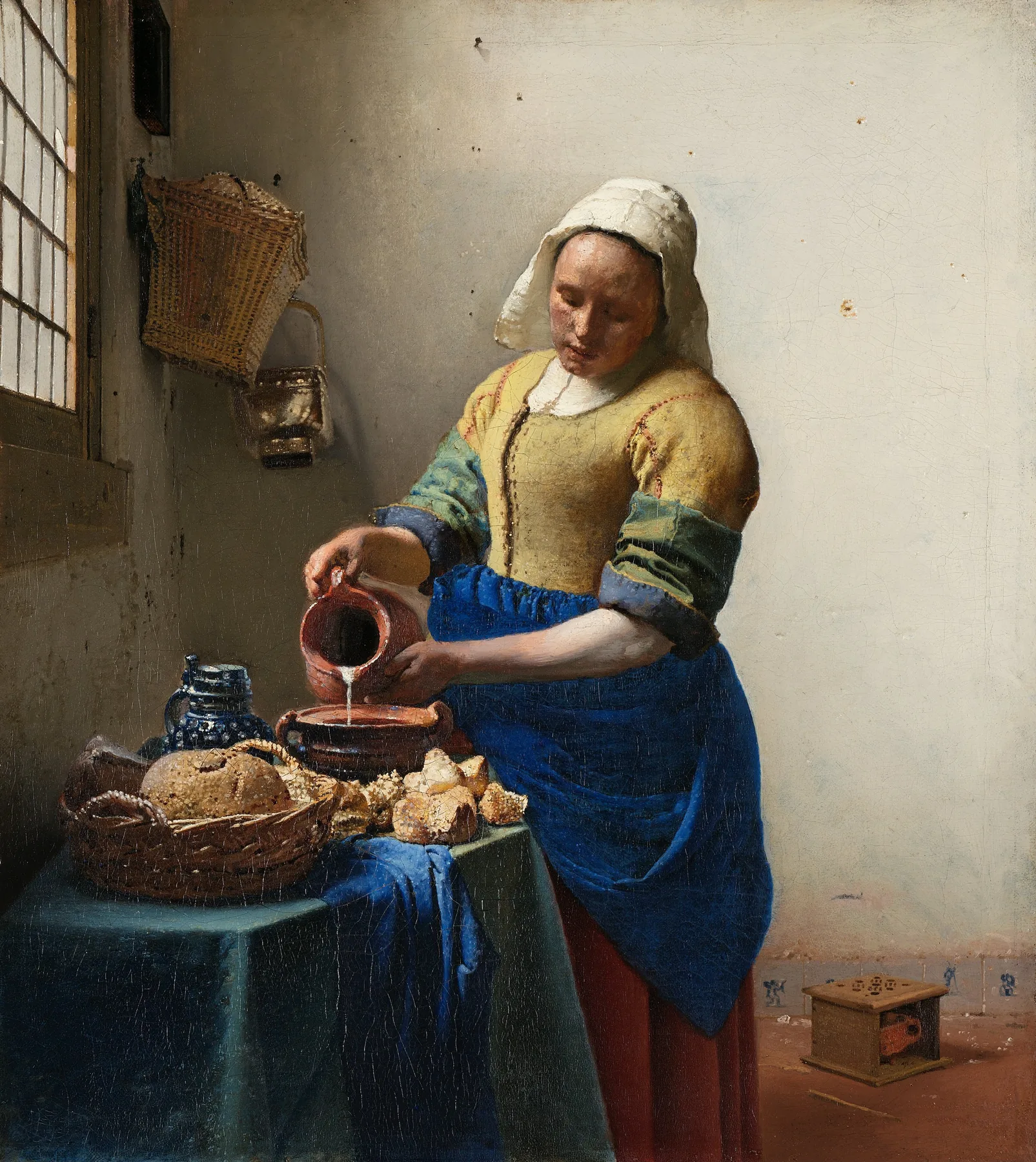
Painted by Johannes Vermeer around 1660 – scholars often narrow the date to about 1657‑58 – The Milkmaid is a modest oil on canvas measuring just 45.5 cm high by 41 cm wide, roughly eighteen by sixteen inches. Its small scale invites an intimate encounter, yet the painting holds a richness that has fascinated viewers for centuries. From the first glance we are drawn into a quiet domestic scene that feels both ordinary and extraordinary, a hallmark of Vermeer’s mature period.
At the centre stands a young kitchen maid, her back turned slightly as she steadies a simple earthenware jug. A thin stream of milk arcs into a shallow bowl, the moment captured at the instant the liquid meets the porcelain. She wears a dark‑blue bodice beneath a white apron, the fabric rendered with soft folds that catch the ambient light. On the table beside her sits a wicker basket brimming with a freshly baked loaf, its crust speckled with tiny bright dots, and a small pitcher that rests within easy reach. Every object is painted with a tactile precision that makes the scene feel almost touchable.
A gentle daylight seems to spill through an unseen window on the left, bathing the interior in a warm, golden glow. Vermeer’s limited palette – chiefly the primary hues of red, blue and yellow – creates a luminous harmony that lets subtle tonal shifts appear to glow from within. This restrained use of colour may allow the light to glide across surfaces – the polished rim of the jug, the woven texture of the basket, the smooth skin of the maid’s hands – enhancing their three‑dimensional presence. To many modern viewers the scene may seem almost photographic in its realism, a testament to Vermeer’s skill at capturing fleeting daylight.
If you look closely at the crust of the loaf and the woven surface of the basket, you’ll notice a constellation of tiny, bright dots. These stippled highlights catch the light and suggest the scintillating quality of daylight on rough textures. Vermeer’s pointillist‑like brushwork gives the bread a porous sheen and the basket a sense of depth, inviting the eye to linger on the materiality of everyday objects.
The Milkmaid’s early history probably began with Vermeer’s Delft patron Pieter van Ruijven, who is thought to have bought the work directly from the artist. After passing through several Amsterdam collections, the canvas was acquired by Lucretia Johanna van Winter. In 1908 the Rijksmuseum secured the painting from the heirs of her two sons, a purchase made possible with financial support from the Dutch government and the Rembrandt Society. Decades later, in 1939–40, the work traveled across the Atlantic for the first time, being exhibited at the New York World’s Fair and introducing American audiences to Vermeer’s quiet brilliance.
To the contemporary eye, The Milkmaid may feel astonishingly immediate, as if a camera had captured a fleeting domestic instant. The meticulous rendering of light, the subtle modulation of the limited palette, and the tactile presence of each object combine to create a scene that might be both historically specific and universally resonant. Viewers often find themselves drawn into the quiet rhythm of the kitchen, noticing how a simple act of pouring milk can become a meditation on concentration and calm.
In this modest canvas, Vermeer offers a timeless window onto 17th‑century Dutch life. The careful balance of composition, the play of light on ordinary objects, and the subtle texture of each surface remind us that beauty often resides in the most everyday moments. The Milkmaid continues to captivate, inviting each new generation to pause, look closely, and discover the quiet brilliance hidden in a simple kitchen scene.
Thank you for joining us in this close‑up look at Vermeer’s The Milkmaid, where a single pour of milk becomes a lasting meditation on light, texture, and quiet beauty.