The story
Title and Artist
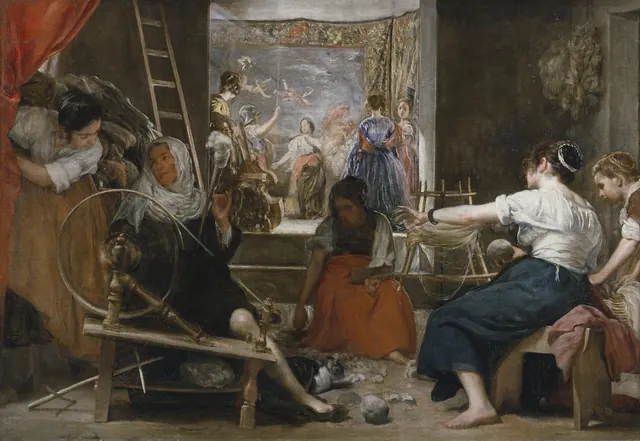
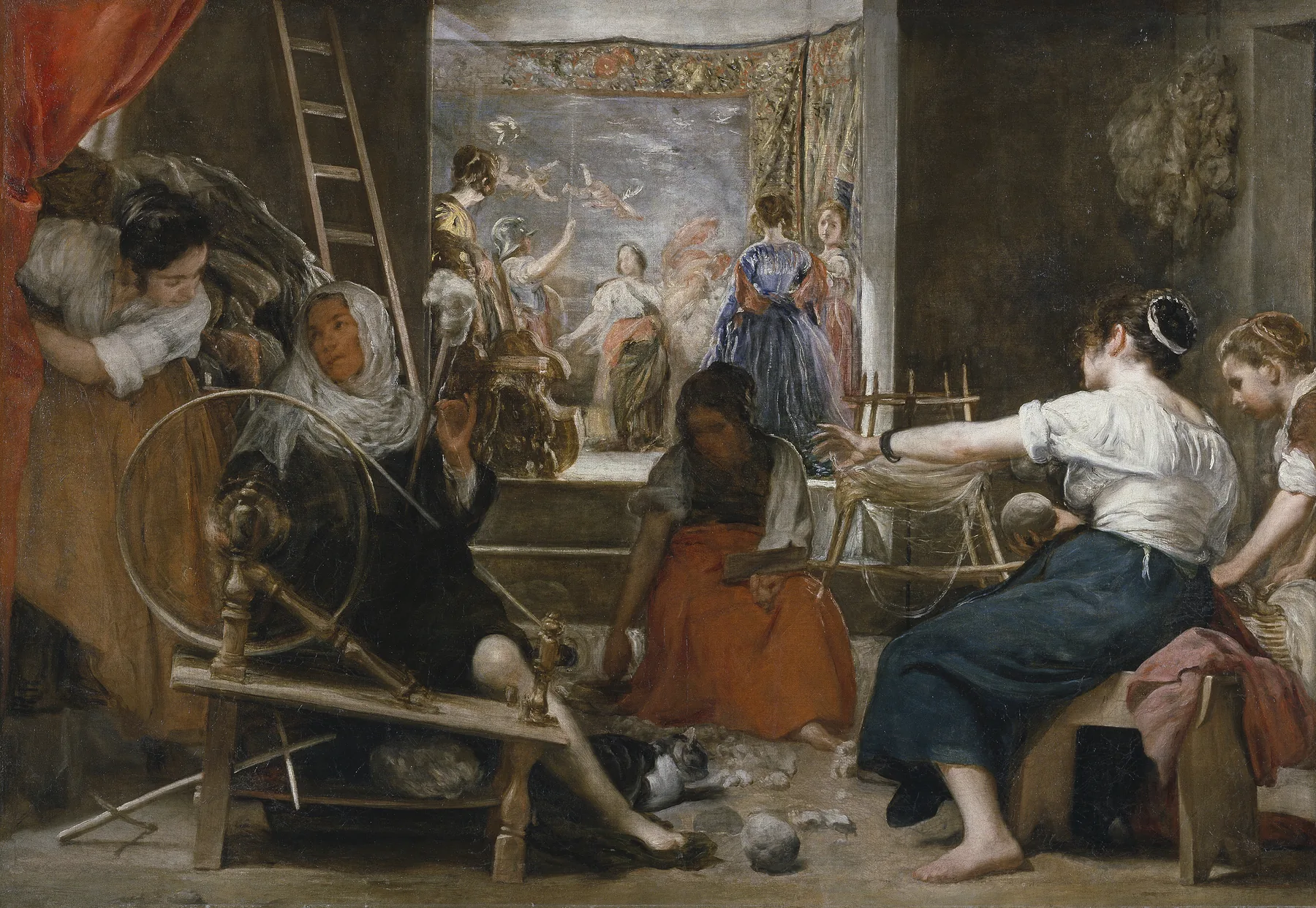
The canvas bears the title “The Spinners, or the Fable of Arachne,” immediately pairing a simple workshop scene with the ancient myth of the mortal weaver who dared to rival a goddess. This dual naming signals that Velázquez intends both a genre depiction and a deeper narrative about artistic ambition in the cultural context of his time.
Diego Rodríguez de Silva y Velázquez, the celebrated court painter of Spain’s Golden Age, is the hand behind this work. Though famed for royal portraits, Velázquez also embraced mythological subjects, allowing him to weave subtle allegory into scenes of everyday life and its enduring influence for later generations.
Dating and Medium
Scholars place the execution of The Spinners between 1655 and 1660, situating it in the final years of Velázquez’s long career. This dating aligns the painting with his late masterpieces, when his brushwork grew looser and his compositions more enigmatic. Recognizing that the work emerges from this late phase helps us see it as a mature synthesis of technical mastery and thematic preoccupations, reflecting a painter who, in his twilight, turned to complex allegory and refined observation of everyday labor.
The Spinners is rendered in oil on canvas, a medium that gave Velázquez the ability to model flesh, fabric, and wood with subtle gradations of light. Oil’s translucency allowed him to build luminous glazes, evident in the sheen of the spinning wheel’s metal accents and the soft folds of the women’s garments, showcasing his command of texture and depth.
Visual Overview and Mythic Background
In the foreground, a woman in a white headscarf and black dress sits at a large wooden spinning wheel, her spindle turning steadily. Behind her, a brown‑dressed figure with white sleeves leans forward, watching the motion. An orange‑skirted woman holds a wooden tool, while a white‑blouse figure rests on a bench draped with pink cloth. A distant figure in a brown bodice looks downward. The tapestry behind them depicts a helmeted goddess, a winged attendant, and a blue sky, adding a mythic layer to the scene.
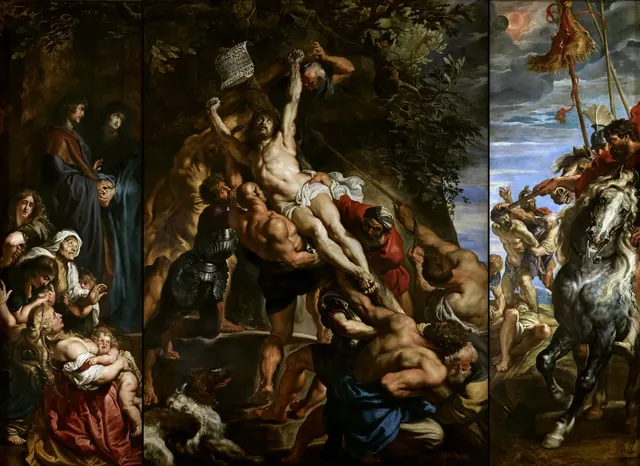
The painted backdrop brings the myth to life: the helmeted goddess Pallas confronts Arachne, the mortal weaver whose skill threatened the divine. Behind them, the tapestry reproduces Titian’s The Rape of Europa, a work later copied by Rubens in Madrid (1628‑1629). By embedding this famous composition, Velázquez creates a dialogue across artists and eras, reinforcing themes of artistic rivalry and the transformative power of the loom.
Technical History and Provenance
Technical study shows Velázquez originally painted only the figures and the tapestry background. In the 18th century a wide strip featuring an arch and oculus, together with narrower side and bottom extensions, was added to the canvas, though these later additions have faded from view today. This suggests the work was once displayed within a larger architectural frame, but the current visibility allows us to appreciate Velázquez’s original composition without the later visual interference.
An inventory drawn up in 1664 for Alcázar employee Pedro de Arce lists a “Fable of Arachne” by Velázquez, noting dimensions that closely match those of the canvas we see today. This document shows the work belonged to Pedro de Arce’s property, confirming its early ownership outside the royal collection and underscoring contemporary recognition of its mythological subject. The inventory thus provides a concrete link to the painting’s provenance in the mid‑seventeenth century.
The UNH digital gallery lists the painting’s date as 1657, offering a precise reference point within the broader scholarly range of 1655‑1660. While scholars accept a span of years, this specific entry gives viewers a convenient anchor when exploring the work online, situating it firmly in the mid‑17th‑century context of Velázquez’s late output.
Interpretations
Some critics interpret the clash between Pallas and Arachne as a warning against pride, reading the mythic confrontation as a political caution relevant to 17th‑century court values.
Another interpretation sees the painting as a study of material turning into form: the act of spinning wool in the foreground leads the eye to the finished tapestry behind the figures. This progression has been read as a defense of painting’s nobility, suggesting the artist, like the spinner, transforms raw material into a higher, imagined reality.
Siglo de Oro mythologist Pérez de Moya argued that the Arachne story demonstrates art’s capacity to advance continually. By portraying Arachne’s skill as surpassing the goddess, Velázquez’s canvas underscores the idea that artistic innovation is an endless forward‑moving force, reflecting the optimism of Spain’s Golden Age.
The vivid motion of the spinning wheel recalls Pliny’s claim that imitating movement is a supreme aim of painting. Velázquez captures the blur of turning thread and the subtle sway of the women, achieving kinetic energy that brings the static canvas to life, thereby fulfilling the classical ideal of rendering motion convincingly.
Late Career Context and Legacy
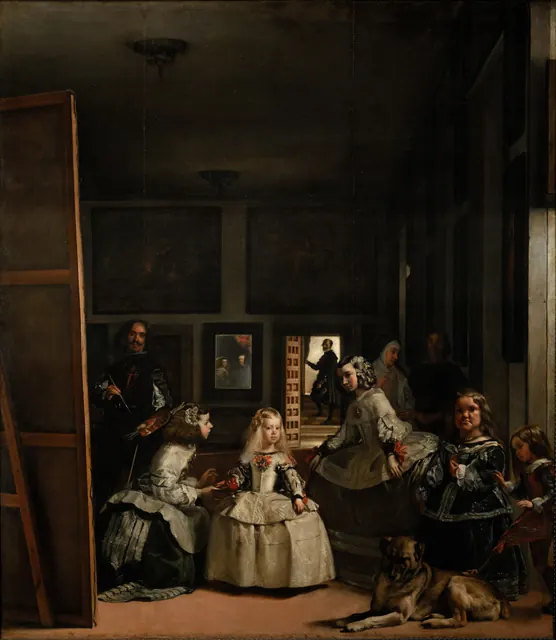
The Spinners belongs to Velázquez’s final decade, alongside Las Meninas and Mercury and Argus. Placing it among these late masterpieces highlights its role in his stylistic evolution, where compositional complexity and psychological depth reached their zenith, marking a period of intense artistic refinement.
Art historians consider this canvas one of Velázquez’s most complex works, marking the culmination of his tendency toward sophisticated, ambiguous compositions that demand active viewer participation. The layered narrative, mythic references, and subtle alterations invite the audience to piece together meaning, making the painting a lasting puzzle that rewards careful, repeated viewing.
Take a moment to linger on the spinning wheel—Velázquez’s silent reminder that art, like thread, weaves past into present.