The story
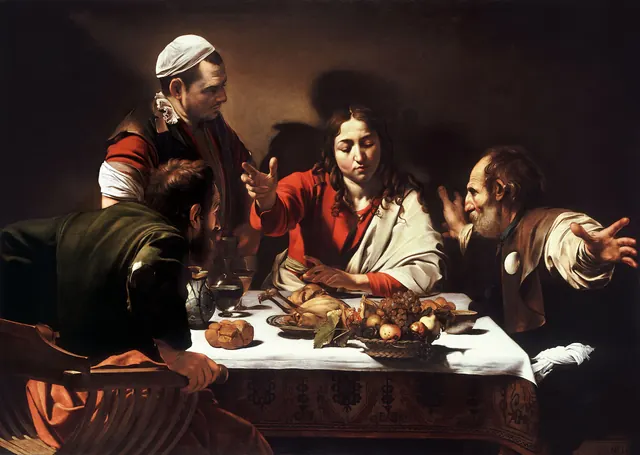
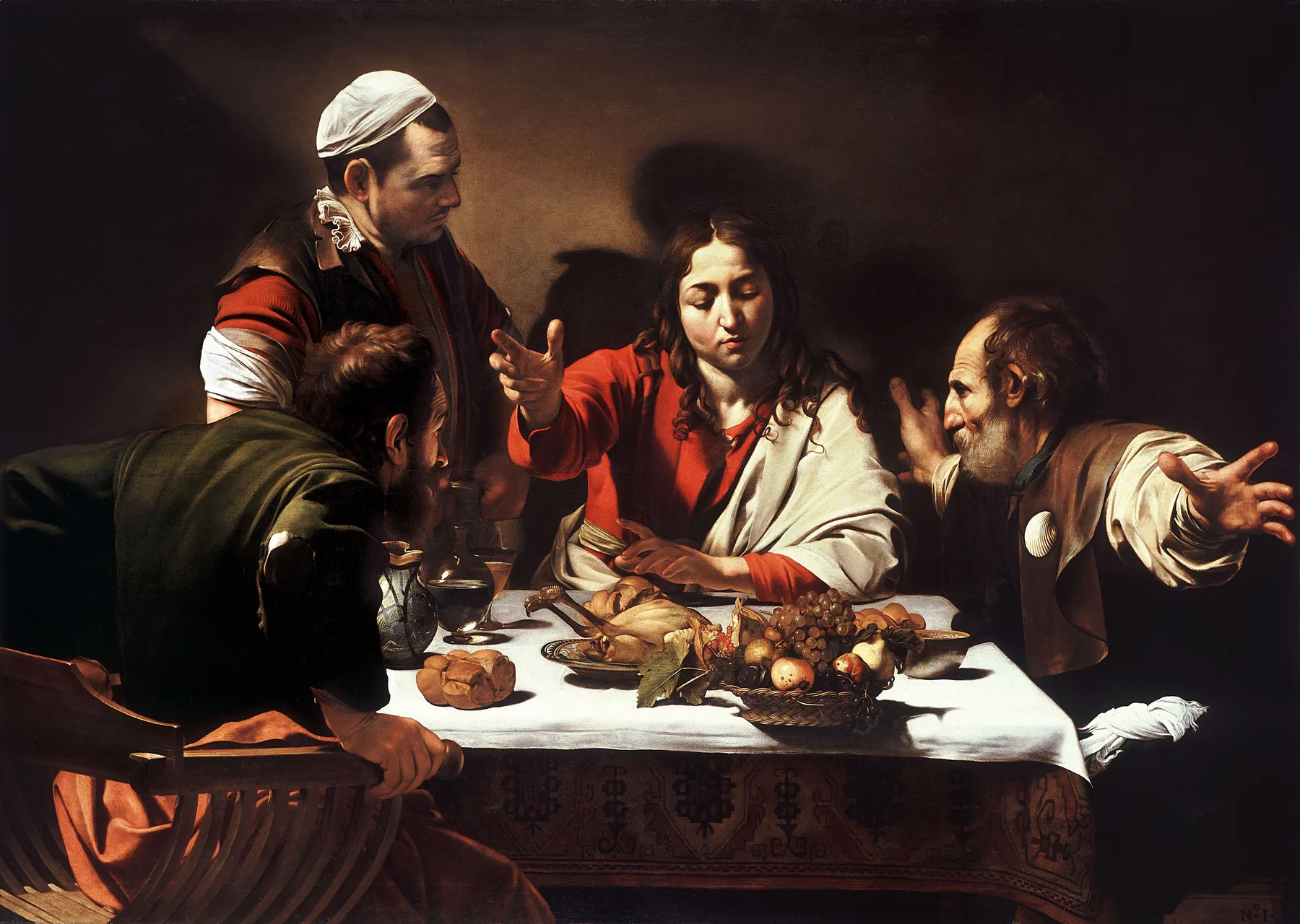
Caravaggio’s ‘The Supper at Emmaus’, painted in 1601, immediately confronts the viewer with a striking play of light and shadow. The artist’s mastery of chiaroscuro—those dramatic contrasts of illumination—turns a simple biblical moment into a theatrical tableau. A single source of light seems to spill from an unseen window, bathing Christ’s face in a soft glow while the surrounding figures recede into darkness. This visual tension not only captures the instant of revelation described in the Gospel, but also showcases the technique that made Caravaggio a revolutionary force in early‑seventeenth‑century painting.
The canvas that hangs in London’s National Gallery was laid down in the year 1601, a time when Caravaggio was at the height of his artistic vigor. Executed in oil on canvas, the work measures roughly one and a half metres in height and approaches two metres in width, giving it a monumental presence that commands the viewer’s space. These physical qualities—its substantial size and the richness of oil pigments—allow the artist to render fine details, from the glint of metalware to the texture of fabric, with a realism that pulls the scene out of the flatness of the picture plane.
Though the canvas now resides in the National Gallery’s Main Collection, its journey to London began in the early nineteenth century. In 1839, the Honorable George Vernon presented the painting to the museum, an act that secured its public accessibility for generations to come. This generous bequest not only enriched the Gallery’s holdings of Italian Baroque art but also placed Caravaggio’s dramatic vision within a broader narrative of European masterpieces on display. The painting’s presence in the Gallery today continues to reflect Vernon’s foresight in recognizing the work’s enduring artistic value.
Created at the height of Caravaggio’s fame, ‘The Supper at Emmaus’ quickly earned a reputation as one of his most impressive domestic religious pictures. Its powerful composition and lifelike figures demonstrate the artist’s ability to bring sacred narratives into everyday life, a quality that resonated with contemporary viewers. The painting’s standing as a masterwork of the period underscores Caravaggio’s influence on the visual language of devotion in the early seventeenth century.
In the center of the canvas, Christ sits calmly behind the low table, his gaze meeting the viewer directly, a compositional anchor that draws the eye through the surrounding drama. Behind him, a plain grey backdrop eliminates any distracting detail, focusing attention on the four male figures gathered around the meal. This restrained setting amplifies the psychological tension as the disciples, unaware of the divine presence, engage in animated conversation. By positioning the Savior at the heart of the scene while surrounding him with ordinary men, Caravaggio creates a visual dialogue between the sacred and the mundane.
Caravaggio’s portrayal of the disciples departs from idealized saints; instead, they appear as ordinary working men, their faces lined with age and their clothing rough and ragged. This deliberate choice grounds the biblical narrative in the reality of everyday life, inviting viewers to see themselves reflected in the scene. The bearded, weather‑worn features suggest laborers rather than lofty theologians, reinforcing the artist’s hallmark of bringing sacred moments into the realm of the common person. Such a humanized depiction was striking for its time, emphasizing the accessibility of divine revelation and personal reflection.
Among the four figures, one is often identified as St Peter, his body subtly arranged to echo the shape of a cross. This compositional gesture, noted by scholars, serves as a quiet reference to the Crucifixion, linking the moment of recognition at Emmaus to Christ’s ultimate sacrifice. The cross‑like posture is not overtly dramatic; instead, it is woven into the natural pose of the disciple, inviting a contemplative reading rather than a didactic one.
At the centre of the table, a modest bowl of fruit rests on a white cloth, its simple presence enriched by a clever visual pun. The bowl casts a shadow that takes the shape of a fish, an age‑old Christian symbol for Christ. This subtle detail, noted by art historians, adds another layer of meaning to the domestic scene, linking the ordinary act of sharing a meal with the spiritual nourishment offered by the Savior.
Since its arrival in London, the painting has traveled far beyond the walls of the National Gallery, appearing in major exhibitions that have introduced it to international audiences. In 2009 it was displayed at the Pinacoteca di Brera, then crossed the Atlantic to the Art Institute of Chicago for a 2009‑2010 showing. The following year it featured in Rome’s Scuderie del Quirinale, and later returned home for a 2016‑2017 exhibition at the National Gallery itself. Subsequent shows in Dublin’s National Gallery of Ireland, Edinburgh’s Scottish National Gallery, and the Ulster Museum in 2024 have continued to highlight its enduring appeal.
Looking once more at Caravaggio’s ‘Supper at Emmaus’, we see a work that synthesizes his celebrated chiaroscuro, his keen eye for human detail, and a composition that bridges the divine and the domestic. Created at the peak of his career, the painting remains a benchmark of religious art, inviting personal reflection while subtly recalling the Passion through posture, shadow, and symbolic objects. Its inclusion in major exhibitions—from Italy to the United States and the British Isles—demonstrates the lasting fascination it holds for audiences across continents.
Thank you for joining us on this close‑up journey through Caravaggio’s timeless vision.