The story
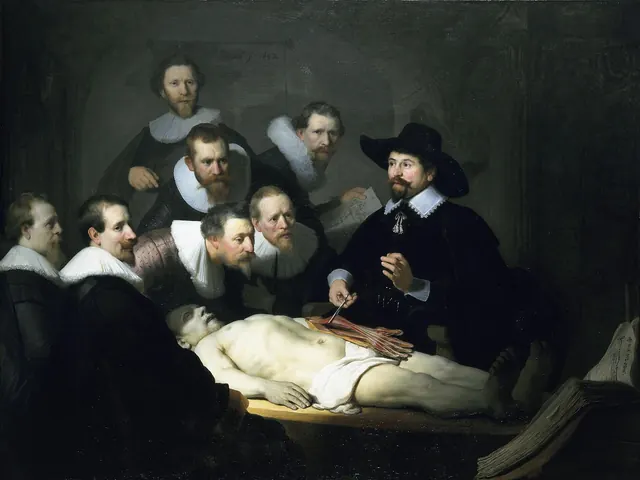
In 1632 the young Rembrandt van Rijn, only twenty‑five years old, completed what would become one of his most celebrated early works, titled “The Anatomy Lesson of Dr. Nicolaes Tulp.” Executed in oil on canvas, the painting bears the unmistakable hand of a master already experimenting with light, texture, and narrative depth. By anchoring the title to both the subject and the occasion, Rembrandt signals a work that is as much a record of a public event as it is a bold artistic statement, inviting viewers to step into a moment of 17th‑century Amsterdam life. The oil medium allowed him to build layers of translucent glaze, giving the flesh a palpable presence, and this early commission would help cement his reputation in the city’s bustling art market.
The painting was not a private commission but a civic one, ordered by the Amsterdam Surgeons’ Guild for the anatomy lesson Dr. Nicolaes Tulp delivered in January 1632. Tulp, appointed praelector of the guild in 1628, would go on to give nine public lectures between 1631 and 1650, cementing his reputation as a leading medical figure. Public dissections themselves had a long tradition in the city, dating back to 1555, when the guild began staging demonstrations in the vaulted anatomy theatre of the De Waag weighing house. The guild’s decision to enlist a rising artist reflected its desire to showcase both scientific progress and civic pride, while the continuity of the public dissections provided a familiar ritual for Amsterdam’s elite.
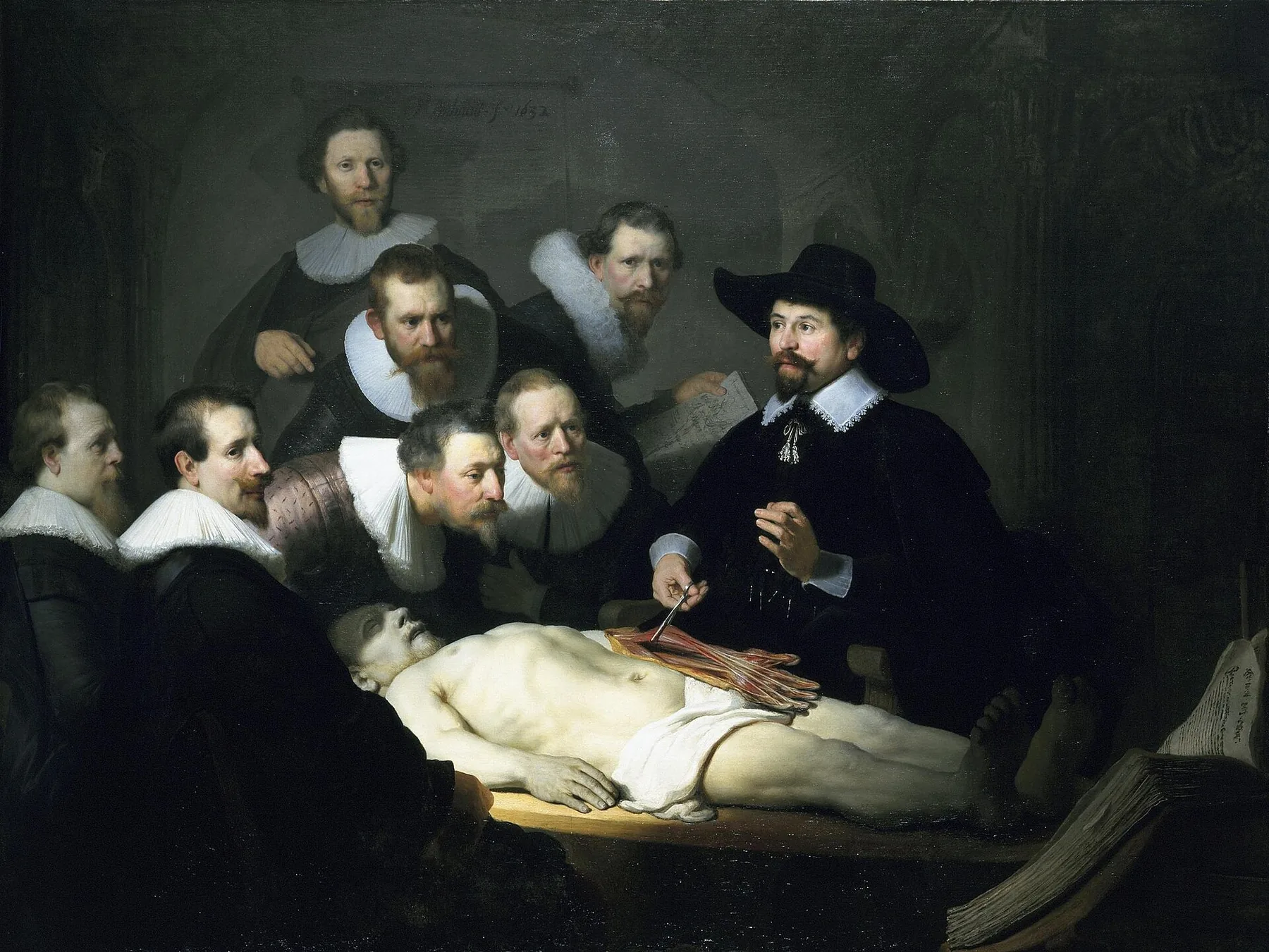
Rembrandt’s compositional strategy is strikingly deliberate. He arranges the figures in a pyramidal layout, placing Dr. Tulp on the right half of the picture while the other surgeons occupy the left. Six heads on the left are positioned so that their gazes and the line of their shoulders form an arrow that points directly toward Tulp’s right hand, the focal point of the dissection. A seventh figure holds a list of participants, reinforcing the sense of an organized, almost theatrical, gathering. The pyramidal arrangement creates a visual hierarchy that guides the eye upward toward the central act, and the list not only records the participants but also underscores the formal nature of the event.
At the heart of the tableau lies the cadaver, identified as the criminal Adriaen Adriaensz, also known as Aris Kindt, who was hanged on 31 January 1632 and supplied to the guild for dissection. By choosing a freshly condemned body, the painting juxtaposes law, morality, and scientific inquiry in a single, unsettling moment. Scholars interpret this staging as a moral tableau: the criminal’s flesh becomes a public lesson, linking sin and death, and reminding viewers that mortality awaits all, regardless of status. The arrow formed by the surgeons’ heads reinforces the notion that the gaze of science is directed toward the consequences of sin.
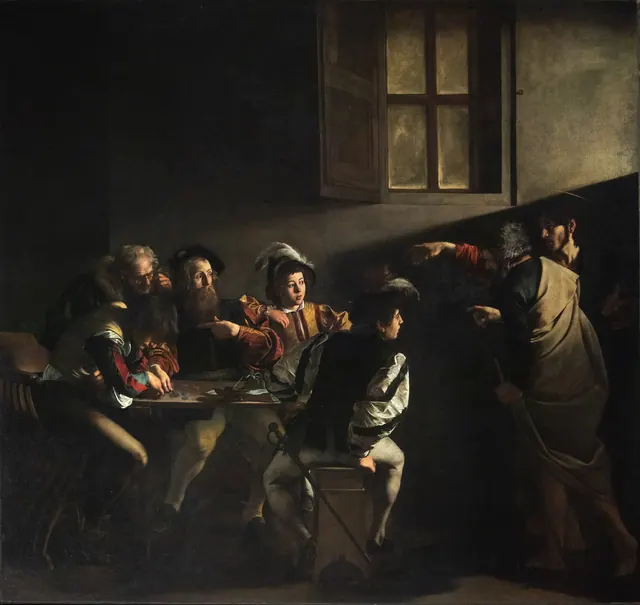
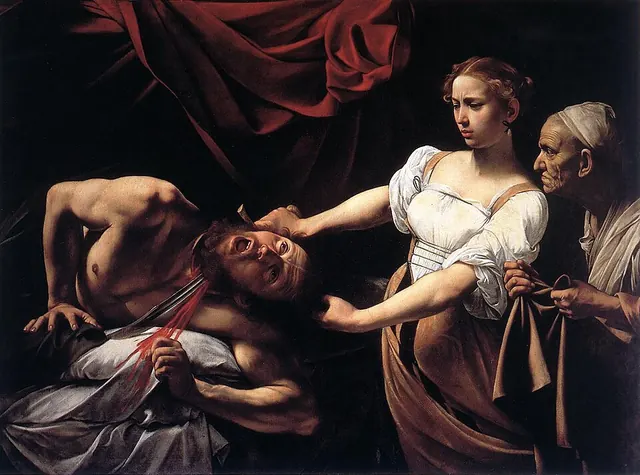
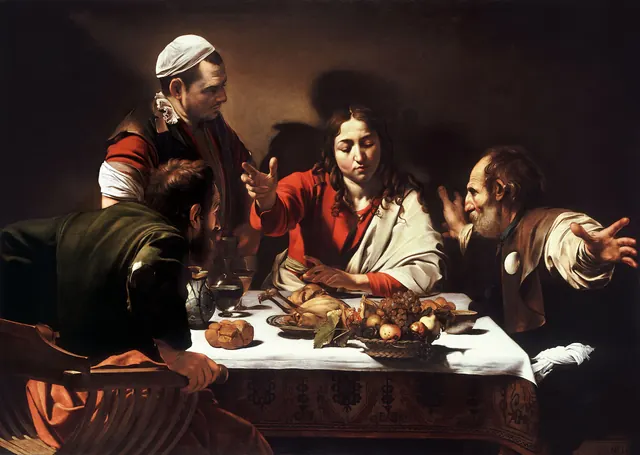
Rembrandt’s handling of light is a masterclass in chiaroscuro. The stark contrast between illuminated faces and deep shadows recalls the dramatic lighting of Caravaggio, though it is unlikely Rembrandt ever saw Caravaggio’s work directly. Instead, he probably absorbed the technique through Dutch artists who had traveled to Italy and brought back the Italianate approach. The dramatic contrast of light and shadow isolates each face, giving the scene a theatrical quality that heightens the tension. Though he likely never saw Caravaggio’s canvases, the diffusion of the Italian style through traveling Dutch painters provided him with the tools to sculpt form from darkness.
While the painting captures a dramatic moment, it is not a precise anatomical textbook. The musculature and bone structure deviate from strict medical accuracy, a fact noted by scholars who argue that Rembrandt deliberately prioritized psychological intensity over anatomical exactness. The faces and postures convey a spectrum of curiosity, concentration, and unease, inviting the viewer to feel the emotional weight of confronting mortality rather than to study the body’s anatomy in detail. In this way the work becomes a study of human response, placing psychological depth above scientific illustration.
Technical investigation has revealed that the painting’s right hand was not part of the original composition. X‑ray examination shows that Rembrandt initially painted only a stump where the corpse’s right hand now appears. Later, a hand was added, and the added hand is a slightly different colour from the arm. This alteration shifts the visual balance, drawing additional focus to the surgeon’s grip and suggesting that Rembrandt was willing to modify the work to achieve a more compelling composition.
The painting’s journey mirrors its enduring significance. After its creation it remained in the hands of the Surgeons’ Guild until 1798, then passed to the Surgeons’ Widows’ Fund. When a public sale was planned in 1828, King William I intervened, and the Dutch State acquired the work for 32,000 guilders, installing it in the Mauritshuis. Today visitors can view the canvas in Room 9, where the museum’s lighting once again reveals Rembrandt’s masterful handling of light and shadow. The provenance—from guild to state collection—underscores the work’s cultural value across centuries.
Thank you for joining us on this journey into Rembrandt’s timeless masterpiece.
Stay curious, and keep exploring the stories hidden in the canvas.