The story
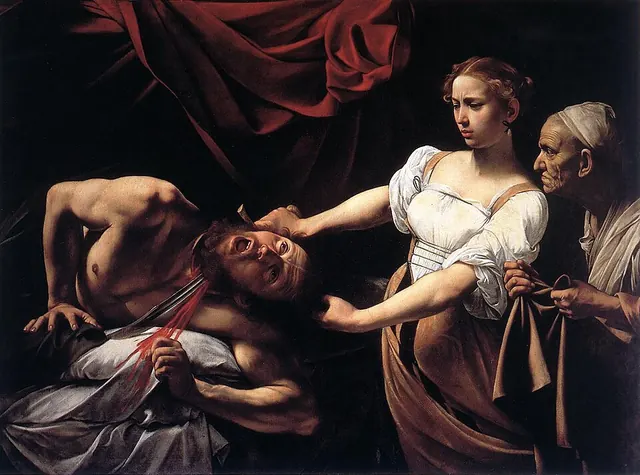
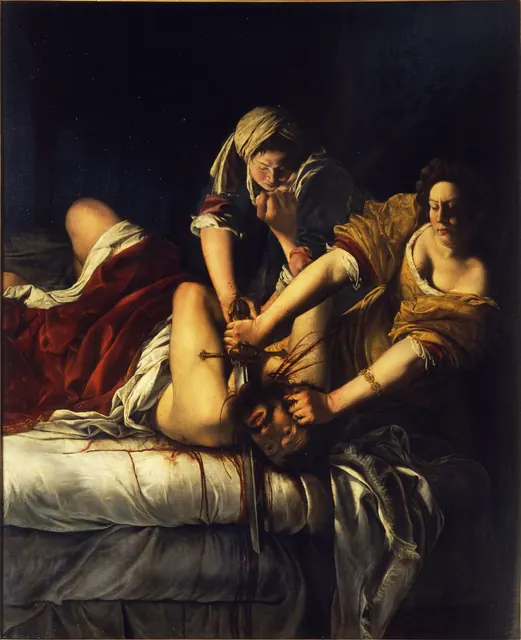
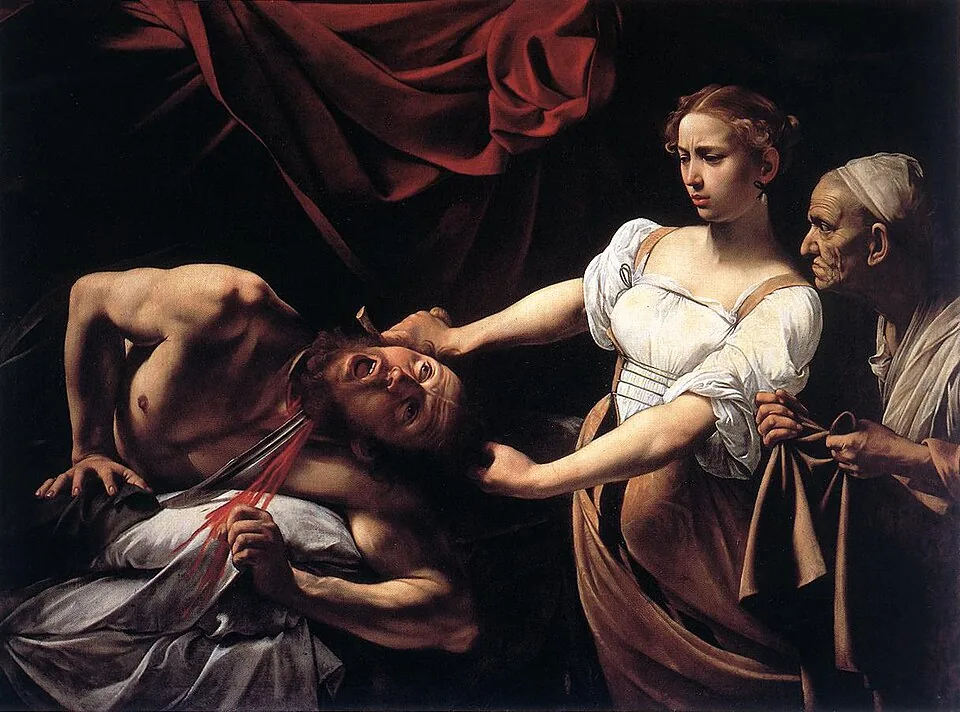
Before us hangs Caravaggio’s Judith Beheading Holofernes, a work universally credited to Michelangelo Merisi da Caravaggio. Scholars date its creation to the cusp of the seventeenth century, around 1599 to 1600, placing it squarely in the early phase of his Roman career. The title alone summons the dramatic biblical episode in which the heroine Judith decapitates the Assyrian general Holofernes, a story that Caravaggio renders with unflinching immediacy. By foregrounding both the painting’s name and its attribution, we anchor our visual journey in the concrete facts that define this masterpiece’s identity.
Caravaggio chose oil on canvas as his vehicle for this scene, a medium that grants him the ability to model flesh with a tactile presence and to render light and shadow with striking precision. The oily pigments can be layered in translucent glazes, allowing subtle shifts in tone that give the skin a luminous quality, while the flexible canvas supports the dramatic contrasts of chiaroscuro that dominate the composition. This technical choice is central to the painting’s power: it lets the artist capture the weight of the bodies, the sheen of the blood, and the stark darkness that frames the action, all within a single, cohesive surface.
In 1595 Caravaggio arrived in Rome, a city whose elite patrons and fellow artists quickly took notice of his daring approach. The capital’s artistic circles, eager for fresh naturalism, responded to his bold realism, granting him access to influential commissions and a network of supporters. This early reception set the stage for the creation of Judith Beheading Holofernes, situating the work within a vibrant environment where Caravaggio’s talent could flourish amid the expectations of powerful collectors and the competitive atmosphere of the papal court.
Judith Beheading Holofernes holds the distinction of being Caravaggio’s earliest known historical painting, marking a decisive shift from his earlier genre scenes toward grand narrative subjects. By tackling a biblical episode of moral weight, the artist demonstrates a willingness to engage with complex storytelling, expanding his repertoire beyond intimate, everyday moments. This transition signals an important moment in his artistic development, where the combination of naturalistic observation and the gravitas of historical narrative begins to define the trajectory of his subsequent oeuvre.
The composition captures a moment of brutal intimacy: a figure grips Holofernes’s hair while blood streams from his severed neck onto a white linen laid beneath him. This precise arrangement draws the viewer’s eye to the vivid crimson against the stark fabric, emphasizing the physical reality of the act. The hand that clutches the hair anchors the scene, conveying Judith’s decisive force, while the flowing blood creates a visual bridge between the two protagonists, linking the violence of the beheading to the surrounding space and underscoring the painting’s raw, unflinching drama.
The museum’s interpretation suggests that the divine light illuminating Judith signifies divine empowerment. This illumination, falling upon her figure, separates her from the surrounding darkness and frames her as the instrument of a higher moral authority. By casting light on Judith, Caravaggio visually elevates her action beyond mere mortal violence, inviting viewers to consider the possibility that her deed is sanctioned by a celestial force. The subtle glow thus adds a spiritual dimension to the otherwise stark physicality of the scene, reinforcing the narrative’s moral complexity.
The painting’s first owner, the banker Ottavio Costa, protected it with a silk curtain and, in his will, stipulated that it should not be sold or removed from his family’s collection. This protective veil not only shielded the canvas from dust and light but also served as a clear statement of the work’s high value to its patron. Interpreting this act, scholars note that the silk curtain indicates both the painting’s personal significance and its status as a treasured heirloom, reflecting Costa’s cultivated taste and his desire to preserve the masterpiece for future generations.
Today the canvas travels far from its Roman home, on loan to the Kimbell Art Museum as a Guest of Honor from the Gallerie Nazionali di Arte Antica in Rome, where it normally hangs in the Palazzo Barberini. This temporary relocation allows a new audience to encounter Caravaggio’s dramatic vision within a modern, light‑filled gallery, while the work’s primary setting remains the historic baroque splendor of its Italian collection. The loan underscores the painting’s enduring relevance, inviting contemporary viewers to experience its powerful chiaroscuro and narrative intensity in a fresh context.
Through light, blood, and a veil of silk, Caravaggio’s Judith Beheading Holofernes continues to speak across centuries, inviting each viewer to witness the moment where art and history converge.