The story
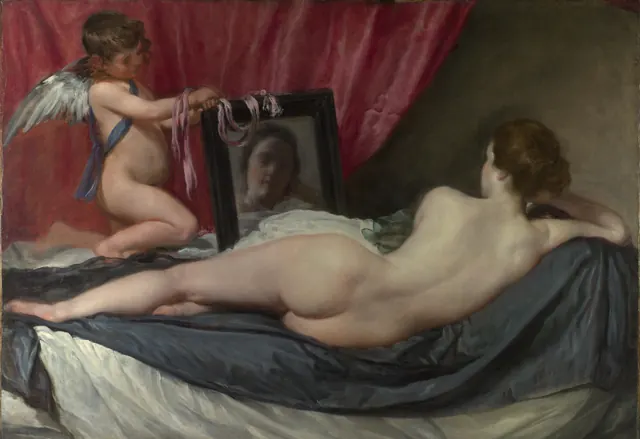
Known formally as 'The Toilet of Venus (The Rokeby Venus)', Velázquez’s masterwork invites us into an intimate, almost private moment. Painted between 1647 and 1651, the canvas captures a late‑stage flourish of the Spanish Baroque, created during the artist’s final years. The title itself hints at a ritual of grooming, while the parenthetical nickname points to the painting’s later home. By anchoring the work in these dates, we see it emerging at a time when the Spanish court was both at the height of its power and bound by strict moral codes, setting the stage for the painting’s quiet defiance.
Velázquez, chief painter to King Philip IV, operated within a court that forbade the ownership or creation of female nudes. Consequently, the patron who commissioned this work remains unknown, a mystery amplified by the fact that it is the only surviving female nude by the master. The painting likely dates from after his second journey abroad, a rare departure that exposed him to Italian influences and the broader European market for such subjects. In this context, the work becomes a subtle act of artistic rebellion, a private indulgence that skirts the strict Spanish edicts while showcasing the court painter’s unrivaled skill.
Executed in oil on canvas, Velázquez employs a luminous, almost translucent handling that allows the flesh of Venus to glow against the darkened backdrop. The canvas, modest in scale—just over a meter high and approaching two meters wide—creates an intimate viewing distance, drawing the eye to the delicate play of light on skin and fabric. Encasing the work is a 17th‑century Italian frame, its carved gilt and muted patina echoing the period’s taste for restrained elegance. Together, the medium, dimensions, and framing reinforce the painting’s private atmosphere, inviting the viewer to step close enough to contemplate the subtle details.
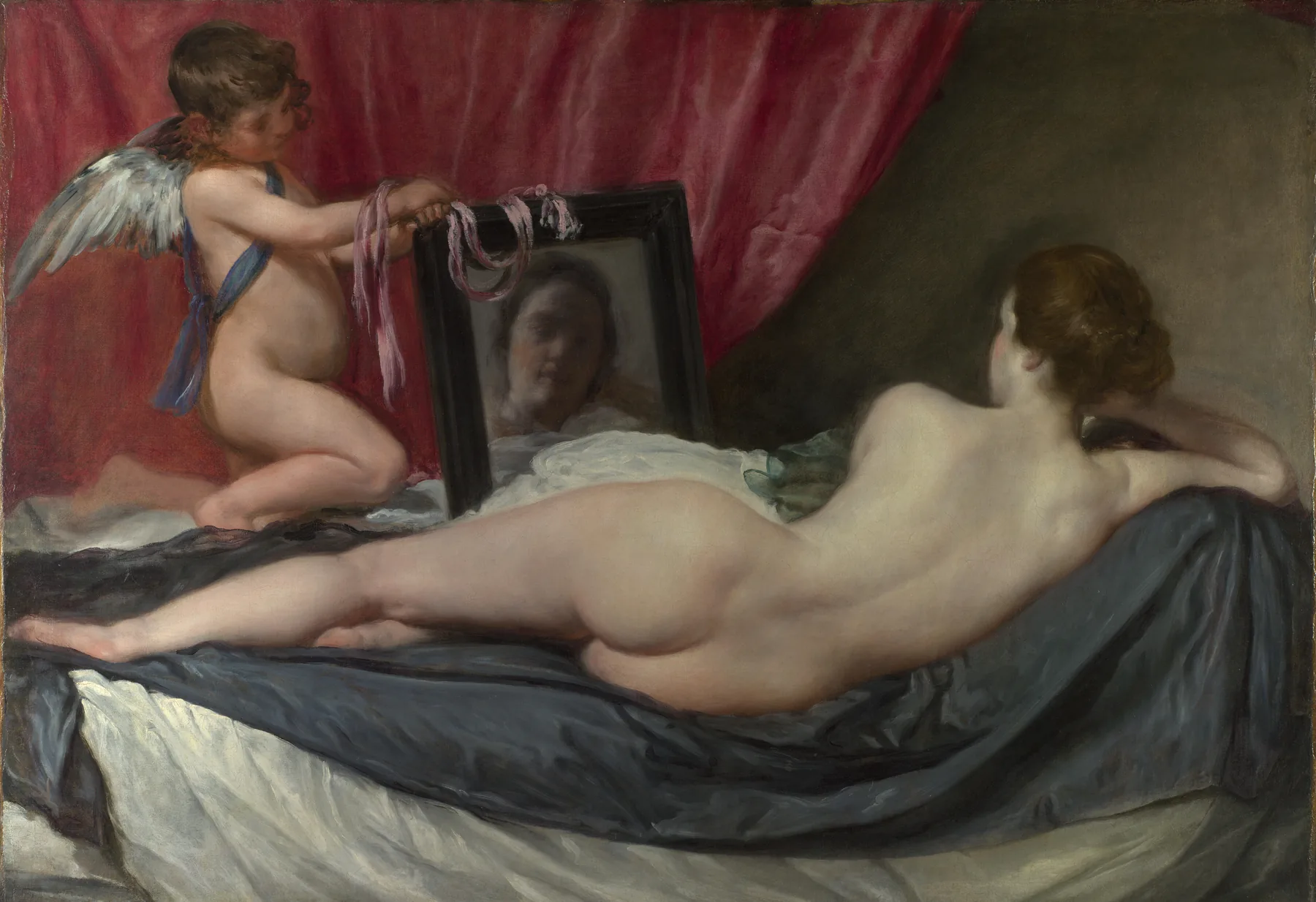
At the heart of the canvas lies a reclining Venus, her pale pink and white skin rendered with a softness that suggests both flesh and marble. Kneeling beside her, a winged child—Cupid—holds a rectangular black‑framed mirror, its surface catching the goddess’s face in a delicate, blurred reflection. The indistinct features, though faintly visible, leave her expression to the imagination, a technique that draws the viewer into an active role. The child’s left foot rests lightly on a white sheet, while his right wing folds gently, framing the scene with a quiet, almost reverent composure.
Velázquez’s palette is restrained yet striking. Venus’s skin is bathed in pale pinks and whites, catching the soft light that spills from the unseen source. A deep crimson curtain dominates the background, its folds absorbing shadow and adding a dramatic contrast to the delicate flesh tones. The child’s blue ribbon and the pink ribbon draped over the mirror’s edge introduce subtle splashes of color that guide the eye across the composition. Together, these hues create a harmonious balance, emphasizing the sensuality of the nude while anchoring the scene within a richly textured, yet subdued, visual world.
Though today we call it the Rokeby Venus, the name traces back to Rokeby Park, a grand country house in County Durham where the canvas hung for much of the nineteenth century. The estate’s owners displayed the work in a private gallery, and over time the association stuck, turning a geographic reference into a lasting nickname. This provenance not only tells us where the painting traveled but also reflects the 19th‑century fascination with collecting Old Master nudes, even in places where such subjects were once forbidden. The moniker thus bridges the work’s Spanish origins with its English custodial history.
In 1906, the Art Fund presented the painting to its present home, securing its place within a public collection where it could be studied and admired. This donation marked a pivotal moment, transitioning the work from private aristocratic walls to a museum setting, thereby widening its audience. The act of presentation also underscored the early twentieth‑century commitment to preserving masterpieces for national heritage. As a result, visitors today can encounter Velázquez’s intimate vision not behind a locked door, but within a gallery that invites contemplation and scholarly inquiry.
The Rokeby Venus has traveled far beyond its home museum, appearing in major international shows that highlight its enduring appeal. Recent highlights include a 2014‑2015 exhibition at Vienna’s Kunsthistorisches Museum and a 2015 showcase at Paris’s Grand Palais, where the painting was displayed alongside other Baroque masterpieces. Most recently, in 2024, it featured at Liverpool’s Walker Art Gallery, drawing crowds eager to see the enigmatic nude up close. These itineraries not only reaffirm the work’s status as a masterpiece but also allow diverse audiences to engage with Velázquez’s subtle dialogue of light, form, and mystery.
Scholars note that the blurred reflection forces viewers to supply the missing features of Venus’s face, turning the act of looking into a participatory experience. This invitation to ‘complete’ the goddess aligns with the painting’s broader strategy of suggestion over explicitness, a subtle defiance of the era’s prohibitions on female nudes. As we stand before the work, the interplay of light, the soft palette, and the enigmatic mirror beckon us to contemplate not just an idealized form, but our own role in shaping its meaning. In this quiet dialogue, Velázquez leaves us with a lingering question about perception itself.
Take a moment to linger on Venus’s unseen smile, and let its mystery linger in your thoughts.