The story
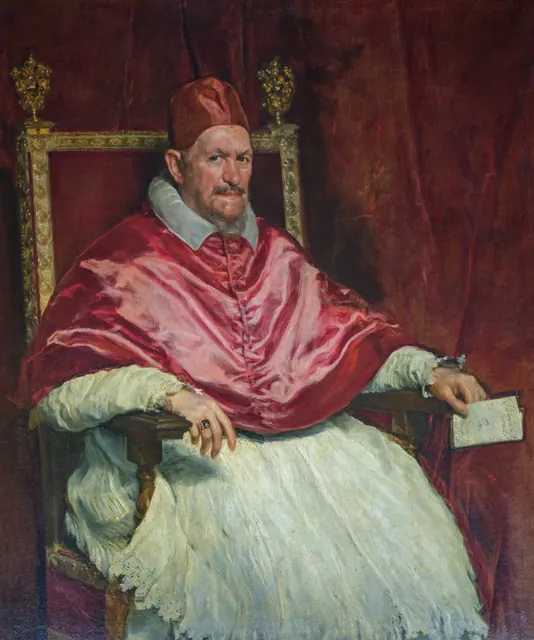
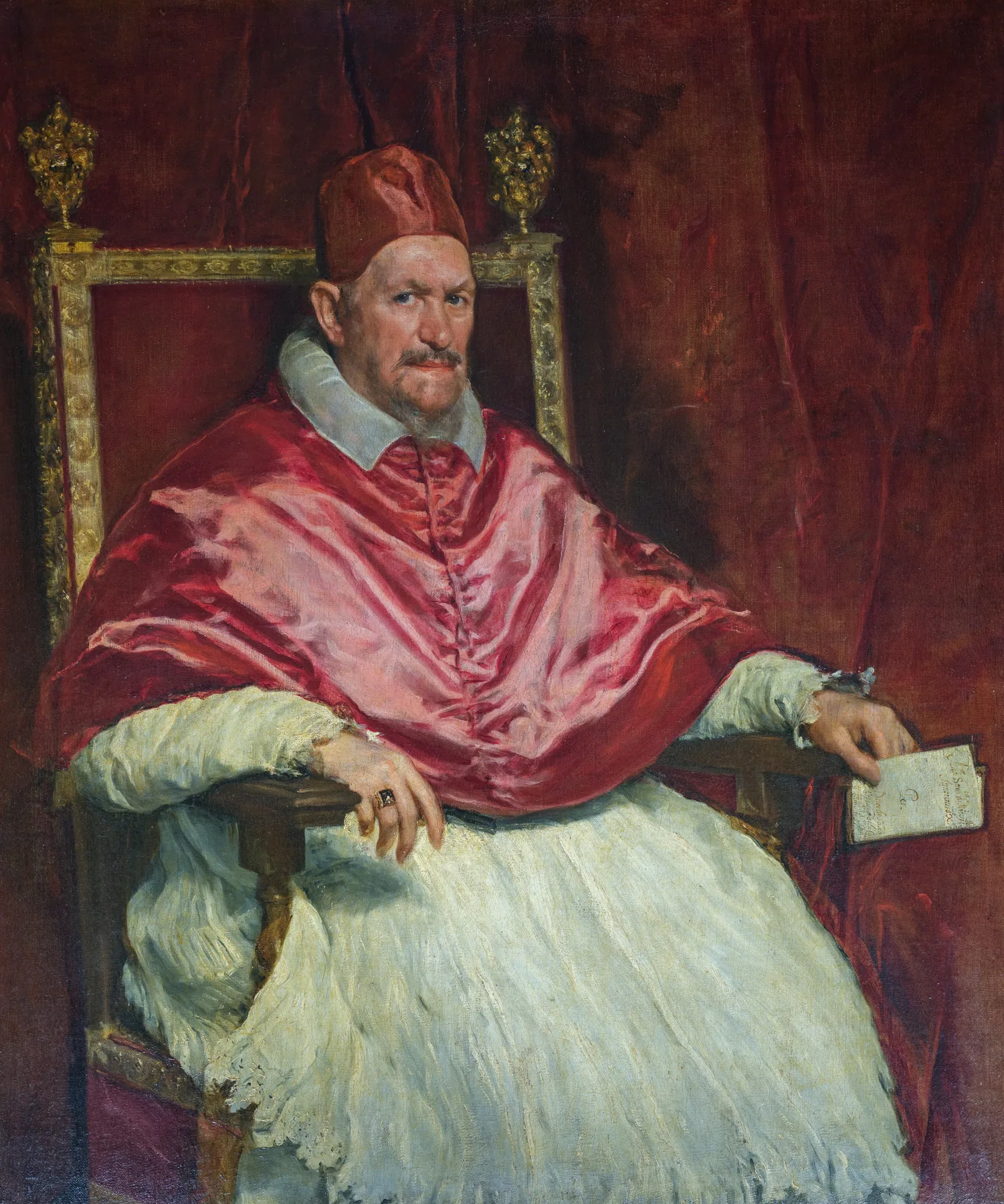
Diego Rodríguez de Silva y Velázquez, the Spanish court painter, completed the work in 1650. Titled Portrait of Pope Innocent X, the canvas presents the pontiff with a direct, unflinching gaze that seems to reach across the centuries. Though the portrait would later be hailed as a masterful study of power, at the time it simply added another distinguished commission to Velázquez’s oeuvre. The painting’s sober realism and psychological intensity already hint at the artist’s extraordinary ability to capture both status and humanity in a single brushstroke. Its execution in oil on canvas would soon reveal the subtle handling of light that defines Velázquez’s mature style.
Velázquez arrived in Rome for his second Italian sojourn between 1649 and 1651, a journey originally commissioned by King Philip IV to acquire masterpieces and recruit fresco painters for the Spanish court. The papal portrait was not part of that official agenda; instead, it emerged from the artist’s own ambition to demonstrate his skill to the highest ecclesiastical patron. During this stay he produced at least ten portraits, though only five have survived, underscoring how this particular image represents a rare glimpse into his prolific, yet largely lost, series of Roman commissions. The sheer number of works created in such a brief period testifies to Velázquez’s relentless productivity and his desire to leave a lasting imprint on the Italian artistic scene.
The canvas measures 141 by 119 centimetres, a size that allows Velázquez to present the pope at a near‑life scale while still preserving an intimate sense of proximity. This proportion gives the viewer enough visual space to observe the subtle variations of flesh, fabric, and light that define the portrait’s realism. At this scale, the red mozzetta and the delicate white collar dominate the field without overwhelming the delicate facial details, creating a balanced visual rhythm that guides the eye from the luminous skin to the richly textured garments. Such dimensions also made the work suitable for display in the intimate settings of private chapels or aristocratic salons, where viewers could engage closely with the pope’s penetrating stare.
According to the record, Velázquez painted this portrait immediately after completing his portrait of Juan de Pareja, moving swiftly from the intimate study of his studio assistant to the grand likeness of the pontiff. The transition between the two works underscores the artist’s ability to shift focus while maintaining a consistent level of technical mastery. Once finished, the painting was shown publicly at Santa Maria del Popolo in Rome, offering the city’s visitors a chance to encounter the Spanish master’s rendering of their own sovereign. This exhibition placed the work within a prominent ecclesiastical setting, highlighting both its artistic significance and its relevance to contemporary Roman audiences.
The portrait is executed in oil on canvas, a medium that allowed Velázquez to model flesh and fabric with subtle gradations of light and texture. This technical choice gives the surface a luminous quality, enabling the delicate rendering of the pope’s skin tones alongside the rich sheen of his red garments. The canvas is held in the Galleria Doria Pamphilj in Rome.
The composition is dominated by a striking visual field of red, a choice that immediately commands the viewer’s attention. Pope Innocent X is cloaked in a deep‑red mozzetta that mirrors the sumptuous red upholstery of the armchair on which he sits, while the background drapes echo this hue, creating a unified chromatic environment. This saturation isolates the figure, amplifying his regal presence and lending the portrait a sense of solemn gravity. The pervasive red also serves to frame the subtle details of the pope’s face, allowing the nuanced rendering of his skin and expression to emerge with heightened intensity against the bold backdrop.
Velázquez renders the pope’s ruddy complexion with a delicate balance of light and pigment, achieving a flesh tone that seems to glow beneath the scarlet garments. The stern expression, marked by a furrowed brow and a piercing gaze, conveys both authority and an inner resolve. Visible brushwork adds texture to the cheek and highlights the bridge of the nose, allowing the viewer to sense the tactile quality of skin. These subtle details, combined with the crisp white collar and the soft fabric of the cap, create a lifelike presence that transcends the canvas, inviting the audience to engage with the sitter’s psychological depth.
The painting’s surface reveals Velázquez’s masterful handling of brushwork, where visible strokes create texture on the pope’s cheek and highlight the bridge of his nose. These deliberate marks give the flesh a palpable quality, suggesting the softness of skin under the light. The technique also delineates the folds of the red mozzetta and the sheen of the white collar, allowing the viewer to discern subtle variations in fabric. By allowing the brushstrokes to remain evident, Velázquez invites the eye to trace the artist’s hand, emphasizing the interplay between observation and the materiality of paint itself.
Art historians note that the portrait showcases Velázquez’s nimble brushstrokes, each swift movement contributing to a cohesive whole. The seemingly spontaneous application of paint belies a meticulous control that captures the interplay of light, fabric, and flesh. This technique allows the portrait to feel both immediate and fully realized, as if the artist painted the scene in a single decisive moment while still achieving a depth that invites prolonged contemplation. The viewer perceives a living presence, not merely a static likeness, thanks to the dynamic energy conveyed through these deft strokes.
Some scholars describe the work as a “victory lap,” a defiant assertion of Velázquez’s artistic powers after years of service to the Spanish crown. By presenting the pope with such confidence and technical mastery, the painter stakes a claim for himself on the international stage, demonstrating that his skill could rival any court artist in Europe. The portrait thus stands as a bold statement of personal achievement as much as a dignified depiction of papal authority, reflecting the painter’s ambition to be recognized not merely as a royal servant but as an artist of universal renown.
The portrait earned praise from contemporaries and later scholars alike, establishing its reputation as a masterpiece of portraiture. Britannica describes it as “lauded as being among the finest portraits ever painted,” underscoring the work’s enduring impact on art history. Such acclaim reflects not only the technical brilliance of Velázquez’s execution but also the compelling psychological presence he achieved in the sitter. The painting’s ability to command admiration across centuries testifies to its timeless appeal and to the artist’s capacity to capture the essence of power in a single, unforgettable image.
The portrait was created while Velázquez was actively pursuing knighthood, a personal ambition that may have intensified his determination to produce a work worthy of such honor. This context adds a layer of personal stakes to the painting’s execution, suggesting that the artist saw the portrait not only as a commission but also as a vehicle for self‑advancement within the Spanish court’s hierarchy. By delivering a portrait that would be lauded as among the finest ever painted, Velázquez positioned himself as a candidate deserving of the chivalric recognition he sought, intertwining artistic triumph with social aspiration.
Take a moment to linger on the pope’s gaze—what does it whisper to you?
The gaze of Pope Innocent X still meets us across the centuries.