The story
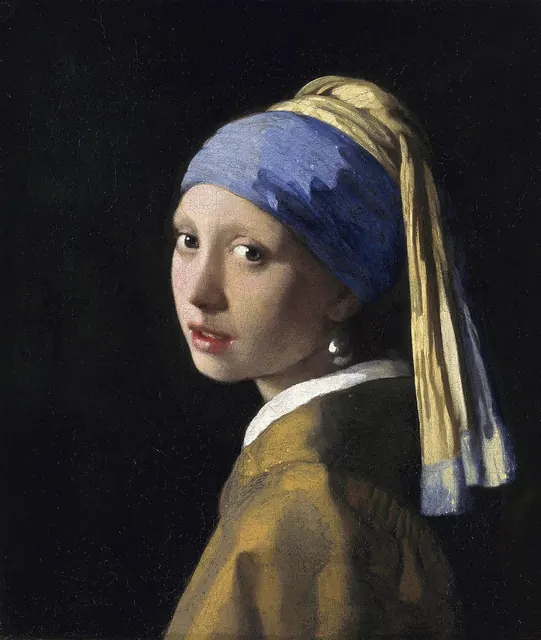
When we first meet the luminous figure in Vermeer’s small canvas, we are drawn into a moment that feels both intimate and timeless. The painting is titled “Girl with a Pearl Earring” and was painted by the Dutch master Johannes Vermeer. Though the title suggests a portrait, scholars generally describe the work as a “tronie” – a study of an imagined or generic character rather than a specific sitter. This classification places the image within a Dutch tradition of character studies that allowed artists to experiment with costume, expression, and light without the constraints of a formal portrait.
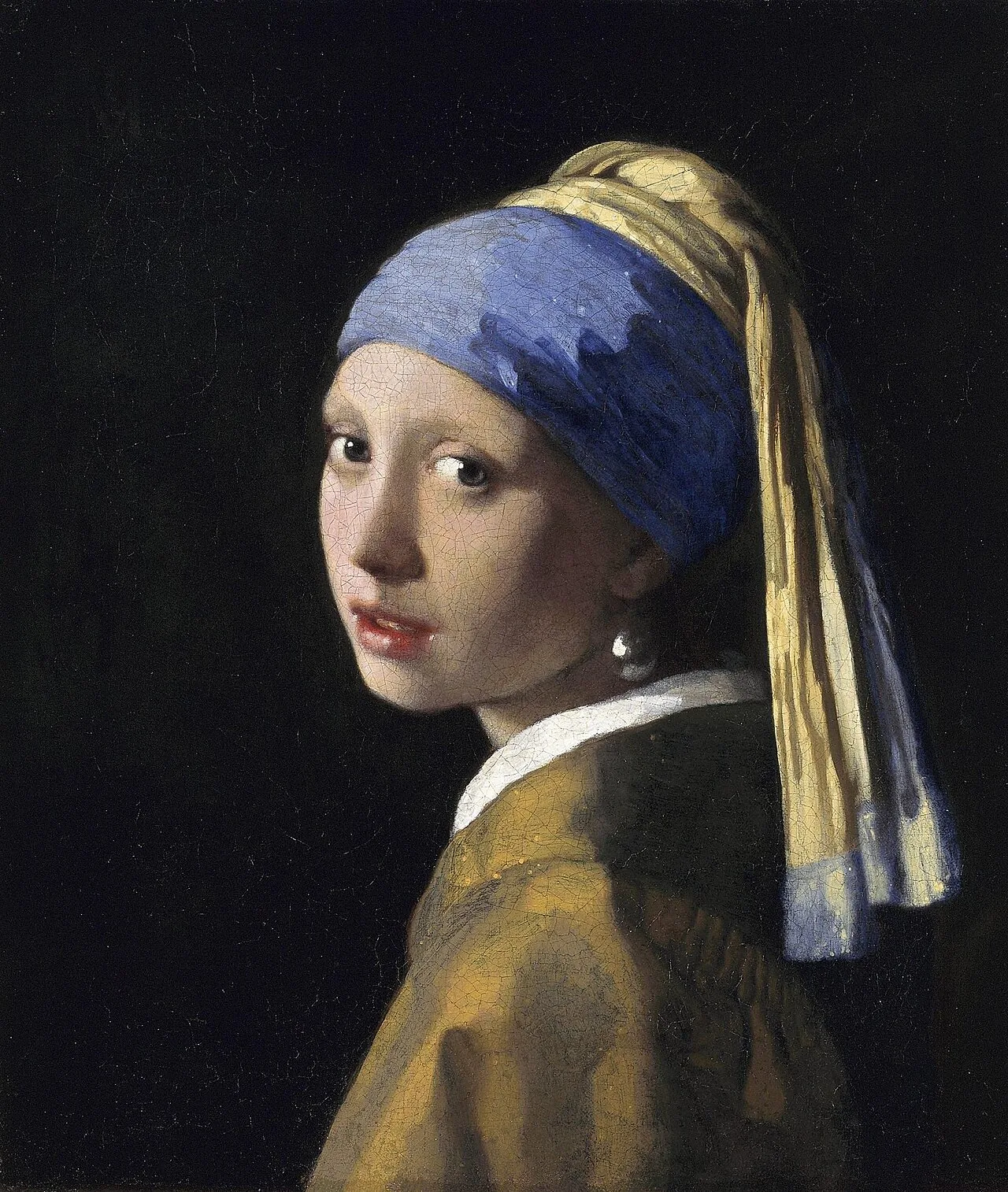
The canvas captures a young woman turned slightly, her head inclined as if she has just heard a whisper behind her. She wears a striking blue‑and‑yellow turban that dominates the upper half of the picture, and a single pearl dangles from her earlobe, catching the soft light. Her lips are barely parting, a faint sheen suggesting a breath caught in the instant, and her eyes meet the viewer with a quiet, questioning gaze. These details – the over‑the‑shoulder glance, the turban, the pearl, the slightly moist lips – define the composition and invite us to linger on the subtle drama of the scene.
Vermeer’s handling of the face reveals his mastery of light. The skin is modeled with soft, gradual transitions, each brushstroke invisible to the eye, creating a luminous surface that seems to glow from within. This technique, noted by scholars, contrasts sharply with the more schematic treatment of the clothing, where tiny dots of paint suggest reflected light on fabric. The effect is a seamless blend of realism and suggestion, allowing the viewer’s eye to fill in the details of the flesh while the surrounding textures remain delicately hinted at.
The clothing receives a different touch. Vermeer applied the white collar in thick impasto, giving it a tactile presence that catches the light in a way the smoother skin does not. In contrast, the turban and the surrounding fabric are painted with drier, stippled strokes – tiny dots that hint at reflected highlights rather than fully resolve them. This juxtaposition of thick, sculptural paint on the collar with the more delicate, dotted application on the turban underscores the artist’s deliberate play between volume and surface.
One of the most striking colors in the work is the vivid blue of the turban, achieved with the expensive pigment ultramarine. Vermeer’s choice of this costly, imported pigment not only provides an intense hue but also signals the artist’s willingness to invest in the finest materials for a single, seemingly modest study. The use of ultramarine for the headscarf is documented, confirming the pigment’s presence in this specific area of the canvas.
The pearl itself is rendered with astonishing economy. Rather than a detailed rendering, Vermeer suggested the luminous orb with only two brushstrokes of white paint – one to indicate the highlight and another to capture the reflection of the white collar. This minimal gesture creates a convincing sense of three‑dimensional sparkle, allowing the pearl to command attention without overwhelming the composition.
Understanding the painting as a tronie also invites us to consider its broader artistic context. The tronie genre was popularized in Dutch art by Rembrandt around 1630, offering painters a way to explore expressive faces and exotic costumes without the obligations of portraiture. By working within this tradition, Vermeer could experiment with the interplay of light, texture, and costume – the very elements that make this work so compelling.
The painting’s journey to the public eye began in 1881, when it was sold at an auction in The Hague’s Venduhuis der Notarissen. It later entered the collection of the Dutch collector Arnoldus Andries des Tombe, who bequeathed it to the Mauritshuis museum in 1903. Today it resides in that historic gallery, forming a centerpiece of the museum’s collection and drawing countless visitors each year.
Although Vermeer produced only about thirty‑six paintings in his lifetime, each work has become a window into his meticulous craft. The “Girl with a Pearl Earring” entered a new phase of fame around the turn of the twenty‑first century, helped by a 1995 exhibition that brought it to an international audience, the 1999 novel by Tracy Chevalier that imagined a narrative behind the canvas, and a subsequent film adaptation that introduced the image to a wider public. This surge of interest has cemented the painting’s status as one of the most beloved images in art history.
In the quiet glow of Vermeer’s brush, a single glance continues to speak across centuries, inviting us to linger, to wonder, and to marvel at the timeless power of light captured on canvas.