The story
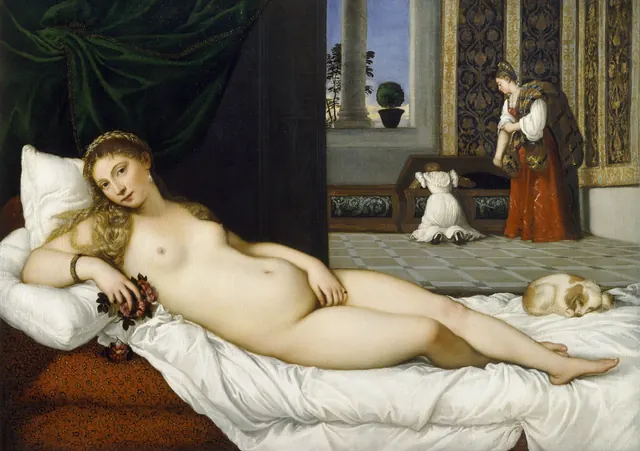
When Mark Twain walked past the Venus of Urbino in 1880, he called it “the foulest, the vilest, the obscenest picture the world possesses.” His blunt verdict captures the painting’s power to provoke strong moral reactions even centuries after its creation. That shock value, however, is only one facet of a work that has fascinated scholars, collectors, and viewers alike. By confronting us with unabashed sensuality framed within a domestic interior, Titian invites a dialogue that bridges the private and the public, the erotic and the allegorical.
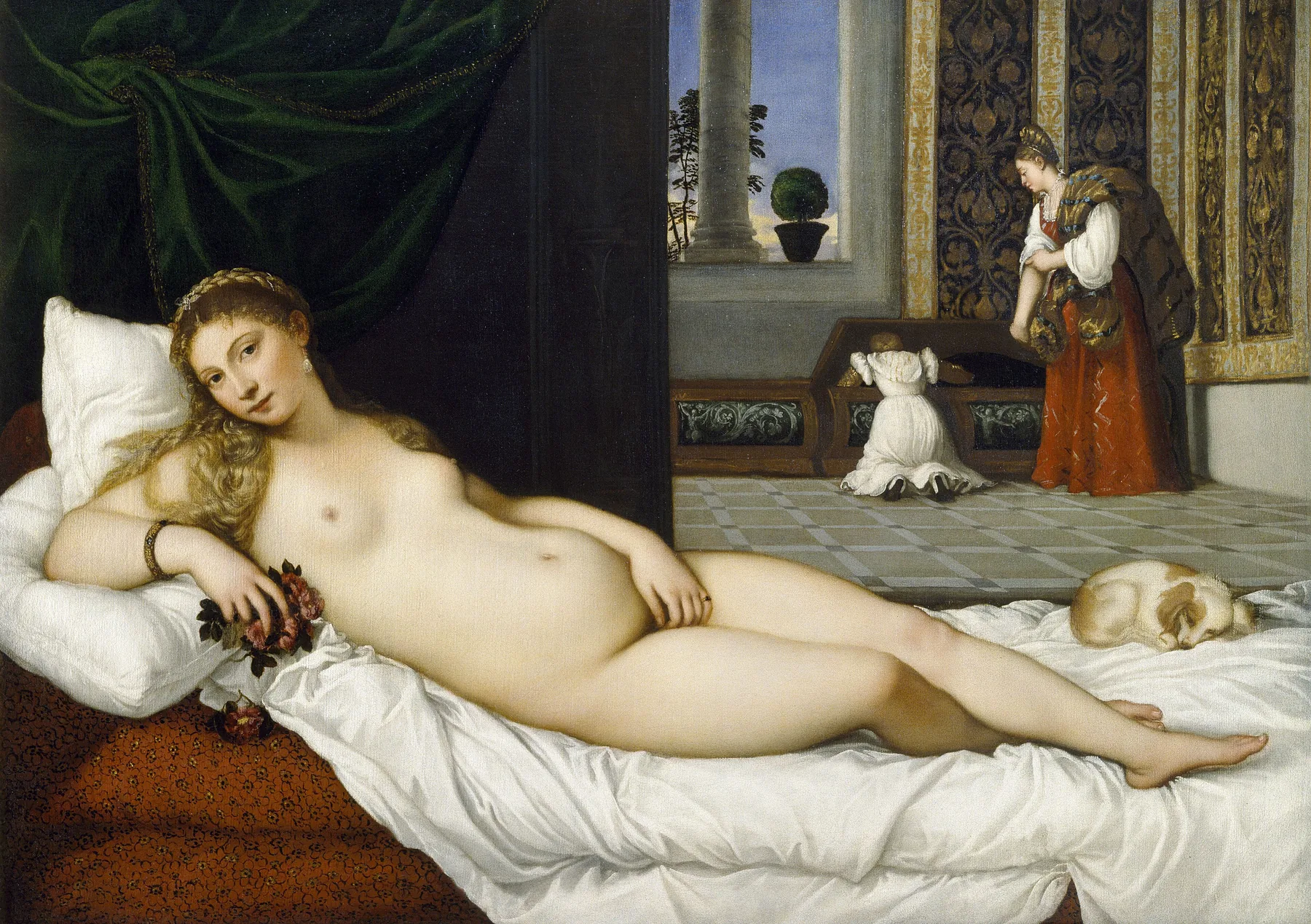
The work we see is executed in oil on canvas, a medium that allowed Titian to build delicate layers of translucent glaze, giving the skin a luminous, almost tactile quality. In March 1538 Guidobaldo della Rovere wrote to his Venetian agent requesting a painting he called “la donna nuda,” a description scholars have linked to this very canvas.
A letter dated 1538 records that Guidobaldo II della Rovere bought the painting directly from Titian, and it was later included in the dowry of his daughter Vittoria when she married Grand Duke Ferdinando II de’ Medici, bringing the canvas to Florence. This correspondence confirms Guidobaldo II as the early purchaser and explains how the work entered the Medici collection.
At the heart of the composition lies a young woman reclining on a richly draped bed. She covers her pubis with a graceful left hand, a modest gesture that paradoxically draws the eye to her vulnerability. In her right hand she holds a small bunch of roses, traditional symbols of love and beauty. At the foot of the bed a sleeping dog rests, its calm presence adding a note of domestic tranquility. A pot of myrtle on the windowsill completes the scene, its glossy leaves recalling the goddess Venus and the constancy of affection.
Flanking the reclining Venus are two maids engaged in a quiet ritual. One searches a painted chest from which a sumptuous gold and light‑blue wedding dress has just been removed, while the other carries the dress on her shoulder. Their presence adds narrative depth, suggesting we are witnessing a moment in a bridal preparation. The contrast between the bride’s bare skin and the richly colored garment hints at themes of transition, from maidenhood to marriage, and underscores the intimate domestic setting of the scene.
Scholars have read the sleeping dog at the foot of the bed as a possible emblem of marital fidelity. The pot of myrtle on the windowsill recalls the goddess Venus and the constancy of love, while the roses in Venus’s hand echo traditional symbols of love and beauty.
One reading, supported by visual clues, suggests the scene captures a young bride on the cusp of the Venetian “il toccamano” ceremony, where the groom’s hand touches the bride’s shoulder to seal the marriage. The presence of the wedding dress, the maids’ activity, and the intimate pose of the bride all align with this ritual. While not universally accepted, this interpretation offers a plausible link between the domestic details and the broader social customs of sixteenth‑century Venice, inviting viewers to consider the painting as a celebration of marital rites.
Art historian Rona Goffen reminds us that to truly understand Titian’s women, we must situate them within the social, political, and economic fabric of their time. The Venus of Urbino, far from being a mere erotic tableau, reflects the intricate web of patronage, gender expectations, and market forces that shaped Renaissance Venice. By viewing the painting through this lens, we see how Titian negotiated the desires of his patrons while embedding contemporary ideas about power and femininity into his luminous compositions.
More recently, Mary Melissa Miller has proposed that the Venus of Urbino functions as an early memento mori and an allegory of lost love. She reads the quiet domestic details—the sleeping dog, the removed wedding dress, the fleeting roses—as reminders of mortality and the transitory nature of desire. In this view, the painting transcends pure sensuality, offering a subtle meditation on the passage of time and the inevitable fading of youthful beauty.
Giorgio Vasari, writing in 1548, described the canvas as a “young Venus, reclining, with flowers and certain fine draperies … very beautiful and well finished.” His early praise underscores the work’s immediate impact on contemporaries, noting both its aesthetic appeal and the skillful handling of fabric and flora. Vasari’s testimony provides a valuable contemporary perspective, confirming that the painting was celebrated for its beauty and technical mastery almost a decade after its creation.
From its market origins to its layered symbolism, Titian’s Venus of Urbino continues to invite curiosity, debate, and wonder—proof that great art lives on in the questions it raises as much as in the beauty it displays.
Thank you for joining us on this journey into Titian’s timeless Venus.