The story
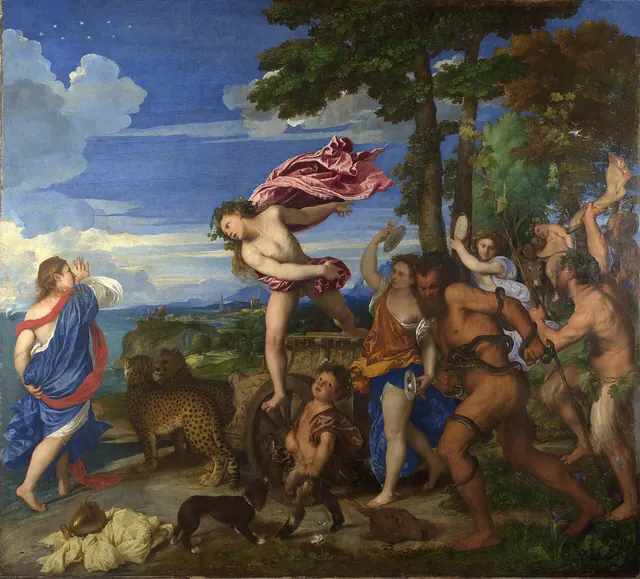
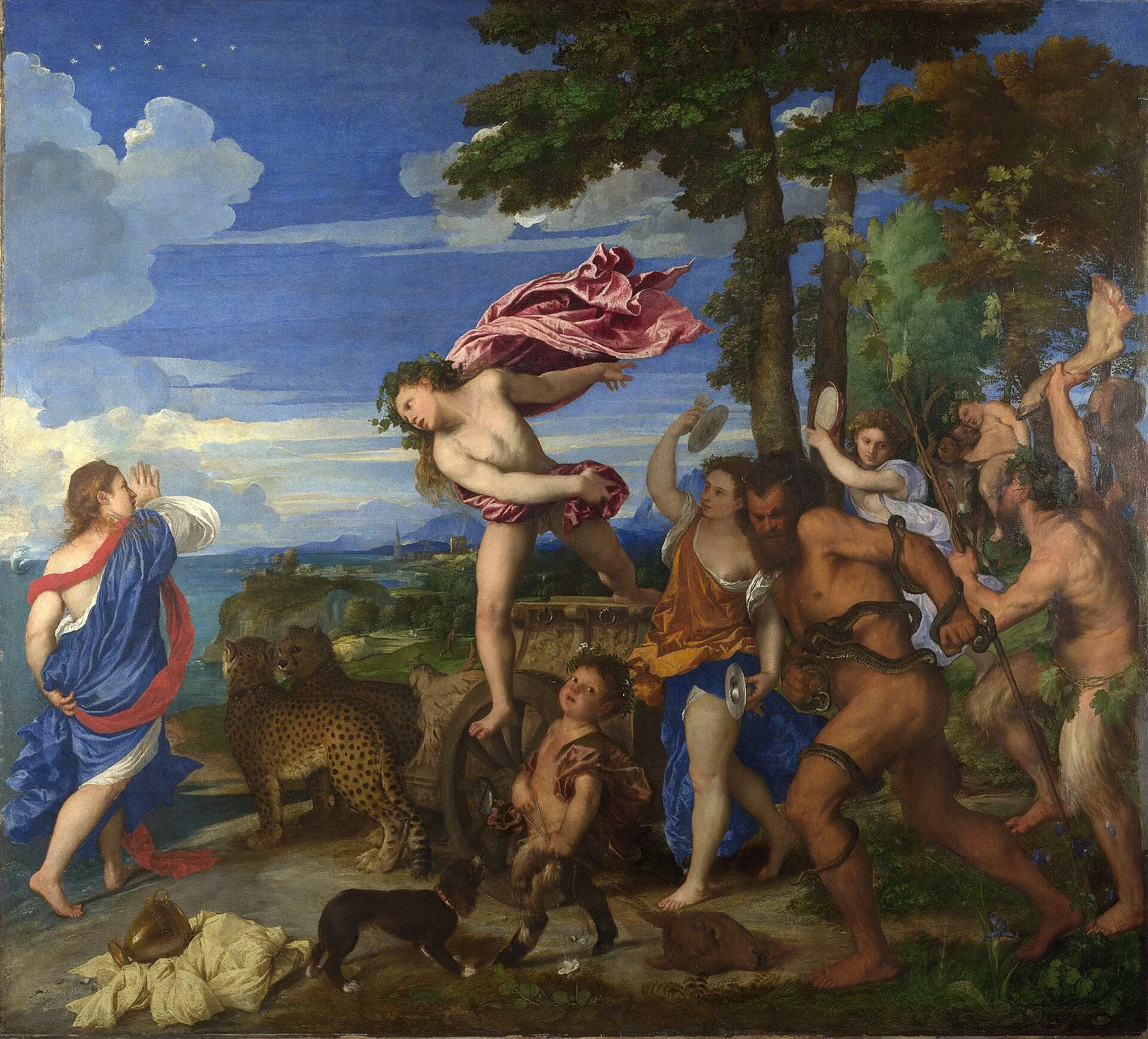
Imagine a summer night frozen on canvas: a god in white, a fleeing bride, a sky of swirling blues. That is Titian’s Bacchus and Ariadne, created between 1520 and 1523. Executed in oil on a large canvas, the work measures roughly 176 by 191 centimetres and carries the inventory number NG35. The National Gallery acquired the painting in 1826, bringing a luminous example of Venetian colour into its collection. Its monumental size and vivid palette immediately command attention, inviting viewers to step into the mythic moment that Titian captured with masterful brushwork and a keen sense of drama.
Titian did not work in isolation; his Bacchus and Ariadne formed part of an ambitious decorative programme for the Camerino d’Alabastro, the alabaster‑clad audience chamber of the Ducal Palace in Ferrara. The duke, Alfonso I d’Este, commissioned three leading artists—Giovanni Bellini, Titian himself, and Dosso Dossi—to create a celebrated series of mythological scenes that would adorn the room’s walls. By placing this myth alongside other classical narratives, the patron demonstrated both his erudition and his desire to showcase the latest Venetian artistic innovations. The painting thus reflects a collaborative courtly vision, where Titian’s contribution stands out for its dynamic composition and sumptuous colour, fulfilling the duke’s cultural ambitions. Together, the three works formed a cohesive visual program that celebrated love, heroism, and divine intervention, reinforcing the duke’s cultural narrative.
The story behind the commission adds another layer of intrigue. Alfonso I d’Este had originally approached the great Raphael to provide a similar subject for the same chamber, but that commission never materialised. Titian’s canvas therefore replaced a work that might have borne Raphael’s hand, marking a decisive shift in the duke’s artistic preferences toward the vibrant colour and dynamic composition that defined the Venetian school. This substitution underscores how courtly taste could pivot dramatically, allowing Titian to imprint his own vision on a narrative that had once been destined for another master.
Titian’s subtle claim of authorship is tucked into the lower left corner of the scene. A golden pot rests on a yellow cloth, and on its surface the artist’s name is inscribed, a quiet yet unmistakable signature. This detail does more than mark ownership; it integrates the painter into the mythic tableau, reminding viewers that the divine drama is also a product of human craft. The gleam of the pot catches the same light that illuminates the surrounding figures, linking the artist’s hand to the luminous world he has created, and offering a tangible point of connection for the observer.
The painting’s colouristic brilliance rests on Titian’s lavish use of natural ultramarine, a pigment derived from crushed lapis lazuli. This pigment was described as about one hundred times more expensive than other pigments, making its extensive application a clear statement of both the patron’s wealth and the artist’s willingness to invest in visual splendor. Titian layered thin glazes of this vivid blue over a warm underpainting, allowing the colour to glow from within the surface. The technique of glazing intensifies the hue, creating a sky that seems to shift as the viewer moves. These glazes give the sky a sense of depth, making the light appear to breathe within the canvas.
The story unfolding before us is drawn directly from the classical poets Ovid and Catullus. Their texts recount how Ariadne, abandoned by Theseus on the island of Naxos, stands alone in desolation, her veil billowing in the wind. Titian captures this precise moment of vulnerability, placing Ariadne at the centre of a luminous space while the surrounding landscape hints at the imminent arrival of Bacchus. By grounding the composition in well‑known literary sources, the painting would have resonated with the educated court audience, who could recognize the mythic episode and appreciate the visual dramatization of Ariadne’s emotional state. The composition’s light emphasizes her isolation and heightens the emotional tension.
Beyond the central drama, a keen eye discovers a youthful satyr trailing Bacchus’s procession. Scholars have identified this figure as Ampelos, a boy‑satyr beloved by the god, a reading that emerged in the seventeenth century but was later overlooked by many modern commentators. Technical analysis has revealed pentimenti—subtle alterations in the underdrawing—that confirm the satyr’s original placement and support the identification. The motif traces its narrative roots to Nonnos’ Dionysiaca, where Ampelos meets a tragic fate. This hidden character adds a layer of personal affection to the myth, reminding viewers that Titian’s composition weaves together multiple literary strands into a single, richly textured visual narrative.
Through colour, myth, and subtle signature, Titian’s Bacchus and Ariadne continues to invite us into a world where history and imagination meet on canvas.