The story
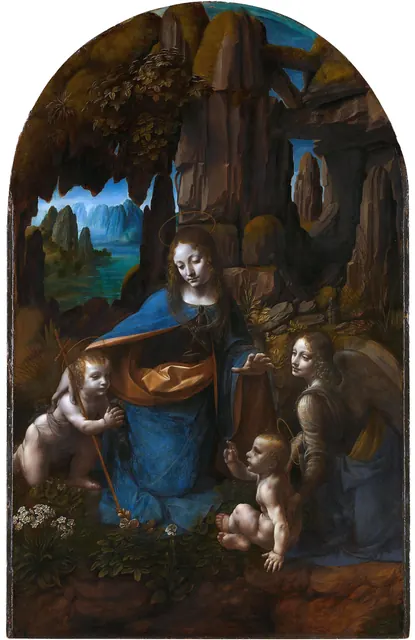
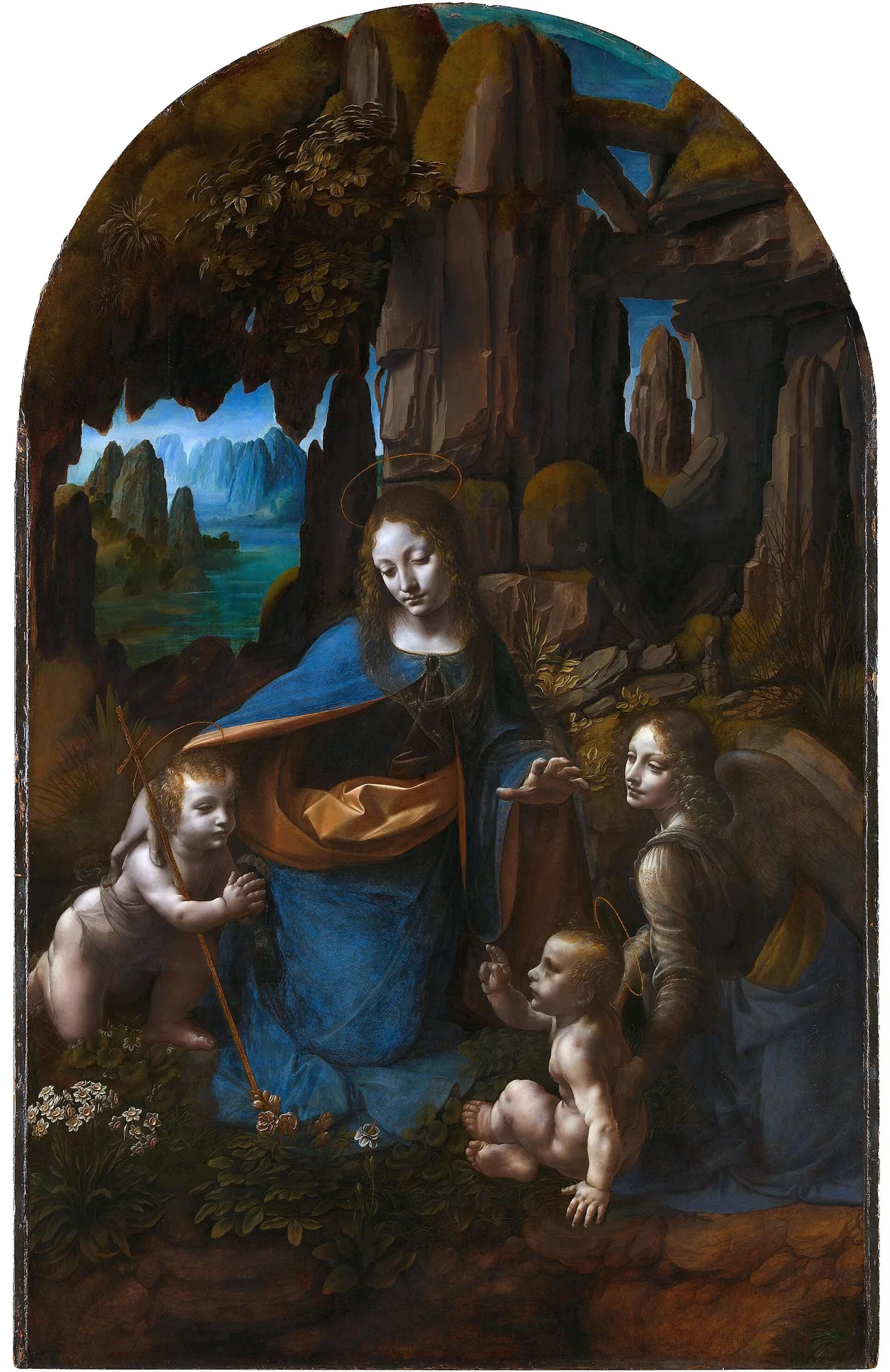
The painting before us bears a remarkably long formal title: “The Virgin with the Infant Saint John the Baptist adoring the Christ Child accompanied by an Angel (’The Virgin of the Rocks’)”. That mouthful does more than list the characters; it signals the layered complexity that has drawn scholars and viewers alike for centuries. The work has been described as a complex and mysterious painting, a quality that lives in the quiet, rock‑filled grotto Leonardo rendered with a subtle, almost invisible light that seems to breathe within the stone.
In 1483 the Confraternity of the Immaculate Conception in Milan commissioned Leonardo to create the central panel of an altarpiece for the chapel of the Immaculate Conception in the great Franciscan church of San Francesco Grande. The work was intended to celebrate the doctrine that Mary was conceived without original sin, a belief dear to the brotherhood. This very panel, now in the National Gallery, is the second version Leonardo painted for the same confraternity, fulfilling the original devotional purpose while allowing him to revisit his ideas.
A payment dispute soon interrupted the first contract, prompting Leonardo to produce a second version for the same patrons. The earlier panel, now housed in the Louvre, was sold to a private client after the confraternity could not meet Leonardo’s bonus demands. Scholars note that the National Gallery panel was worked on in two distinct phases – roughly 1491/2 to 1499 and again from 1506 to 1508 – a timeline that aligns with the later completion date of 1508, twenty‑five years after the initial commission. This two‑phase process reflects both the artist’s evolving vision and the practical realities of the commission.
Leonardo chose oil on poplar wood for this work, a medium that allowed him to build luminous layers and achieve the delicate atmospheric effects we see today. The panel stands about 190 centimetres tall and 120 centimetres wide, a near‑two‑metre vertical presence that still feels intimate. It rests within a 15th‑century Italian frame that bears later additions, a silent witness to the painting’s long journey through changing tastes and restorations.
The composition follows a clear pyramidal scheme. At the apex sits the Virgin, her serene gaze overseeing the scene. Below her, the infant Christ and the kneeling angel form the base of the triangle, while the infant Saint John, clutching a gilded cross, occupies the left side. The figures interact through subtle gestures, creating a quiet dialogue that draws the eye upward and reinforces the harmonious balance of the grotto setting.
Leonardo employed his signature sfumato and chiaroscuro, blurring edges and modelling forms with subtle light to create atmospheric depth. He also used aerial perspective, allowing the distant rocks to recede into a smoky haze while the nearer figures emerge from a gentle glow. This combination of techniques gives the landscape a three‑dimensional feel and the figures a soft, almost ethereal presence, as if the light itself were part of the stone.
Scholars interpret the painting as expressing the Franciscan doctrine of the Immaculate Conception, suggesting Mary was conceived without original sin. The second version also explores new lighting effects based on Leonardo’s research into optics and the physiology of human vision, allowing light to filter through foliage and catch the infant’s skin in a way that feels both scientific and deeply spiritual.
Technical studies indicate that some of the fine details – perhaps certain foliage or the delicate rendering of the angel’s wings – were added after Leonardo’s hand had left the panel. High‑resolution imaging also revealed faint handprints in the priming layer, most likely left by someone patting down the surface to achieve a smoother ground. One reading suggests that the change from Leonardo’s original composition may have been prompted by a settlement of the disagreement, hinting at a collaborative hand in the final appearance.
The painting underwent a thorough cleaning in 2008–09, removing centuries of grime. Until 2010 the surface was covered by a cracked and yellowing varnish applied in 1949; after eighteen months of specialist treatment the work now appears close to Leonardo’s finished state. Since that restoration it has featured in major National Gallery shows – “Leonardo da Vinci: Painter at the Court of Milan” (2011‑12) and “Leonardo: Experience a Masterpiece” (2019‑20) – allowing new audiences to encounter its quiet brilliance.
In the hush of the gallery, Leonardo’s Virgin of the Rocks continues to invite us into its misty grotto, a timeless dialogue between light, faith, and the ever‑curious human eye.