The story
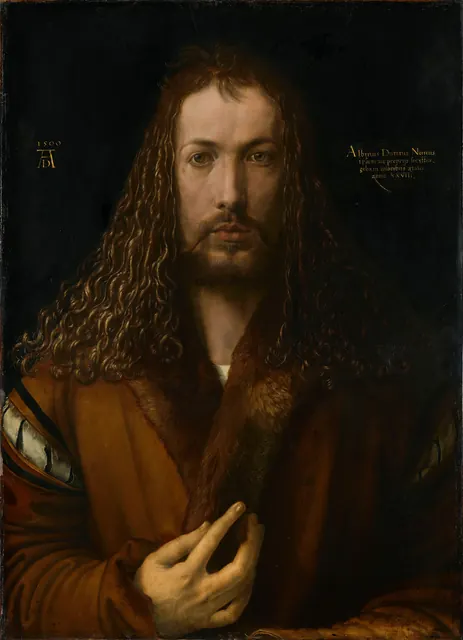
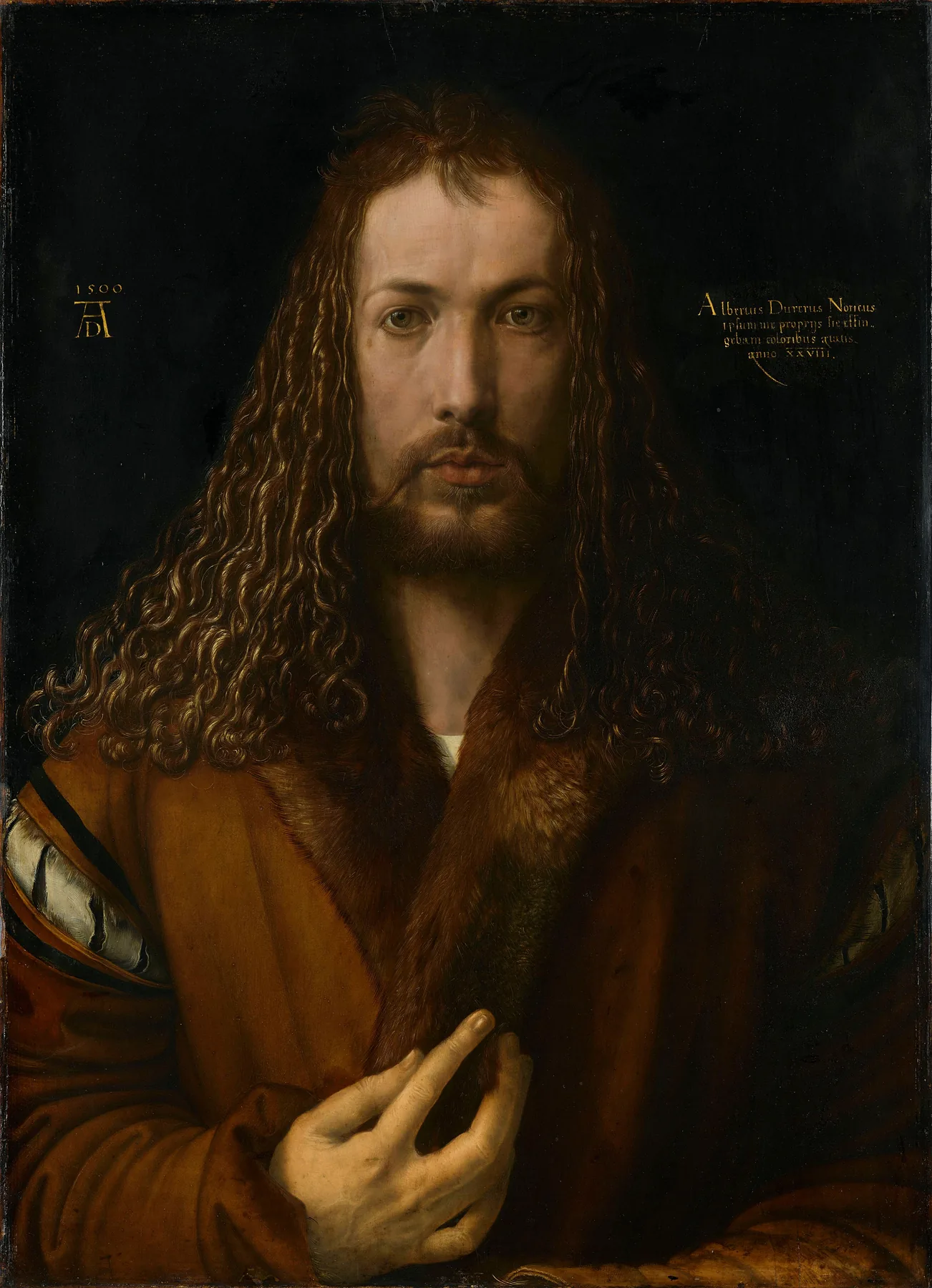
Before we linger on the canvas, let’s name the image we’re about to explore: Self‑Portrait at Twenty‑Eight Years Old Wearing a Coat with Fur Collar. This precise title tells us exactly how Dürer chose to present himself, down to the fur‑trimmed coat that frames his shoulders. And, of course, the hand behind the brush is unmistakable – the work is by Albrecht Dürer, the German Renaissance master whose name alone carries the weight of innovation in printmaking, drawing, and painting. Knowing both title and artist grounds our visual journey in a concrete historical anchor.
The canvas—well, the lime‑panel—was completed in the year 1500, placing it at the very start of the sixteenth century, a period when Dürer was emerging as a leading figure in Northern European art. More specifically, the portrait was finished early in that year, just weeks before Dürer would have turned twenty‑nine. This narrow window of time hints at a moment of self‑reflection, as the artist captures himself on the cusp of a new decade, still youthful yet already seasoned by his travels and studies. The dating gives us a precise temporal frame for the work’s creation.
Dürer chose oil on panel as his medium, a combination that allowed for both the luminous depth of oil pigments and the smooth, stable surface of a lime‑prepared wooden board. This technique gave him the ability to render fine details—like the delicate sheen of the fur collar and the subtle gradations of light across his face—with a clarity that would have been impossible in tempera alone. The oil’s slow drying time also let Dürer blend tones seamlessly, achieving the soft modeling that makes the portrait feel almost three‑dimensional.
Today, the painting resides in Munich’s Alte Pinakothek, part of the Bavarian State Painting Collections. Its presence in this historic museum places it among other masterpieces of the Renaissance, allowing visitors to encounter Dürer’s work within a broader narrative of European art. The museum setting also ensures the painting is preserved under optimal conditions, protecting the oil layers and the panel from the wear of time, while offering scholars a reliable venue for continued study.
Within Dürer’s own oeuvre, this portrait holds a special place: it is the last of his three painted self‑portraits. Earlier self‑representations show a younger artist, but here, at twenty‑eight, Dürer presents a more mature, self‑assured figure. Recognizing it as the final painted self‑portrait helps us see a progression in his self‑image, from the tentative curiosity of his youth to the confident, almost solemn bearing captured in this work.
Art historians have long described this painting as the most personal, iconic, and complex of Dürer’s three self‑portraits. The claim of personal intimacy stems from the direct gaze that meets the viewer, while its iconic status is reinforced by the compositional balance and the dignified pose that echo classical portraiture. Complexity arises from the layers of meaning—technical mastery, self‑reflection, and symbolic undertones—all woven together in a single, striking image.
Scholars note that Dürer deliberately borrowed conventions from religious painting. The portrait’s symmetry, the subdued dark tones, and the gesture of the raised hand—reminiscent of a blessing—create a visual language more often reserved for depictions of saints. By employing these elements, Dürer blurs the line between secular self‑portraiture and sacred iconography, inviting viewers to contemplate the sitter in a quasi‑spiritual context.
Building on that religious resonance, some interpret Dürer’s intent as deliberately Christ‑like.
Throughout his life, Dürer kept this masterpiece in his family’s private collection, never sending it to a patron or displaying it publicly. Moreover, he never mentioned the painting in any of his journals or other writings. This silence adds an aura of privacy to the work, implying that Dürer regarded it as a deeply personal object, perhaps a private meditation rather than a public statement.
Interpretations of the portrait diverge. Some scholars suggest Dürer painted it as a personal reminder to emulate Christ’s virtues, while others argue he intended to show Christ reflected in the face of every ordinary person, using his own likeness as the exemplar. Both readings highlight the painting’s capacity to function as a mirror for spiritual aspiration, whether directed inwardly or outwardly toward humanity at large.
In Dürer’s own brushstroke we glimpse a young artist poised between earthly ambition and spiritual yearning, a portrait that continues to invite us to look, reflect, and perhaps see a hint of the divine in ourselves.