The story
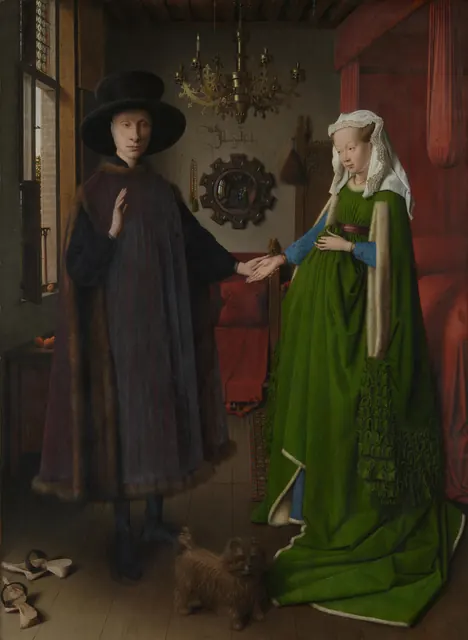
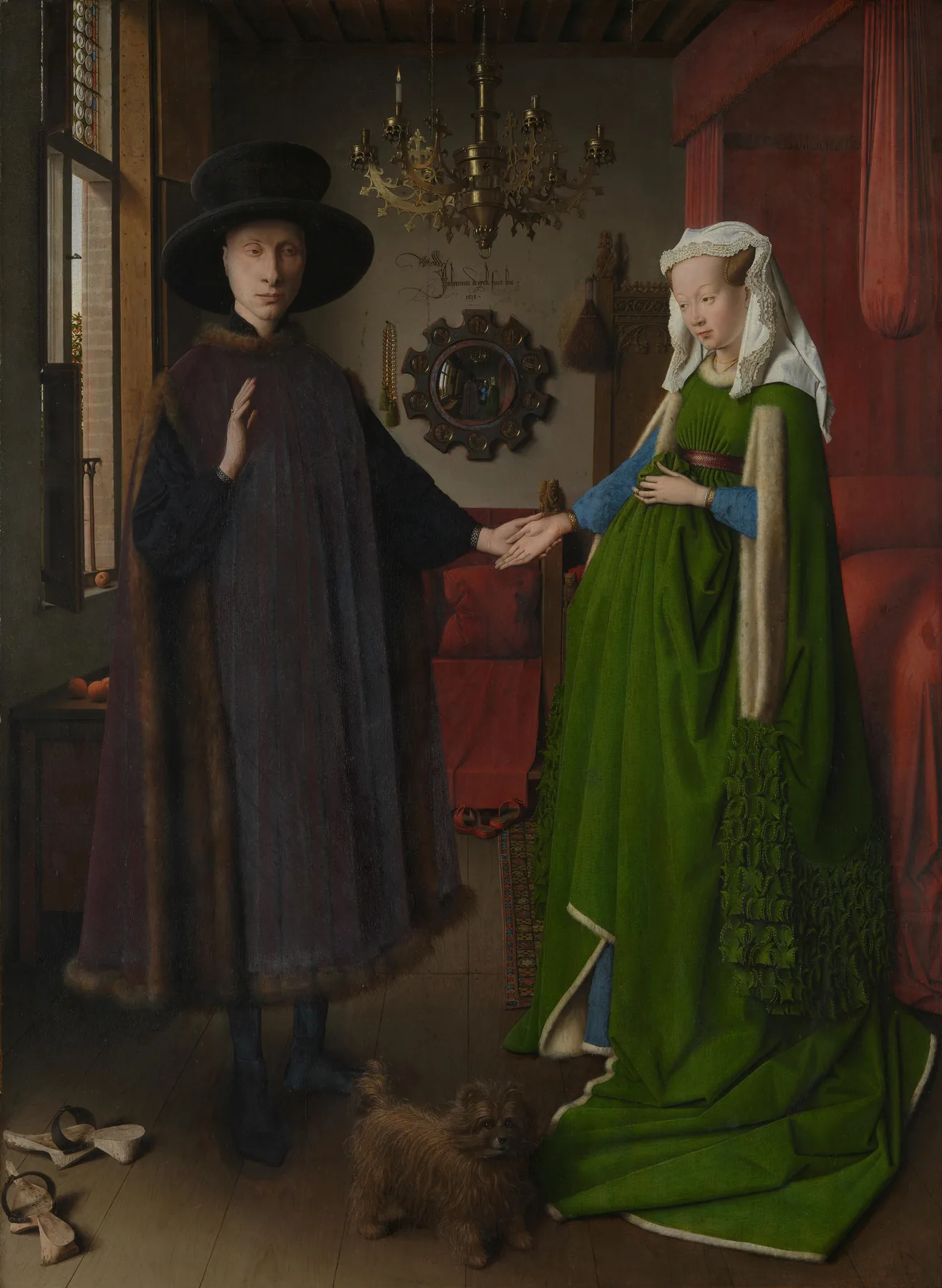
The work we see is formally titled “Portrait of Giovanni(?) Arnolfini and his Wife”. The question mark hints at lingering uncertainty, but the title points to an Italian merchant and his spouse. The brush belongs unmistakably to Jan van Eyck, also recorded under the Latinized name Johannes de Eyck. This pairing of a tentative identification with a master of the early Netherlandish school sets the stage for the layers of meaning we will explore. It has become one of the most studied images of the 15th century, inviting endless debate.
The canvas—actually an oak panel—was completed in 1434. Van Eyck employed oil paint on this wooden support, a combination that was still relatively new in the early 15th century. The oil medium, with its slow drying time, allowed him to blend tones and render textures with a realism that seems to capture the very breath of the objects. The painted surface measures roughly eighty‑two centimeters high by sixty centimeters wide, a modest size that draws the viewer into an intimate domestic space.
A striking feature dominates the back wall: a convex mirror whose curved surface reflects the couple and, beyond them, two men entering the room, one raising his arm. The mirror’s ten short spokes each bear a tiny roundel depicting a scene from the Passion of Christ, turning the reflective surface into a miniature narrative tableau. This combination of a realistic mirror image with embedded devotional scenes showcases Van Eyck’s virtuoso handling of perspective and symbolism.
Above the pair hangs a polished brass chandelier. Its design holds two candles: one burns brightly, casting a gentle, warm glow across the couple’s faces; the other is snuffed, its wick dark and still. The contrast between light and extinguished flame invites contemplation of presence and absence, while the meticulous rendering of metal and flame demonstrates the painter’s ability to capture subtle variations of light on reflective surfaces.
On the wall behind the couple a Latin inscription reads “Johannes de eyck fuit hic”, translating to “Jan van Eyck was here”. This brief declaration functions both as a signature and a statement of presence, anchoring the artist within the very scene he records. The clear Gothic script, rendered in the same oil technique, underscores Van Eyck’s confidence in his role not merely as observer but as participant in the moment.
The convex mirror also captures two figures standing at the doorway, one with an arm raised. Some scholars suggest they may be the artist and his assistant, a possible self‑referential gesture that blurs the line between creator and creation, turning the portrait into a visual dialogue between the painted world and the hand that brought it to life.
Between the husband and wife a small brown dog sits attentively. In 15th‑century iconography, dogs commonly symbolize marital fidelity, reinforcing the intimate bond suggested by the couple’s joined hands. The animal’s glossy fur, rendered with delicate brushwork, catches the chandelier’s light, adding a tactile quality that further grounds the scene in everyday reality.
A string of amber prayer beads with green silk tassels drapes across the chest, their tiny reflections painted on the wall, a testament to Van Eyck’s eye for minute detail. On the windowsill and the chest rest bright orange fruits, an expensive commodity in the period, signaling the couple’s wealth and the domestic abundance of the setting. These objects, rendered with luminous glaze, contribute to the painting’s reputation as an early demonstration of oil paint’s capacity for realistic detail.
The woman’s dress swells around her stomach, a voluminous fold that some early viewers mistook for a pregnant belly. Contemporary scholarship interprets this bulge not as evidence of pregnancy but as an excess of material fashionable at the time, a style that conveyed status and elegance. This reading reminds us that clothing in the 15th century often employed generous drapery to signal wealth rather than to depict bodily condition.
Erwin Panofsky famously read the work as a wedding portrait, pointing to the couple’s hand‑fastening gesture and the single lit candle. Later scholars, however, have questioned this view, noting the absence of many conventional wedding symbols and suggesting the scene could represent a betrothal or a contractual agreement. This ongoing debate illustrates how a single image can sustain multiple, equally plausible narratives.
Art historian Jean Wilson has argued that the painting may have been a gift from Philip the Good to the Arnolfini couple, a diplomatic token reinforcing alliances between the Burgundian court and wealthy merchant families. If true, the work functions not merely as a private record but as a strategic gesture within the network of 15th‑century patronage, adding a layer of political generosity to its visual richness.
Through its meticulous detail and layered meanings, the Arnolfini Portrait continues to invite us into a 15th‑century world where art, status, and intimacy converge in a single, unforgettable frame.
Join us next time as we step into another masterpiece and uncover the stories hidden within its brushstrokes.