The story
Context and Patronage
Leonardo worked as a salaried court artist for Duke Ludovico Sforza in Milan, a fact recorded in multiple sources (C1, C12). This official appointment tied his creative output directly to the ducal household, meaning that any portrait he painted for the court was produced under the duke’s patronage. While the precise duties of a court artist varied, the relationship itself signals that Leonardo’s work was expected to align with the cultural and political ambitions of his patron, embedding the portrait within the broader visual program of the Sforza regime.
Because Leonardo was employed by the duke, it is reasonable to suggest that his portraits could reflect the symbols and tastes favored by the Sforza family (C1, C12). The court’s patronage system often encouraged artists to incorporate subtle references to ducal emblems, allowing a work to serve both as a personal likeness and as a visual affirmation of the court’s refined self‑image. In this light, the portrait can be read as a product of that environment, where artistic brilliance and courtly allegory were expected to coexist.
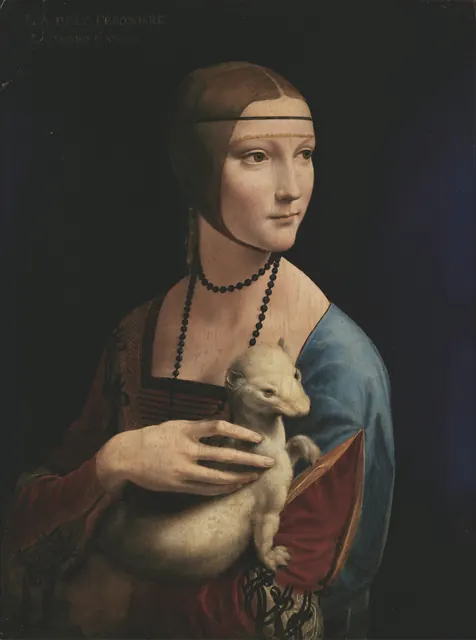
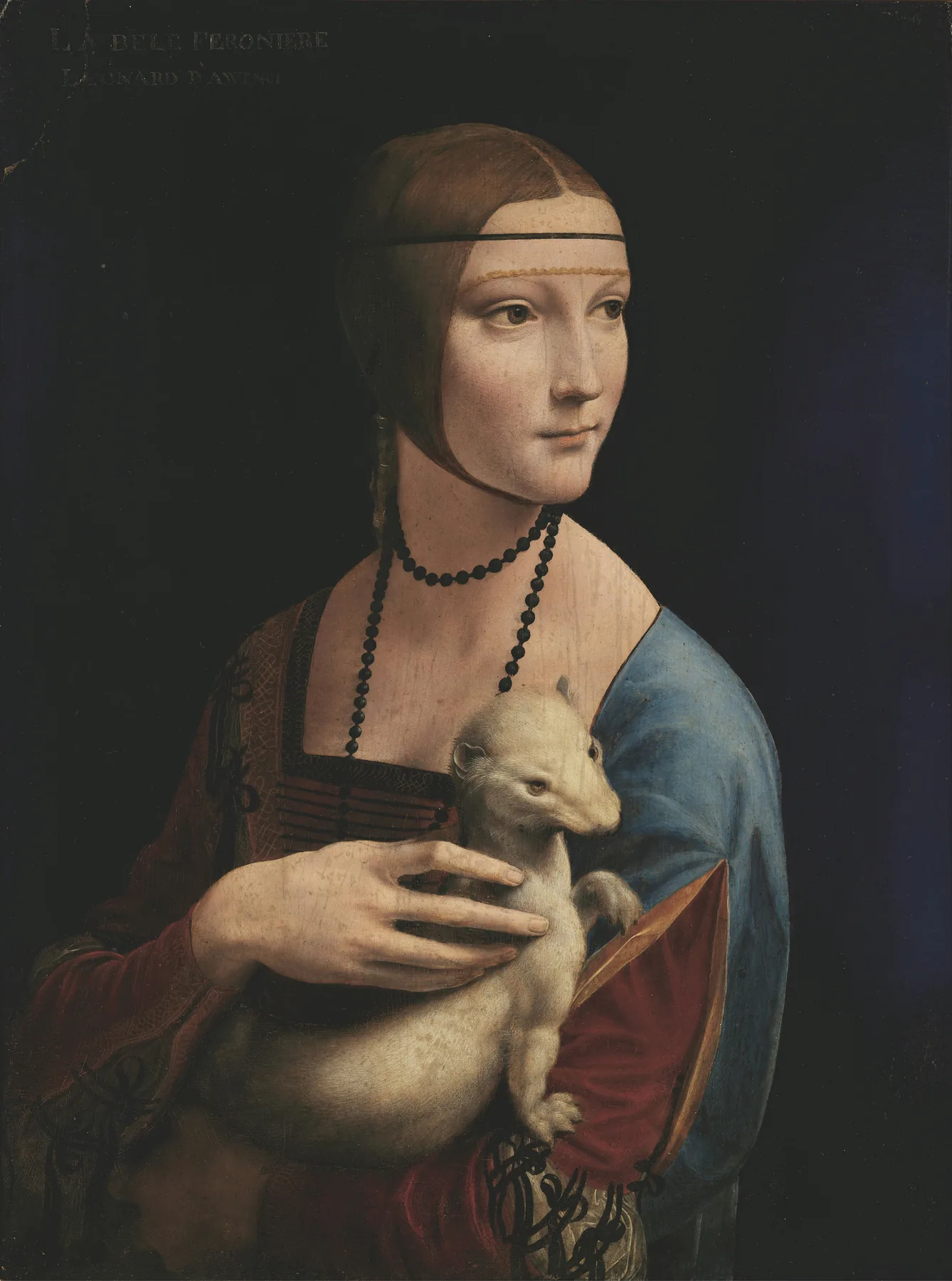
The woman in the painting is identified as Cecilia Gallerani, who was known to be the mistress of Duke Ludovico Sforza (C7). This identification grounds the portrait in a specific personal relationship within the ducal circle, giving the work a dual function: it records the likeness of an individual while also hinting at the intimate connections that shaped court life. Recognizing her as the sitter helps us understand why certain symbolic choices—such as the animal she holds—were deliberately chosen to convey layered meanings tied to her identity and status.
Symbolic Layers of the Ermine
By tradition, the white animal cradled in Cecilia’s arms is interpreted as a visual pun on her name. The Greek word galeé—meaning weasel, marten‑cat, or ferret—sounds similar to “Gallerani,” and the presence of the creature creates a clever linguistic bridge (C2, C5, C13). This wordplay would have resonated with the humanist courtiers of Milan, who prized classical learning and enjoyed subtle intellectual jokes. The pun therefore functions not merely as decoration but as a cultured signpost, linking the sitter’s identity to a learned, classical reference that would have been appreciated by her elite audience.
A second traditional reading ties the animal to the emblem of Duke Ludovico Sforza himself. The ermine, prized for its white fur and associated with purity, appears in the duke’s coat of arms, serving as a visual shorthand for his authority (C3, C6, C14). By placing the creature beside his mistress, Leonardo may have been signaling her connection to the ducal household, reinforcing her role within the Sforza sphere. This emblematic layer adds a political dimension to the portrait, suggesting that the sitter’s identity is inseparable from the power structures that surrounded her at the Milanese court.
A Modern Re‑examination
Recent scholarship by Ozzie Elliott challenges the long‑held belief that the animal is an ermine. Elliott argues that the creature’s proportions, the texture of its fur, and the shape of its head correspond more closely to a good‑sized male European ferret, Mustela putorius furo (C4). By focusing on these zoological details, Elliott suggests that Leonardo may have been observing a familiar, domesticated animal rather than a heraldic emblem. This reading shifts the emphasis from symbolic allegory toward Leonardo’s keen interest in naturalistic observation, highlighting his meticulous study of animal anatomy as an integral part of his artistic practice.
Reception and Influence
The portrait has long been celebrated as a beautiful representation of Ludovico’s mistress, praised for its elegance and psychological depth (C10). Viewers have admired the subtle interplay of light on the sitter’s skin, the delicate rendering of the animal, and the poised yet intimate composition. This appreciation underscores the work’s lasting appeal and its status as a masterful example of portraiture that captures both personal likeness and broader cultural resonance.
Contemporary accounts note that the painting set a new artistic standard for Leonardo’s Milanese contemporaries, influencing how portraiture was approached in the region (C11). By combining a refined naturalism with layered symbolism, Leonardo established a benchmark that other artists sought to emulate. This pioneering quality helped shape the visual language of the court, encouraging a synthesis of technical brilliance and emblematic content that became characteristic of Sforza patronage.
Scholars also observe that Leonardo’s style in this work contributed to the visual language of the Sforza regime, reinforcing the court’s self‑image through sophisticated composition and symbolic nuance (C9, C15). The portrait’s blend of realistic detail, subtle allegory, and graceful poise exemplifies how Leonardo’s artistic choices served the political and cultural narratives of his patron. In this way, the painting not only records a single individual but also participates in the broader project of defining Milan’s courtly identity during the late 15th century.
In Leonardo’s Lady with an Ermine, every brushstroke, every subtle symbol, invites us to peer into a world where art, power, and personal identity are inseparably intertwined.