The story
Setting the Scene
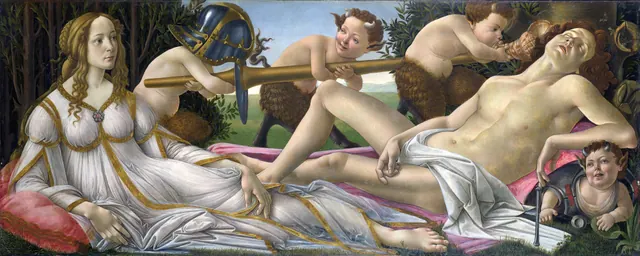
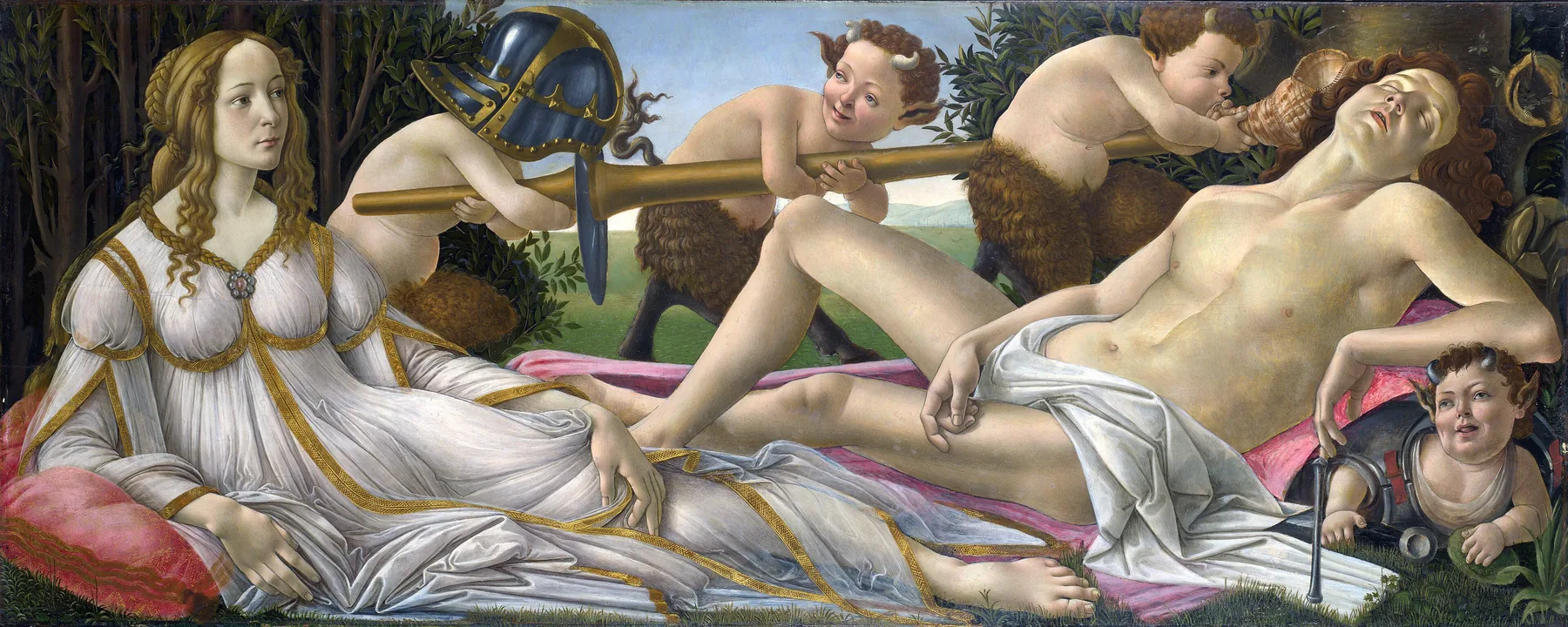
Around 1485 Sandro Botticelli created the painting titled Venus and Mars on a wooden panel, using egg tempera and oil. The work was likely commissioned to celebrate a marriage, its elongated shape meant to hang in a Florentine bride’s bedroom. In this intimate setting the goddess of love reclines beside the sleeping god of war, offering a private allegory of partnership that would have spoken directly to newlyweds. Its tender composition invites the couple to contemplate the harmony of love and peace.
Botticelli employed a mixed technique that was innovative for his day: egg tempera combined with oil on a wooden panel, most likely poplar. The tempera provides the luminous, almost translucent skin tones of the figures, while the oil adds depth to the shadows and the rich glint of the gold trim on Venus’s dress. This combination allows the artist to render both the delicate details of the silk and the solid, sculptural quality of Mars’s muscular body, creating a visual harmony that bridges the fragile and the robust.
The painting entered the National Gallery’s collection in London in 1874, where it now resides as a centerpiece of the museum’s Renaissance holdings. Its journey from a private Florentine marriage chamber to a public gallery underscores how the work has transitioned from a personal emblem of love to a shared cultural treasure, inviting viewers from around the world to contemplate its timeless narrative.
Form and Function
The panel’s unusually long, narrow shape identifies it as a spalliera—a decorative board designed to hang above a marriage bed. Measuring roughly 1.7 metres across and just under a metre high, its panoramic format frames the lovers within the bedroom wall itself. This width gives the scene a sweeping, intimate feel, emphasizing its original domestic function as a visual centerpiece for the newlyweds, and reinforces the theme of love’s expansive reach.
Venus sits poised in her white gown trimmed with gold, her right hand resting gently on her own lap, while Mars lies asleep, his weapons set aside. The two figures share the foreground but do not touch, a visual cue that love dominates war without a physical grasp. This calm, untouching presence underscores the painting’s message that affection can subdue even the fiercest forces.
Around the slumbering god, a troupe of mischievous satyrs adds a playful, almost ribald layer to the narrative. One blows a conch shell, another holds a golden horn, while a third peers from within a dark armor piece. Their gestures mock Mars’s lethargy, and art historians have read these details as visual jokes about sexual exhaustion, underscoring the painting’s intimate, private humor intended for a married couple’s eyes.
Mars himself is rendered with a striking naturalism that recalls ancient sculpture. His nude body, defined by smooth, pale skin and well‑modeled musculature, showcases Botticelli’s study of classical forms. The artist’s attention to anatomical detail—visible in the defined pectoral muscles and the relaxed pose of his limbs—creates a sense of timeless heroism even as the god lies peacefully, a visual reminder of love’s ability to tame even the most formidable forces.
Beyond its mythic tableau, the panel likely functioned as a headboard or front panel of a wedding trousseau. Its placement would have framed the couple’s sleeping space, turning the bedroom into a visual lesson in marital harmony. By foregrounding Venus’s gentle dominance over Mars, the work subtly emphasized the primacy of love and partnership in the newly formed household, reinforcing the painting’s role as both décor and didactic piece.
Interpretations and Legacy
Art historians Harris and Platzner interpret the scene as showing Venus dominating Mars despite his weapons. Their reading emphasizes that Venus’s poised presence dominates the sleeping warrior without any physical contact, presenting her as the clear orchestrator of the tableau.
The National Gallery notes that works like this were often commissioned as furniture for a son’s marriage chamber, serving a dual purpose. Not only did they beautify the space, but they could also act as erotic instruction for a new bride, subtly teaching the dynamics of love and desire through mythic imagery. This practical function underscores how art in the Renaissance was woven into everyday life, shaping intimate moments as well as public display.
Finally, the panel’s unusual spalliera shape reinforces its intended role in a marriage chamber. Its elongated format, far wider than it is tall, was designed to fit above a bed, creating a visual narrative that surrounded the couple. This architectural consideration reveals how Botticelli tailored his composition to the physical space it would occupy, ensuring that the story of love’s victory over war would be literally framed within the couple’s nightly repose.
When you look again at Botticelli’s Venus and Mars, notice how love quietly dominates the room.