The story
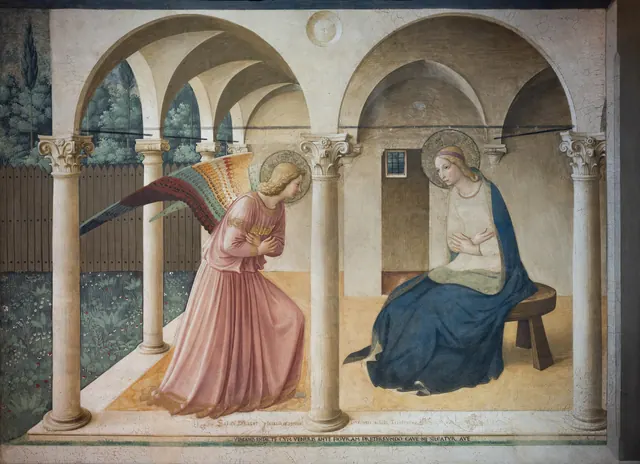
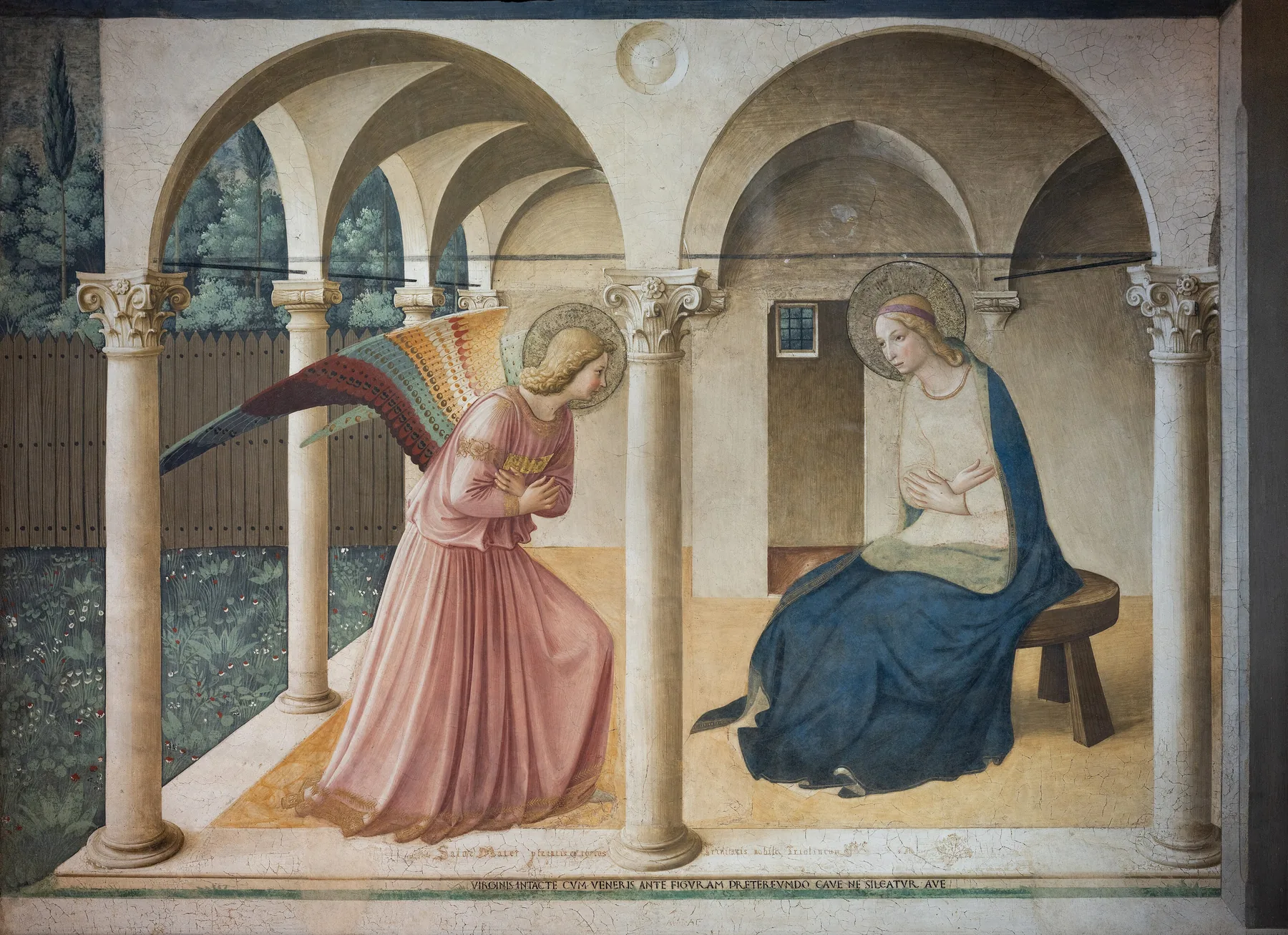
Step into the quiet cloister of San Marco and let your eyes rest on a moment frozen in time: the Angel Gabriel kneels before a humble Virgin, their gazes lowered, their hands folded in reverent prayer. The fresco’s soft, golden light spills across marble arches and a tiled floor, inviting us to share in a scene that feels both intimate and timeless. This opening glimpse draws us into a world where the divine touches the everyday, setting the stage for a deeper exploration of the work’s creator, its setting, and its subtle visual language.
The painting is attributed to Fra Angelico, the Dominican friar whose name has become synonymous with luminous spirituality in early Renaissance art. His hand is evident in the delicate rendering of the Virgin’s white tunic and blue mantle, the precise modeling of the angel’s multicolored wings, and the harmonious balance of figures within the architectural setting. Fra Angelico’s reputation for merging devotional intensity with a refined, almost scientific observation of light makes this fresco a quintessential example of his mature style, reinforcing why scholars and visitors alike recognize his signature touch in every brushstroke.
A few decades earlier, Fra Angelico explored the same biblical episode on a tempera‑on‑poplar panel, dated to 1425‑26. That version, executed in a portable medium, presents the figures in a more intimate, close‑up setting, lacking the expansive architectural backdrop we see here. By contrasting the panel with the later fresco, we can appreciate how the artist expanded his vision from a personal devotional object to a monumental wall painting that integrates architecture, light, and space, turning a private moment into a communal experience within the convent’s sacred walls.
The fresco resides in a monastery rebuilt for the Observant Dominicans of Fiesole, a project made possible through the patronage of Cosimo de’ Medici. Cosimo’s financial support not only funded the physical reconstruction of San Marco but also enabled the commissioning of artworks that would embody the order’s renewed spiritual rigor. The elegant arches, the composite capitals, and the orderly rhythm of the columns all reflect the Medici’s desire to create a space where contemplation could flourish, linking the building’s architecture directly to the devotional purpose of the fresco itself.
One of the most striking technical achievements in the fresco is the consistent rendering of light and shadow, especially evident in the angel’s wing. Fra Angelico mixed a fine silica powder into the fresco plaster, a practice that gives the wing a subtle sparkle as the light catches the multicolored feathers. This deliberate manipulation of the medium creates a luminous effect that seems to hover above the painted surface, reinforcing the otherworldly presence of the angel while demonstrating the artist’s experimental approach to achieving radiant realism.
Cosimo de’ Medici’s patronage of San Marco was motivated by a personal desire for salvation, a common aspiration among Renaissance benefactors who saw art as a conduit for divine favor. By funding a space where the Annunciation could be contemplated daily, Cosimo aligned his own spiritual hopes with the convent’s mission. The very act of viewing this fresco—seeing the Angel’s humble approach and the Virgin’s quiet acceptance—served as a visual prayer, echoing the patron’s own quest for redemption through pious works of art.
Fra Angelico’s architectural vocabulary in the fresco draws unmistakably on the early‑Renaissance designs of Brunelleschi. The clean, proportioned arches, the orderly composite capitals, and the subtle play of perspective echo Brunelleschi’s innovations in the Florence Cathedral and other civic projects. By integrating these elements, the artist not only situates the sacred scene within a rational, harmonious space but also signals a dialogue between religious devotion and the burgeoning humanist appreciation for classical order, a hallmark of the period’s artistic synthesis.
The fresco’s dimensions—spanning a wall roughly 230 cm by 321 cm—allow the scene to dominate the viewer’s field of vision, immersing the observer in the architectural frame and the tender exchange between angel and Virgin. This scale, combined with the careful placement of the Latin inscription along the lower ledge, transforms the wall into a liturgical tableau that guides the eye from the text to the figures, reinforcing the narrative of divine announcement within the very fabric of the convent’s daily life.
Taken together, these layers of attribution, patronage, technique, and architectural reference reveal a work that is both a product of its time and a timeless meditation on the moment of divine encounter. Fra Angelico’s Annunciation invites us to linger on the subtle sparkle of the angel’s wing, the quiet humility of the Virgin, and the harmonious space that frames them, reminding each viewer that the sacred can be found in the careful balance of light, stone, and painted breath.
May the quiet grace of Fra Angelico’s Annunciation linger in your thoughts as you leave San Marco.