The story
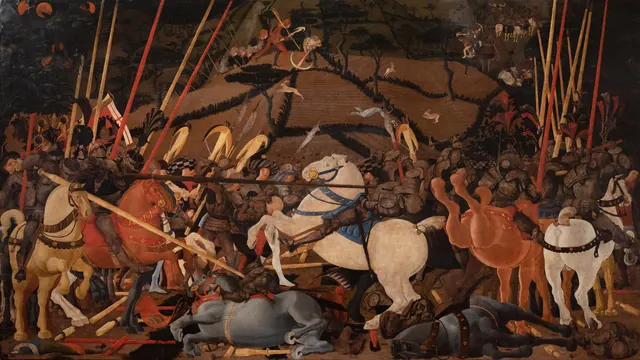
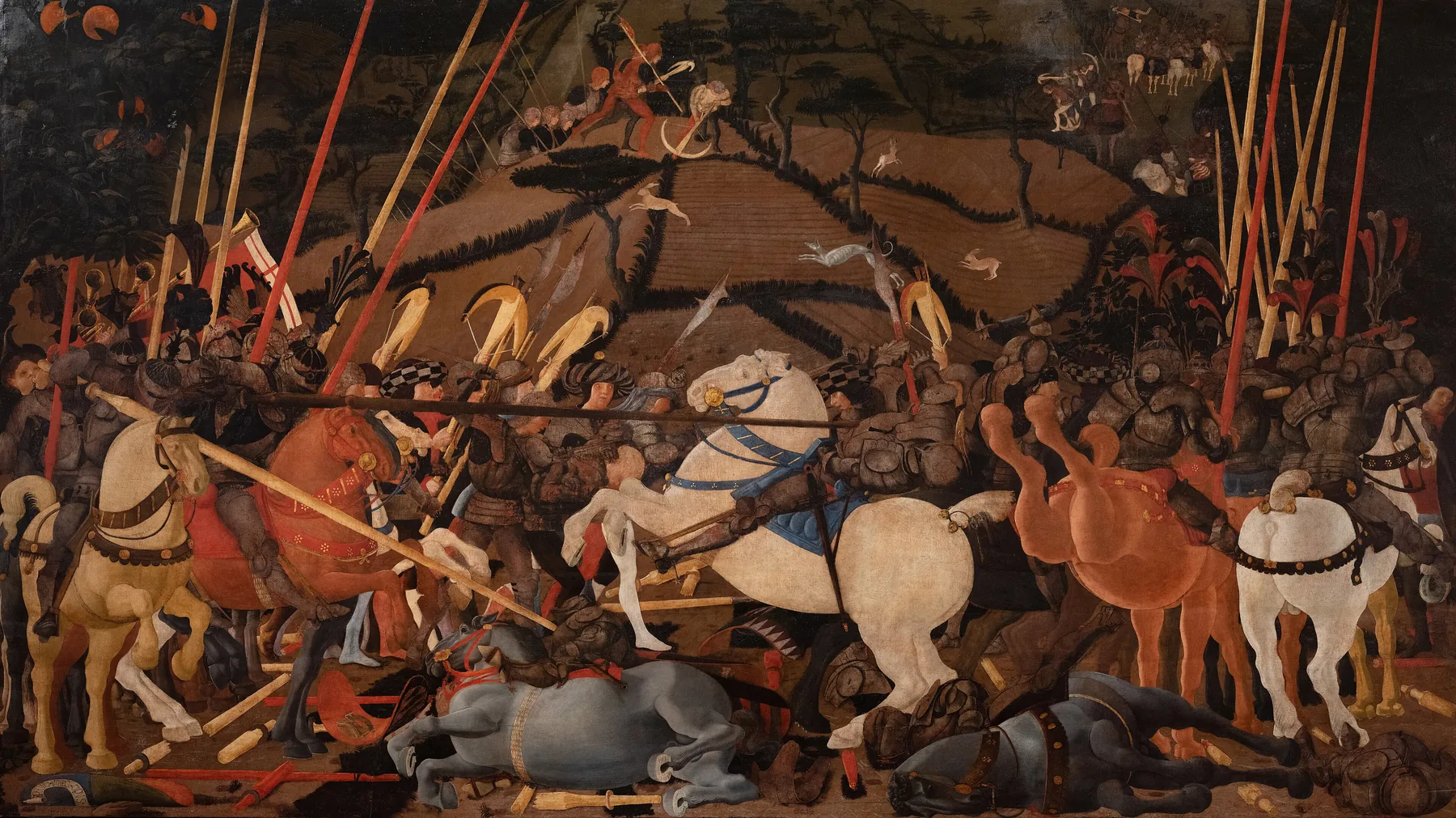
At the heart of Paolo Uccello’s San Romano series lies this central panel, the most dramatic of the three. Commissioned by the Florentine merchant Lionardo Bartolini Salimbeni for his palace only a few years after the clash, the work captures the 1432 victory of Florence over the Sienese and their Milanese allies at the river San Romano. Uccello translates the chaos of cavalry and infantry into a tightly organized composition, positioning the decisive moment in the middle of the narrative cycle. By focusing on this pivotal episode, the painting not only celebrates a civic triumph but also showcases the patron’s desire to immortalize his city’s prowess.
Even before the eye is drawn to the battlefield, a quiet signature anchors the work to its creator. In the lower left corner, Paolo Uccello inscribed his name, a clear mark of authorship that survived centuries of relocation and alteration. This modest yet decisive flourish not only confirms the hand behind the daring perspective and luminous armor, but also serves as a personal claim to the triumph depicted on the panel. The presence of the signature reassures viewers that the daring visual experiments belong to a single, innovative mind, linking the artist’s identity directly to the historic scene he rendered.
The panel commands space with its monumental size, stretching over three meters in width and approaching two meters in height, a scale that would dominate any wall of a Renaissance palace. Crafted on poplar wood, Uccello employed the traditional egg tempera technique, enriched with subtle touches of oil that lend a softness to the otherwise crisp surface. This combination of medium and scale not only amplifies the drama of the battle but also reflects the technical innovations of the early 15th‑century Florentine workshop, where artists were beginning to experiment beyond pure tempera to achieve richer colour and depth.
Today the panel bears the marks of its long journey. When it was first created it was crowned with an elegant arched top, a common decorative feature of the period. At an unknown date, probably in the late 15th century, the arches were cut away about 64 cm from the top and the corners were filled in, converting the original shape into the rectangular format we see now. The work later passed from the heirs of Lionardo Bartolini Salimbeni into the collection of Lorenzo de’ Medici, linking the painting to the Medici’s renowned patronage.
Where the original arched top was removed, the upper corners were filled in with new painted foliage. These additions were not part of Uccello’s initial design; they were introduced later, after the panel had been reshaped. Scientific analysis shows that the pigments used in these corner sections date to the 15th century, confirming they belong to the later adaptation rather than the original commission. The green and brown leaves soften the rectangular frame and contrast with the battlefield’s earth tones, subtly reminding us of the work’s long history of alteration.
Uccello’s fascination with light and materiality shines through his lavish use of metal leaf to render the gleaming armor and bridles of the mounted soldiers. The reflective surface catches the eye, creating a rich, colourful texture that would have dazzled contemporary viewers. Beyond the surface sparkle, the artist’s mastery of linear perspective becomes evident in the way bodies are foreshortened, receding into space with mathematical precision. The overlapping figures and converging lines guide the viewer’s gaze toward the vanishing point, reinforcing the sense of depth and movement across the battlefield. Together, the metallic sheen and the disciplined perspective fuse to produce a dynamic, almost cinematic tableau of combat.
Technical examination of the panel reveals a meticulous construction. Beneath the painted surface lie eight poplar planks joined to form the support, over which a thick two‑layer anhydrite primer was applied, creating a smooth ground for the tempera. Careful incised lines, some drawn freehand and others traced with a straight edge, can be seen within the paint layers, evidence of Uccello’s precise planning of composition and perspective. Pigment analysis of the orange corner additions shows they date to the 15th century, confirming that these elements belong to the later adaptation rather than the original commission.
After passing through the Bartolini Salimbeni family, the three panels entered the collection of Lorenzo de’ Medici, who displayed the complete narrative cycle in his Florentine residence. By assembling the central battle scene with its two companion panels, Lorenzo not only showcased his refined taste but also reinforced his family’s cultural prominence during the Renaissance. The presence of the later orange corner additions, added after the panels were reshaped, underscores the work’s evolving history, while the dramatic depiction of the 1432 victory continues to captivate viewers as a masterpiece of early Renaissance art.
Through its grand scale, meticulous technique, and layered symbolism, Uccello’s central panel of the Battle of San Romano stands as a testament to the artistic ambition of early Renaissance Florence. It captures a moment of civic triumph while simultaneously bearing the marks of patronage, political power, and innovative material practice. As we step back from the shimmering armor and the precise perspective lines, we are reminded that each brushstroke and decorative leaf carries a story that bridges history and art. The painting invites us to look again, to see both the battle and the subtle signatures of its time.
Today the panel hangs in the Uffizi Gallery, where it continues to draw the gaze of visitors from around the world. Set against the museum’s bright walls, the work’s size and luminous surface command attention, allowing viewers to step into the 15th‑century battlefield. The gallery’s lighting highlights the remaining metal leaf, revealing flashes of gold that echo the original brilliance of the armor. As you stand before it, the painting bridges centuries, offering a direct visual link to the moment when Florence celebrated its victory and when a young artist pushed the boundaries of perspective and material.
Take a moment to linger on the gleaming armor—Uccello’s triumph still shines.