The story
Opening the Frame
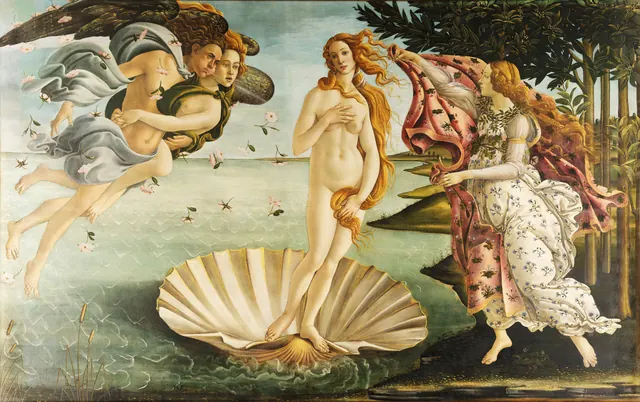
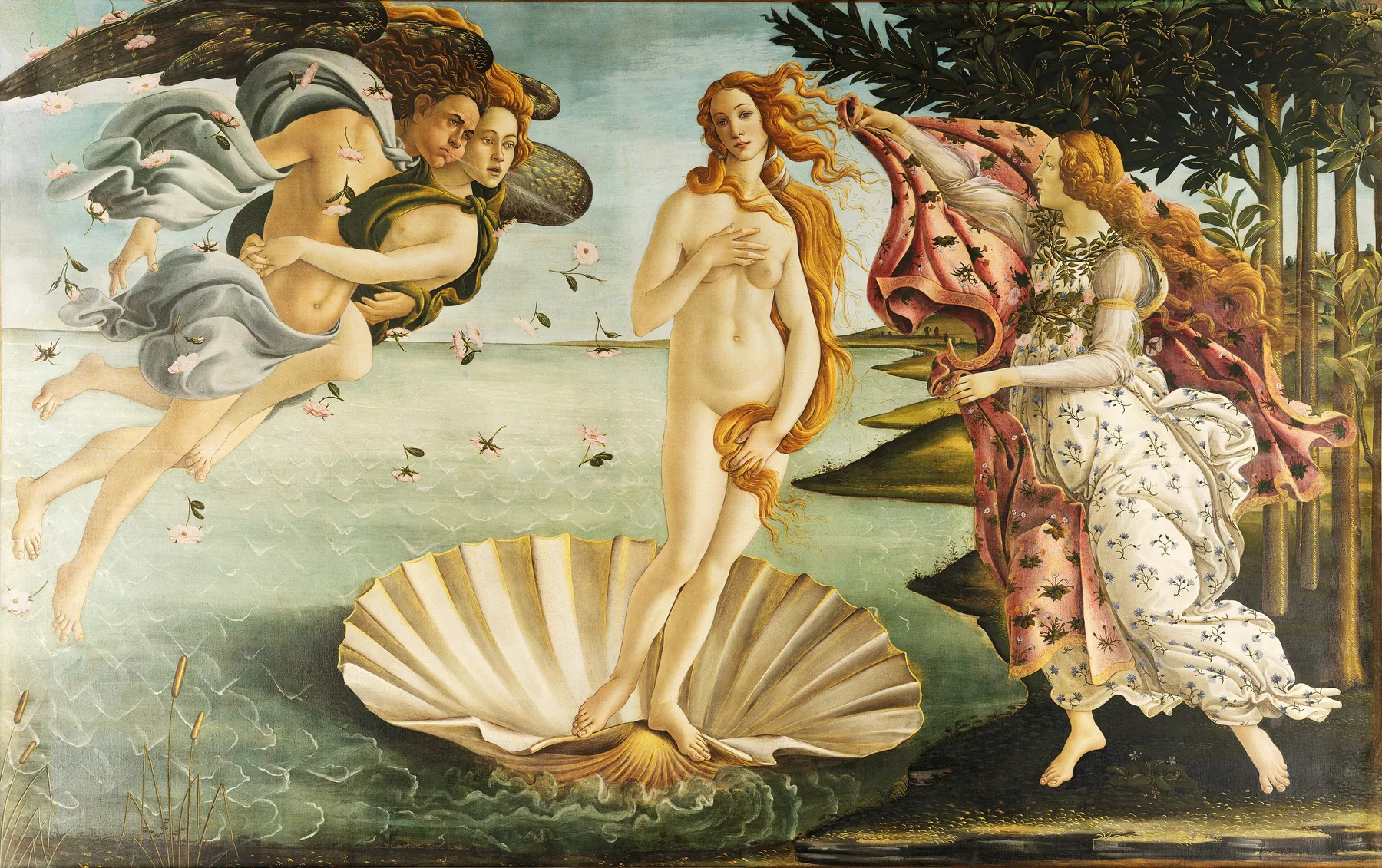
The painting we meet is titled “Birth of Venus,” a name that instantly summons the mythic moment of the goddess’s emergence. It bears the unmistakable hand of the Florentine master Sandro Botticelli, whose career spanned the late fifteenth century. Unlike the majority of Tuscan art of his day, which was executed on wooden panels, Botticelli chose canvas as his support – a decision that makes this work the first known Tuscan painting on canvas. That choice was revolutionary, allowing a broader, more open composition while preserving the delicate tempera washes that give the sky and sea their luminous glow.
When and Why It Was Made
Scholars date the canvas to around 1485, placing it squarely in the height of the Florentine Quattrocento. The work was probably commissioned by a member of the powerful Medici family, a conclusion supported by several lines of evidence. While no contract survives, the balance of probability points to a Medici patron, perhaps Lorenzo the Magnificent himself or his cousin Lorenzo di Pierfrancesco, known as “il Popolano.” Some researchers also suggest the painting may have been intended for the Medici Villa in Correggio, a country retreat just outside Florence. All of these possibilities remain hypotheses, but they underline the close ties between Botticelli’s art and the Medici court.
The Mythic Arrival
At the heart of the canvas we see Venus poised on a giant scallop shell, the classic emblem of her birth from the sea. The composition places her on the island of Cyprus, a setting suggested by the distant shoreline and gentle swell of water. She is being carried forward by the west wind Zephyr, whose invisible breath lifts her flowing hair and the diaphanous veil that clings to her form. Some observers also detect a secondary breeze, the nymph Aura, adding a subtle ripple to the water and a whisper of motion that guides the eye toward the goddess’s serene face.
A Classical Stance
Venus stands in a graceful contrapposto, her weight shifted onto the left leg while the right leg remains relaxed. This pose, borrowed from ancient sculpture, gives the figure a sense of poised movement even as she appears to float on the air. The subtle shift of weight creates a gentle S‑curve that leads the viewer’s gaze from the curve of her hip, up through the line of her torso, and finally to the delicate tilt of her head. In Botticelli’s hand, the classical stance becomes a visual expression of both stability and ethereal lightness.
The Attendant Figure
To Venus’s left, a young woman reaches out, her hand poised to smooth the goddess’s hair. Scholars have long debated her identity. Some read her as one of the Three Graces, embodiments of charm, beauty, and creativity, while others argue she represents the Hora of spring, a personification of the season that heralds renewal. The figure’s gentle gesture reinforces the theme of transition—from the tumult of surf to the ordered realm of divine beauty—while also adding a human touch that bridges mythic grandeur with approachable tenderness.
Flora as Symbol
Scattered across the foreground, delicate roses are caught in the same breezy current that lifts Venus’s veil. According to an ancient myth, roses were said to have sprung up alongside the birth of Venus, a poetic association that Botticelli weaves into the scene. Their soft pink petals introduce a warm contrast to the cool blues of sea and sky. In the distant background, a grove of orange trees punctuates the horizon. These trees were likely an emblem of the Medici dynasty, referencing the linguistic link between the family name and the Italian word for orange, “mala medica.” Their inclusion offers a subtle visual pun that would have resonated with contemporary viewers.
Layers of Meaning
Many scholars interpret the entire scene as a Neoplatonic allegory of beauty and perfection, a theme that circulated within the Medici court. In this reading, Venus embodies the ideal of divine beauty, a bridge between the imperfect material world and the realm of pure forms. Her emergence from the sea, guided by gentle breezes, can be seen as the soul’s ascent toward higher truth. The surrounding figures, the roses, and the orange trees all reinforce a harmony between earthly love and transcendent ideal. It is important to note that this is an interpretation, not a documented intention, but it offers a compelling lens through which to view the composition.
Afterlife of an Icon
Centuries after its creation, Botticelli’s “Birth of Venus” became a touchstone for the nineteenth‑century Pre‑Raphaelite movement. Artists who sought to revive the lyrical beauty and classical references of early Renaissance art looked to this canvas as a model, imitating its line work, its mythic subject, and its delicate palette. The painting was also widely parodied, underscoring its status as an iconic image that continued to inspire and provoke creative dialogue long after the Medici patronage that may have birthed it.
Through its graceful lines, inventive canvas, and layered symbolism, Botticelli’s Birth of Venus remains a living conversation between myth, technique, and the timeless pursuit of beauty.