The story
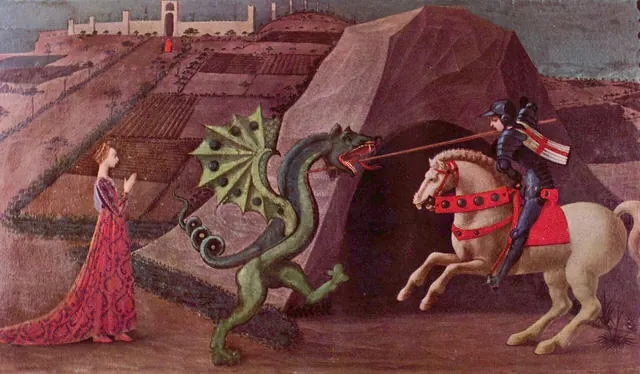
The scene we see is rooted in a legend that traveled from the East to medieval Europe. Though its origins lie in oriental storytelling, early Christians adopted the tale to symbolize the Church’s deliverance when it was oppressed by pagan forces. In this painting the drama of Saint George’s victory becomes a visual metaphor for that spiritual rescue. The narrative thus serves as a visual prayer, asking viewers to contemplate the triumph of faith over worldly threats, a theme that resonated deeply in a period when religious identity shaped daily life. Scholars have noted a striking duality in Uccello’s work, a balance between opposing elements that runs through the whole composition. This duality invites us to read the picture not only as a single heroic moment, but as a carefully staged dialogue between two worlds.
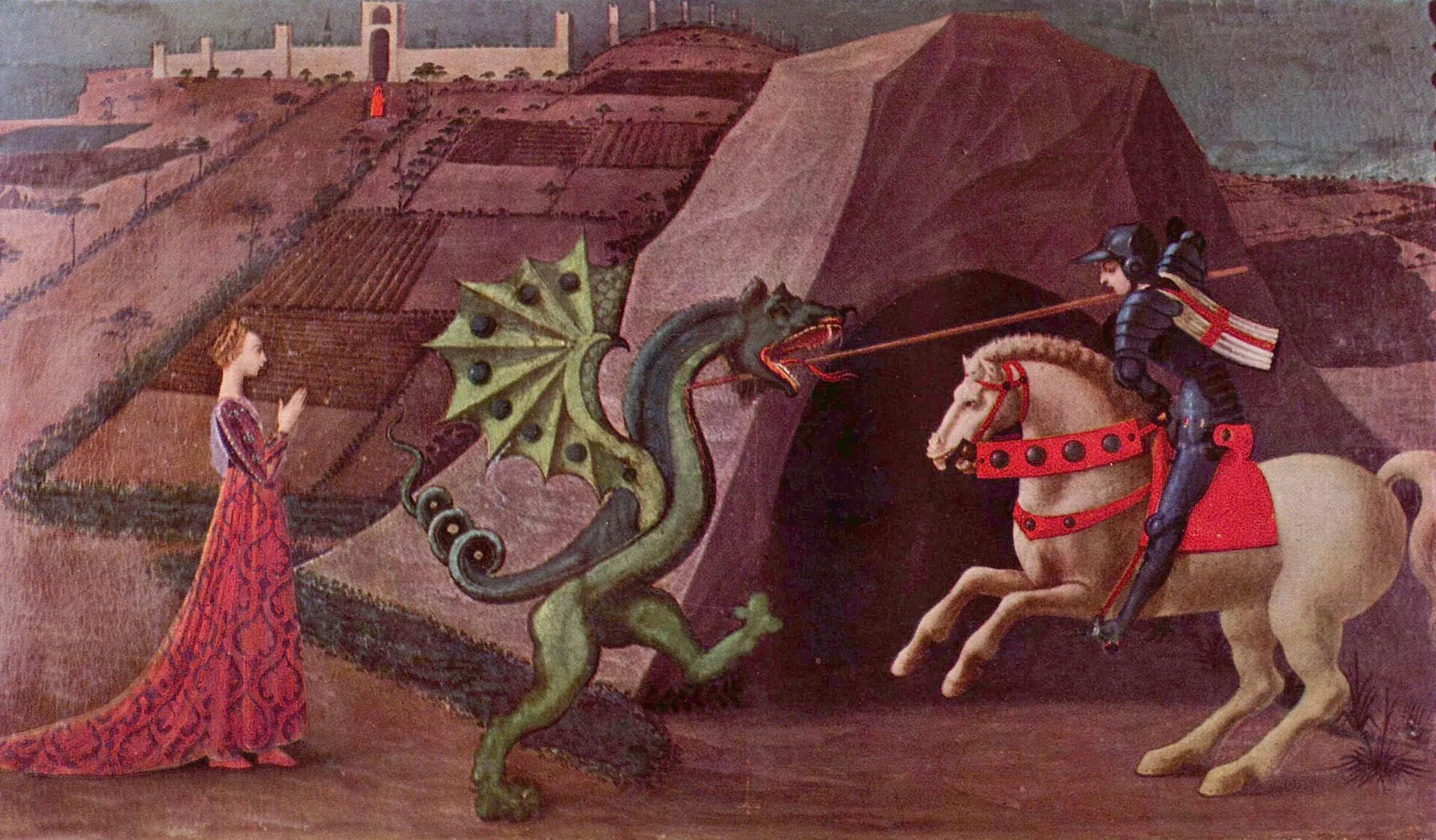
At the heart of the scene a massive, faceted rock thrusts forward, splitting the landscape into two distinct zones. To the right, Saint George in dark armor rides his white horse, lance poised toward the rearing green dragon. To the left, the princess in her red gown watches, her figure outlined like a medallion, while a walled city crowns the distant hill. The rock creates two independent perspective systems, each with its own vanishing point, so the eye alternates between the violent foreground and the tranquil background. The careful arrangement of stones and foliage on either side further emphasizes the contrast between order and chaos.
Uccello’s fascination with linear perspective is evident in every line that converges toward the rock’s interior. The lance thrust by the knight, the angled planes of the stone, and the receding terraces of the city all obey a consistent system of vanishing points, producing a convincing illusion of depth on the wooden panel. Such complex perspective treatment is described as very characteristic of Paolo Uccello’s art, marking this work as a milestone in the early Renaissance’s exploration of spatial order. The disciplined geometry thus becomes a visual roadmap, leading the eye from conflict to calm.
Amid the turmoil, the princess stands in a long red gown, her figure outlined like a medallion against the surrounding action. The dress is traced with a dark ornamental pattern that isolates her silhouette, giving her an emblematic presence. Opposite her, the dragon’s sinuous body is rendered in an arabesque style that recalls the decorative motifs of a Gothic coat of arms. This juxtaposition of a courtly, medallion‑like figure with a heraldic, ornamental beast creates a visual contrast that heightens the painting’s blend of traditional iconography and innovative spatial treatment. The contrast underscores how Uccello marries familiar symbols with a forward‑looking perspective.
The overall composition embodies a duality that scholars have long associated with Uccello’s oeuvre. On one side, the scene bursts with kinetic energy: the knight’s lance, the dragon’s thrashing, the dramatic lighting that catches the armor’s sheen. On the opposite side, the city and its terraced fields unfold in measured, calm perspective, their stone walls bathed in cool light. This visual opposition mirrors the thematic clash between chaos and order, violence and peace, and reflects the legend’s deeper meaning of deliverance. By embedding this duality within the very geometry of the painting, Uccello creates a balanced visual narrative that resonates across the split rock and the two vanishing points.
Painted on a wooden panel between 1430 and 1435, this Saint George and the Dragon entered the Musée Jacquemart‑André after Nélie Jacquemart acquired it at a London auction in 1899. The museum’s records confirm that the 1430‑1435 panel and Jacquemart’s 1899 purchase refer to this very work, not to a later copy. Today it rests in the museum’s main collection, framed by a 15th‑century Italian wooden frame that echoes the period of its creation. As viewers step back, the painting’s bold perspective and dramatic narrative continue to speak across the centuries, inviting contemplation of both its technical daring and its enduring story.
When we step back from the painting, the split rock remains the anchor that holds together two worlds—one of heroic combat, the other of tranquil order. Uccello’s masterful use of perspective not only creates depth but also reinforces the story’s symbolic layers, inviting us to contemplate both the physical battle and the spiritual deliverance it represents. The work stands as a testament to the early Renaissance’s daring experiments with space, while its enduring visual drama continues to captivate viewers centuries later. In this single panel, the legend of Saint George becomes a timeless dialogue between past and present, chaos and harmony.
Join us next time as we uncover more hidden stories behind the masterpieces that shaped art history.