The story
Opening
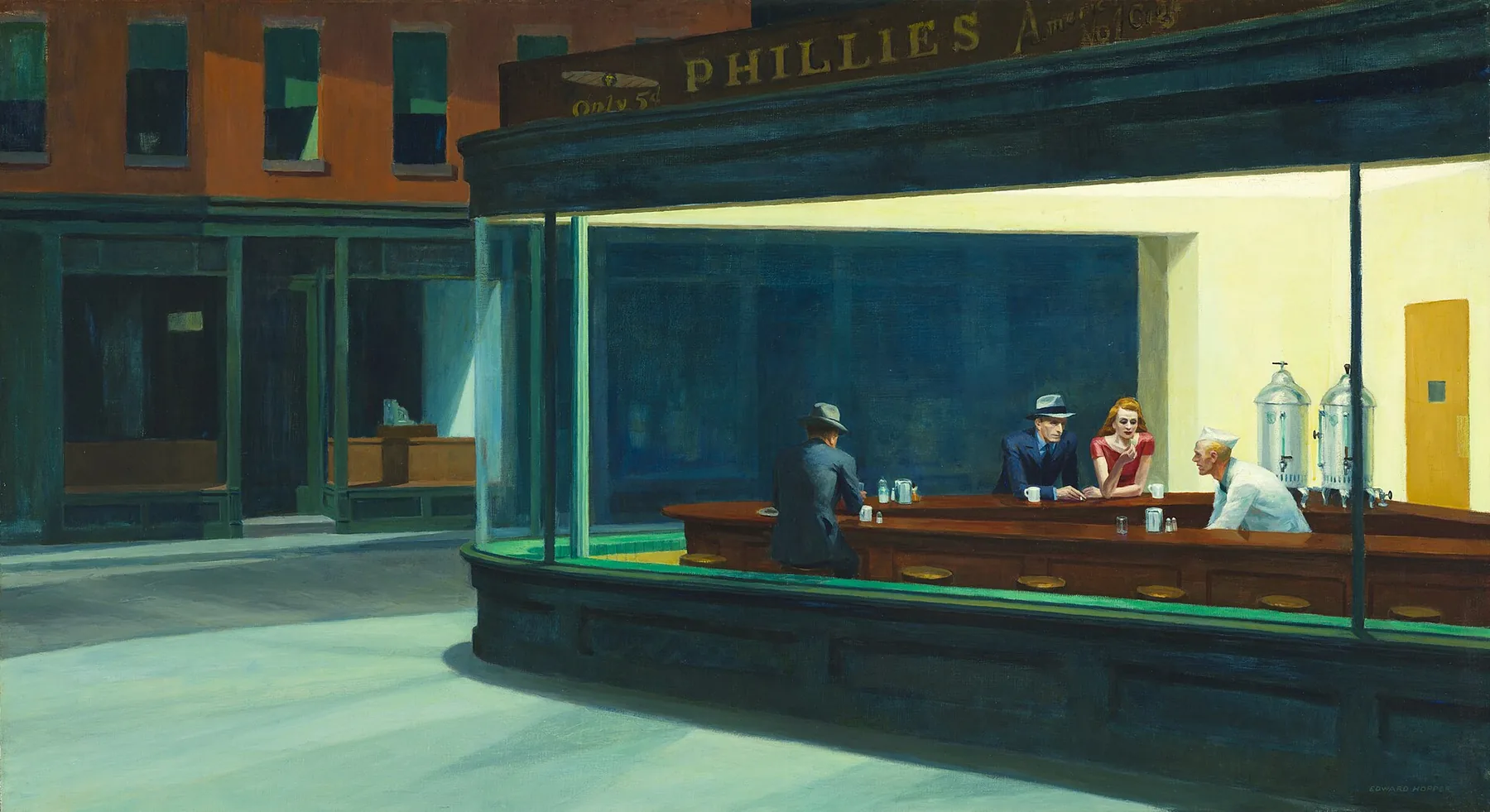
The canvas before us bears the simple, unmistakable title “Nighthawks,” a name that immediately summons a quiet urban night scene. It was painted by the American realist Edward Hopper, whose careful eye for light and solitude defined much of twentieth‑century American art. By foregrounding the title and the artist, we set the stage for a work that has become a cultural shorthand for late‑night contemplation, inviting us to look beyond the surface and consider what lies in the glow of that downtown diner.
Hopper completed the painting in 1942, employing oil on canvas to achieve a luminous, almost photographic quality. The medium allows him to render the stark contrast between the artificial interior light and the deep, enveloping night outside. This temporal anchor places the work squarely in the early‑forties, a period when American art was turning inward, focusing on everyday scenes rendered with meticulous observation. The choice of oil gives the surface a subtle depth, letting the viewer feel the weight of the night pressing against the bright, glass‑bound interior.
Physical Details
Measuring roughly eighty‑four by one‑fifty‑two centimeters, the canvas commands a presence that is both intimate and expansive. It belongs to the Friends of American Art Collection at the Art Institute of Chicago, a testament to the museum’s commitment to American modernism. In the lower‑right corner, Hopper signed his name in green paint, a modest mark that authenticates the piece while echoing his understated approach to self‑presentation. These concrete details—size, collection, signature—ground the work in a physical reality that viewers can encounter in person, reinforcing its status as a tangible artifact of its era.
Provenance and Artist’s Letter
In 1942 the painting was consigned to Frank Rehn Galleries and sold to the Art Institute of Chicago, a swift movement that underscores the immediate recognition of its significance. Shortly after the sale, on May 13 1942, Hopper wrote to the museum’s director, expressing his pleasure that the institution had acquired the work and calling it one of the very best things he had painted. That personal endorsement offers a rare glimpse into the artist’s own valuation of the piece at the moment it entered public view, reinforcing the sense that Hopper himself recognized the quiet power of the scene he had rendered.
Artist’s Reflection
Later, Hopper recalled that, “unconsciously, probably, I was painting the loneliness of a large city.” This candid admission, recorded in his own words, frames the painting as a study of urban isolation rather than a deliberate social statement. By acknowledging the unconscious nature of his intent, Hopper invites viewers to sense the quiet melancholy that pervades the scene—a feeling that emerges from the empty streets outside the diner’s glowing window and the solitary figures within, each absorbed in their own private moment.
Real‑World Inspiration
The diner’s façade was inspired by a real restaurant on Greenwich Avenue in New York City, situated at a wedge‑shaped corner where two streets meet. This concrete reference grounds the imagined scene in an actual urban location, lending the composition an authenticity that resonates with viewers familiar with the rhythm of city life. By borrowing the geometry of a specific corner, Hopper creates a setting that feels both particular and universal—a place anyone could recognize as a quiet, late‑night eatery tucked into the city’s grid.
Personal Models
Hopper used his wife, Josephine—affectionately known as Jo—as the model for the red‑haired woman seated at the counter, while the solitary diner across the counter was modeled after himself. This personal involvement blurs the line between observation and self‑portraiture, embedding intimate familiarity within a public setting. The presence of the artist’s own likeness adds a layer of introspection, suggesting that the loneliness depicted may also be a reflection of Hopper’s own experience, even as the scene remains a broader comment on urban solitude.
Composition and Architecture
The composition features curved geometric forms and an Art Deco façade, giving the building a sleek, modern silhouette that feels both timeless and of its day. These curved lines guide the eye inward toward the illuminated interior, while the Art Deco detailing adds a subtle sense of the era’s design sensibilities. The geometry creates a visual rhythm that balances the static stillness of the interior with the implied movement of the city outside, reinforcing the painting’s quiet tension between interior comfort and exterior isolation.
There is no visible entrance to the diner; the viewer is shut out by a seamless wedge of glass that dominates the front. This barrier frames the interior like a luminous island, heightening the feeling of observation, as if we are peering into a private moment through an unbroken surface. The absence of a doorway emphasizes the separation between the world outside and the quiet interior, reinforcing the painting’s theme of isolation and the sense that the figures inside are both observed and unreachable.
Inside, the space is spare yet meticulously detailed. Round stools sit at wide intervals along a simple counter, each isolated in its own quiet corner. A few coffee mugs, sugar jars, napkin holders, and an abandoned water glass are rendered with deadpan precision, emphasizing the stillness of the scene. These objects, rendered with careful realism, create a sense of everyday routine frozen in time, allowing the viewer to linger on the quiet details that speak to the painting’s broader meditation on solitude.
Light, Mood, and Interpretation
Hopper later recalled that darkness inspired Nighthawks, prompting him to imagine a brightly lit diner against a night of uncertainty.
Cinematic techniques of early film noir—such as sharp angles, dramatic shadows, and patterned light—made their way into Hopper’s picture, reinforcing a sense of tension and mystery that resonates with the visual language of the era. The interior is illuminated by fluorescent light, casting an eerie glow that heightens the nocturnal atmosphere. By borrowing these filmic strategies, Hopper creates a tableau that feels both painterly and cinematic, inviting viewers to linger in the quiet drama of the night‑time diner.
Cultural Legacy
Since its debut, the composition has been repeatedly parodied, cartooned, digitally altered, and referenced extensively in popular culture, testifying to its enduring visual power. The painting’s iconic arrangement of three figures framed by a luminous window has become a staple of visual shorthand, re‑imagined in countless contexts while retaining the quiet, almost cinematic stillness that Hopper first captured. This pervasive presence in media underscores how the work continues to resonate, inviting each new generation to reinterpret its simple yet profound scene.
Closing Reflection
In the soft glow of Hopper’s night‑time diner, we find a timeless window into the quiet moments that define urban life, a scene that continues to speak across decades.
Thank you for joining us on this quiet night at the diner—may its soft light linger in your thoughts.