The story
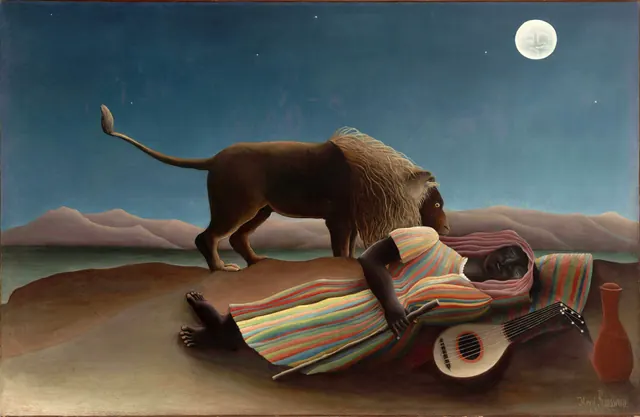
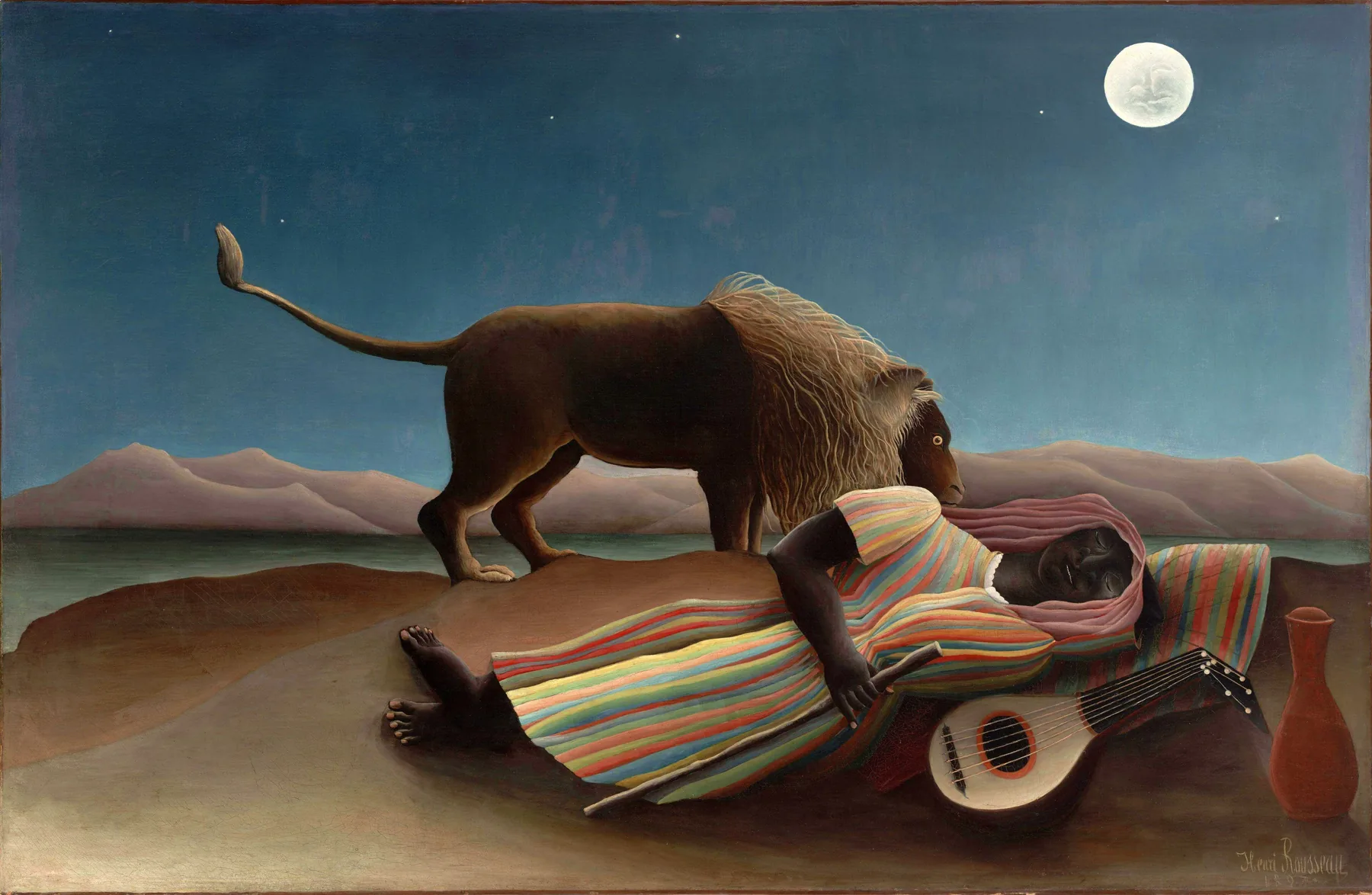
The canvas before us bears a simple, evocative title—'The Sleeping Gypsy'—and it bears the unmistakable hand of Henri Rousseau, the French naïve painter whose imagination turned modest materials into timeless visions. By naming the work and its creator at the outset, we invite the viewer into a quiet, nocturnal world that feels both intimate and universal. Rousseau’s outsider status, his self‑taught background, and his singular visual language all converge in this single, iconic image, setting the stage for a meditation on stillness, mystery, and the unexpected companionship of a lion under moonlight. Its quiet presence continues to draw viewers into a world where the ordinary and the exotic meet under a shared night.
Completed in 1897, the painting is executed in oil on canvas, a medium that gave Rousseau the capacity to model the subtle glow of moonlight and the soft textures of sand and fur. The date anchors the work at the close of the nineteenth century, a moment when the artist was finally gaining public notice after years of exhibiting at the Salon des Indépendants. The oil medium, applied in thin, layered strokes, allows the night sky to breathe across the surface, while the canvas provides a sturdy plane for the stark silhouettes that define the composition.
After a long period of obscurity, the canvas resurfaced as a gift to the Museum of Modern Art in New York, arriving in December 1939. That same year it found a permanent home on MoMA’s walls, ending decades during which the painting had been missing from public view. Earlier, Rousseau had attempted to place the work in his hometown of Laval, but the mayor rejected the offer, leaving the painting to wander through private hands before its eventual donation. The 1939 acquisition not only secured the painting’s preservation but also introduced it to a wider audience, cementing its status within a leading modern art institution.
The painting’s dramatic re‑emergence occurred in 1924, when it was found tucked away in a Parisian charcoal merchant’s shop—a setting far from the climate‑controlled walls of a museum. The discovery in such a modest, and arguably unsuitable, environment underscores how the work survived despite neglect, hidden among supplies that were ill‑suited for preserving oil on canvas. This unexpected location not only revived interest in Rousseau’s oeuvre but also highlighted the precarious journeys many avant‑garde works endured before finding institutional care. The surprise of finding a major work in such an ordinary place sparked a flurry of attention among collectors and critics, who recognized that a masterpiece had been hidden in plain sight.
In recent conservation work, experts removed nearly a century’s worth of discolored varnish layers, a process that unveiled Rousseau’s original palette beneath the accumulated film. This meticulous cleaning revealed the true intensity of the moonlit hues and the subtle tonal variations that had been muted by the aged varnish. By stripping away the obscuring layers, conservators allowed contemporary viewers to experience the painting much as the artist intended, with the luminous night sky and the delicate contrast between figure and beast restored to their original brilliance. The restored colors not only brighten the visual impact but also reinforce the painting’s atmospheric depth, confirming that Rousseau’s subtle handling of light was central to its enduring allure.
The composition centers on a dark‑skinned woman lying in repose, her figure rendered in a simple, almost silhouette‑like form, while a lion leans forward, its nose gently lifted as it sniffs her shoulder. Both figures are bathed in the eerie light of a full moon that hangs low over the desert landscape, casting a silvery wash that unifies the scene. This stark juxtaposition of tranquil sleep and the watchful animal creates a tension that is both intimate and unsettling, inviting the viewer to linger on the quiet exchange between human and beast under the night sky.
Critics have long praised the painting for the simplicity of its composition combined with a subtle execution that yields a dreamlike yet strangely real atmosphere. This balance positions the work as one of the most important paintings of the period when Rousseau began to receive recognition as an artist, marking a turning point in his career. Its flattened forms and imaginative spatial arrangements caught the attention of avant‑garde pioneers such as Pablo Picasso, Robert Delaunay, and Henri Matisse, who saw in Rousseau’s naïve style a fresh visual vocabulary. Understanding that Rousseau was entirely self‑taught, having worked in modest administrative jobs before retiring on a small pension to paint full‑time and exhibiting regularly at the Salon des Indépendants, deepens our appreciation of how his outsider perspective reshaped modern art.
In the hush of night, Rousseau’s gypsy rests under the moon, inviting us to linger in a quiet mystery that endures across a century.