The story
From Sea Voyages to Canvas
Winslow Homer completed The Gulf Stream on the windswept cliffs of Prout’s Neck, Maine, after returning from a voyage to the Bahamas. That 1898 trip sparked his memory of earlier Caribbean sketches, reminding him of work he had already begun exploring. The convergence of fresh observation and those prior studies gave him the material to translate a seafaring experience into a dramatic, solitary tableau on canvas. By situating the painting’s genesis in this moment of return and recollection, we see how Homer’s own journeys fed directly into the visual story he would soon render.
A Scene of Peril on the Open Sea
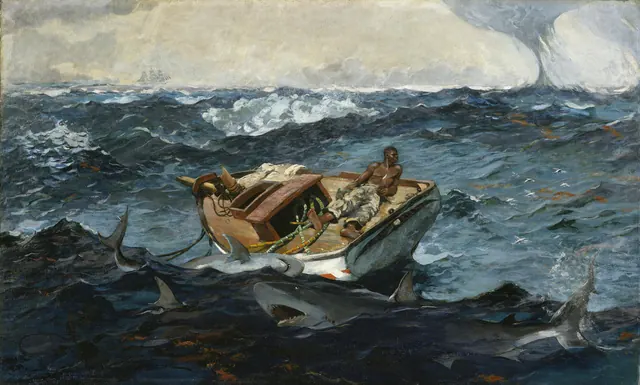
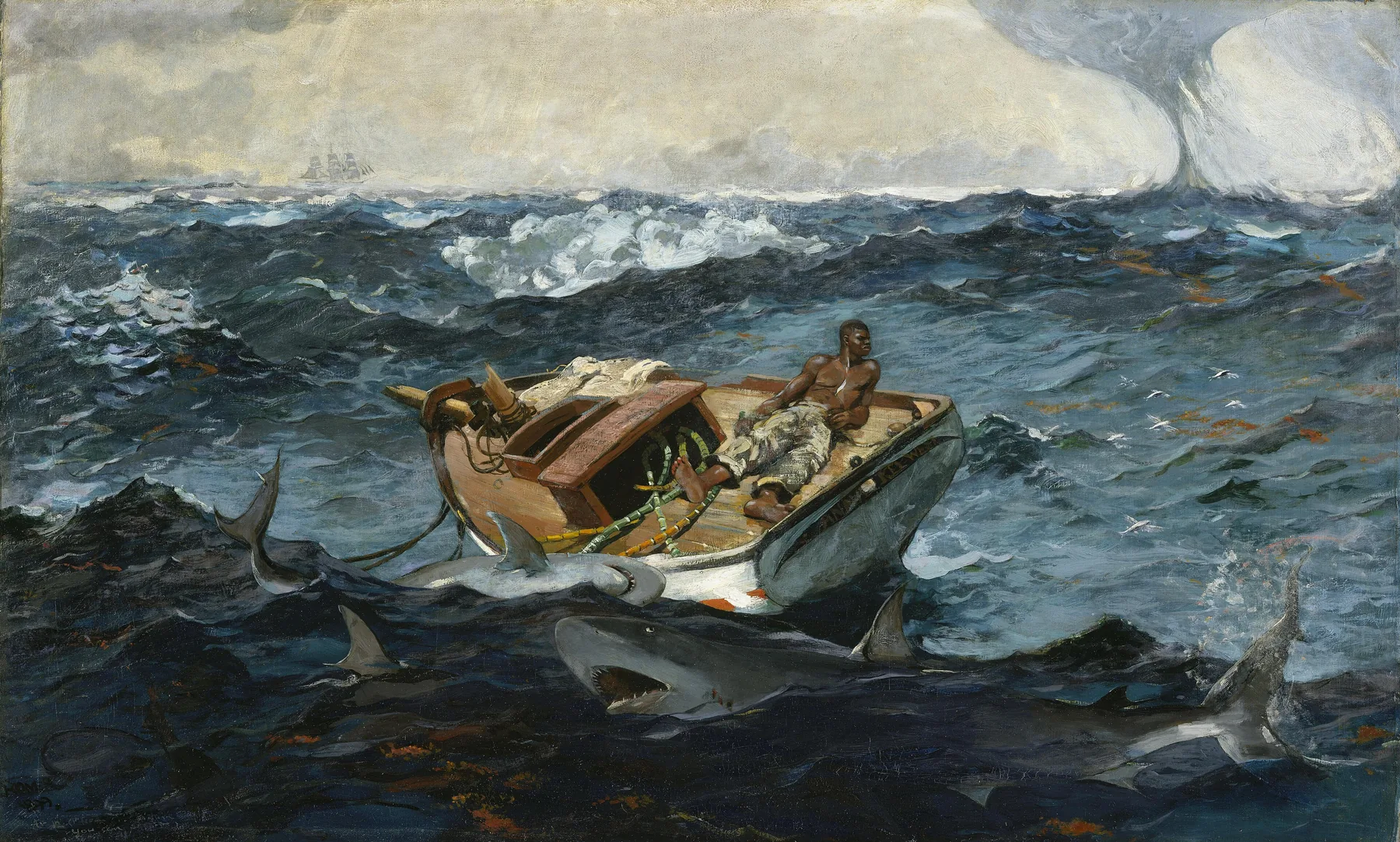
The canvas presents an African‑American man adrift on a damaged sailboat, his lone figure surrounded by a circle of aggressive sharks. Above the turmoil a dark waterspout spirals upward, while on the distant horizon a faint sailing ship breaks the line of the sky. This stark arrangement isolates the sailor against the indifferent ocean, letting the viewer feel the tension between human vulnerability and the relentless forces of nature that loom in every direction. The composition’s balance of figure, beast, and atmospheric threat creates a visual narrative that is both immediate and unsettling.
The Title as a Geographic Metaphor
The Gulf Stream, the title Homer chose, refers to the powerful oceanic current that carries warm Caribbean waters up the United States’ east coast before crossing the Atlantic toward Europe. Daniel Immerwahr reads this as a metaphorical bridge linking three continents—Caribbean, United States, and Europe—suggesting that the drama on the canvas unfolds within a larger system of trade, migration, and climate that has shaped history. By naming the work after a real current, Homer anchors his dramatic scene in a tangible geographic reality, inviting viewers to contemplate how natural and human currents intersect.
The Ambiguous Sailor
Scholar Daniel Immerwahr notes that the central figure remains deliberately ambiguous; his emotional state—whether confident or afraid—is left uncertain. The lack of explicit expression forces the viewer to project their own reading onto the sailor, turning the painting into a study of human endurance under pressure. This intentional ambiguity aligns with Homer’s broader practice of withholding narrative details, allowing the scene to hover between resolve and panic, and keeping the audience engaged in a quiet, unresolved dialogue with the work.
A Canvas of Empire and Turmoil
At the time Homer painted this work, the United States was expanding its empire while political turmoil swirled throughout the Caribbean. Interpretation suggests that the artist alludes to those broader issues, embedding a subtle commentary on the era’s geopolitical currents within the storm‑tossed sea. The painting’s isolated figure, caught between sharks and a looming waterspout, can be read as a visual echo of a nation navigating uncertain waters of power and unrest, a theme that resonates without naming any specific conflict.
Race, Geopolitics, and the Environment
Critics argue that The Gulf Stream engages with charged subjects of race, geopolitics, and the environment. Some interpretations link the work to the legacy of slavery and imperialism that followed the 1898 Spanish‑Cuban‑American War, reading the lone Black sailor as a symbol of displaced peoples caught in trans‑Atlantic currents of exploitation. Others see the painting as an allegory of human endurance amid natural forces, highlighting how ecological and social upheavals intersect. These layered readings underscore the painting’s capacity to speak to multiple, often uncomfortable, histories at once.
Technique, Scale, and Signature
The Gulf Stream is an oil‑on‑canvas work measuring 28 1/8 by 49 1/8 in. (71.4 × 124.8 cm). Executed in a medium that allowed Homer to render both the luminous flesh of the sailor and the brooding, storm‑filled sea with equal vigor, the painting bears his signature in the lower left corner: “HOMER/1899.” The generous dimensions give the viewer a panoramic sense of the ocean’s vastness, while the oil’s rich texture captures the sheen of water and the roughness of the damaged hull, reinforcing the tactile immediacy of the scene.
From Wolfe Collection to Museum Icon
The Metropolitan Museum of Art acquired The Gulf Stream in 1906 as part of the Catharine Lorillard Wolfe Collection, assigning it accession number 06.1234. This acquisition placed the painting within one of America’s premier art institutions, where it has been recognized as an iconic centerpiece of the museum’s Crosscurrents exhibition—the most extensive critical overview of Homer’s work in more than a quarter of a century. Its presence in the Met’s collection underscores its lasting influence and affirms its status as perhaps Homer’s most consequential painting.
In The Gulf Stream, Winslow Homer captures a moment where sea, history, and human resolve converge, leaving us to contemplate the currents that shape both the world and our own destinies.