The story
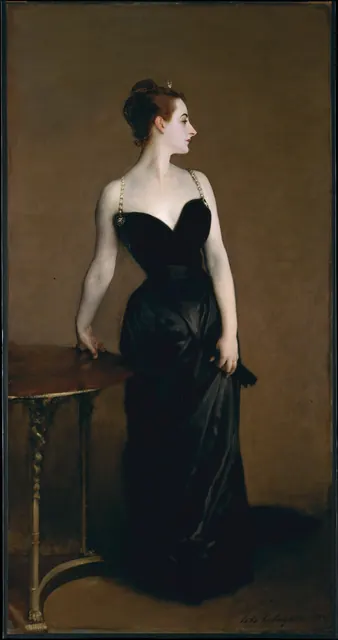
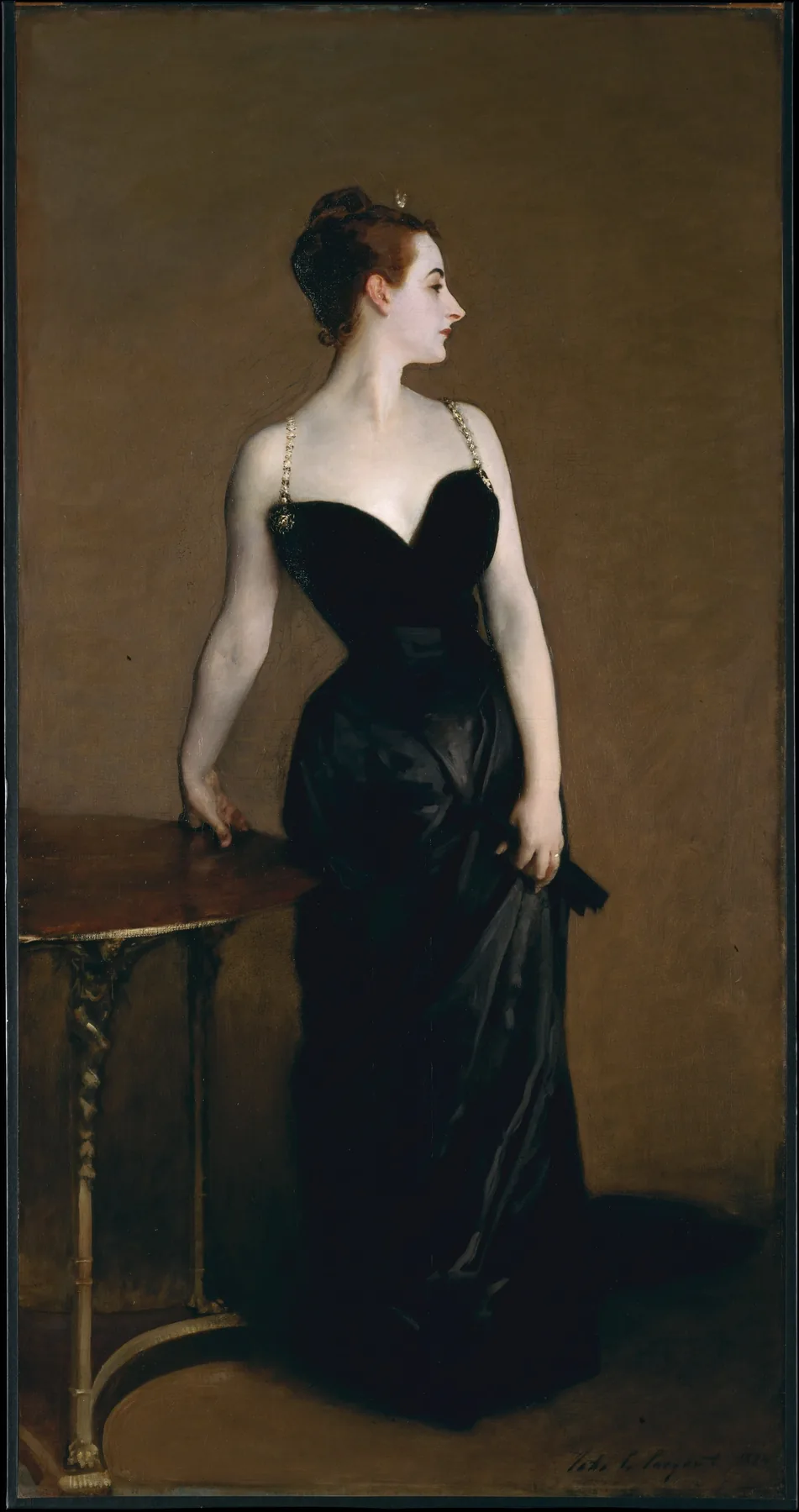
The work is formally titled “Madame X (Virginie Amélie Avegno Gautreau),” a title that records the sitter’s full name. It is also widely known simply as “Portrait of Madame X.” The artist behind this portrait is John Singer Sargent, an American painter. By stating both the precise title and the commonly used name, the record clarifies how the painting is identified in scholarly and public contexts, while the attribution to Sargent anchors the work within the oeuvre of a transatlantic artist whose reputation rests on technical mastery and portraiture.
Sargent executed the portrait in oil on canvas, a medium that allows for subtle tonal modulation and luminous surface quality. The canvas measures 82 1/8 × 43 1/4 in., that is 208.6 × 109.9 cm, giving the work a tall, narrow format. The painting was created during the years 1883–84, situating it firmly in the late‑nineteenth‑century period of high‑society portraiture. These physical specifications—medium, size, and date—provide the material framework within which all subsequent visual and historical discussions take place, establishing the work’s tangible presence before any interpretive layer is added.
The sitter is Virginie Amélie Avegno Gautreau, an American beauty who married French businessman Pierre Gautreau. Sargent recorded her skin tone as a “uniform lavender or blotting‑paper colour all over,” a description that highlights his observation of a consistent, muted hue across the flesh. This precise wording from the artist underscores his attention to the subtle coloration of the sitter’s complexion, a detail that contributes to the overall visual harmony of the portrait without invoking any symbolic reading beyond the factual observation.
The portrait was exhibited at the Paris Salon of 1884, where it provoked a scandal. Contemporary viewers were shocked by Gautreau’s haughty demeanor, provocative dress, and the dramatic artificiality of her cosmetics. Sargent later referred to the 1884 exhibition as the “Gautreau disaster,” and the public responded with hostility. These factual statements document the immediate reception of the work, showing how the combination of the sitter’s presentation and the public’s expectations produced a pronounced and documented controversy at the time of its debut.
Sargent asked that the picture not be called by the sitter’s name; the museum renamed it “Portrait of Madame X.” He also requested that the formal paperwork refer to the sitter simply as Madame X, and consequently the title “Madame X” was adopted. These actions reflect the artist’s desire to detach the work from a direct personal identifier, allowing the portrait to be known by a more enigmatic label while still preserving its connection to the sitter through the alternate title.
The original composition showed the sitter’s right jeweled strap sliding off her shoulder; Sargent later repainted the strap. This factual detail indicates that the artist altered a specific element of the dress after the initial execution, a change that is documented both in contemporary accounts and in later technical studies. By noting the exact location—the right shoulder strap—and the action of repainting, the record clarifies a concrete visual modification made by Sargent in response to the work’s early reception.
X‑ray fluorescence mapping identified pigments such as cerulean, viridian, and vermilion within the portrait, and a transparent red lake was used for flesh tones. These scientific findings document the specific materials Sargent employed, illustrating the complexity of his color palette and his skill as a colorist. By naming each pigment, the analysis provides concrete evidence of the layered approach to hue and tone that underlies the visual surface of the painting, reinforcing the technical sophistication recorded in the work’s material history.
The painting, catalogued as Object Number 16.53, was acquired in 1916 through the Arthur Hoppock Hearn Fund after Sargent offered it for sale in January 1916. In a 1916 letter to Edward Robinson, Sargent wrote, “I suppose it is the best thing I have done,” expressing his high regard for the work decades after its creation. After the Salon scandal, Sargent kept the portrait in his studio and did not exhibit it publicly for more than twenty years. It re‑emerged in 1905 at the Carfax Gallery in London and later traveled to Berlin in 1909 and Rome in 1911. The portrait’s scandalous reception has made it a frequent subject in popular culture, and it is considered Sargent’s most famous portrait. These factual points trace the work’s provenance, the artist’s own assessment, its long period of concealment, subsequent re‑exhibitions, and its enduring presence in cultural discourse.
Through these verified details, we see how Madame X stands as a testament to Sargent’s technical mastery, the complexities of its early reception, and its lasting imprint on art history.