The story
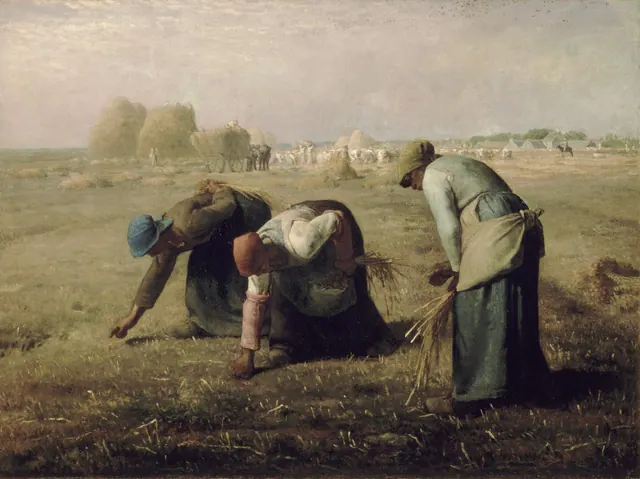
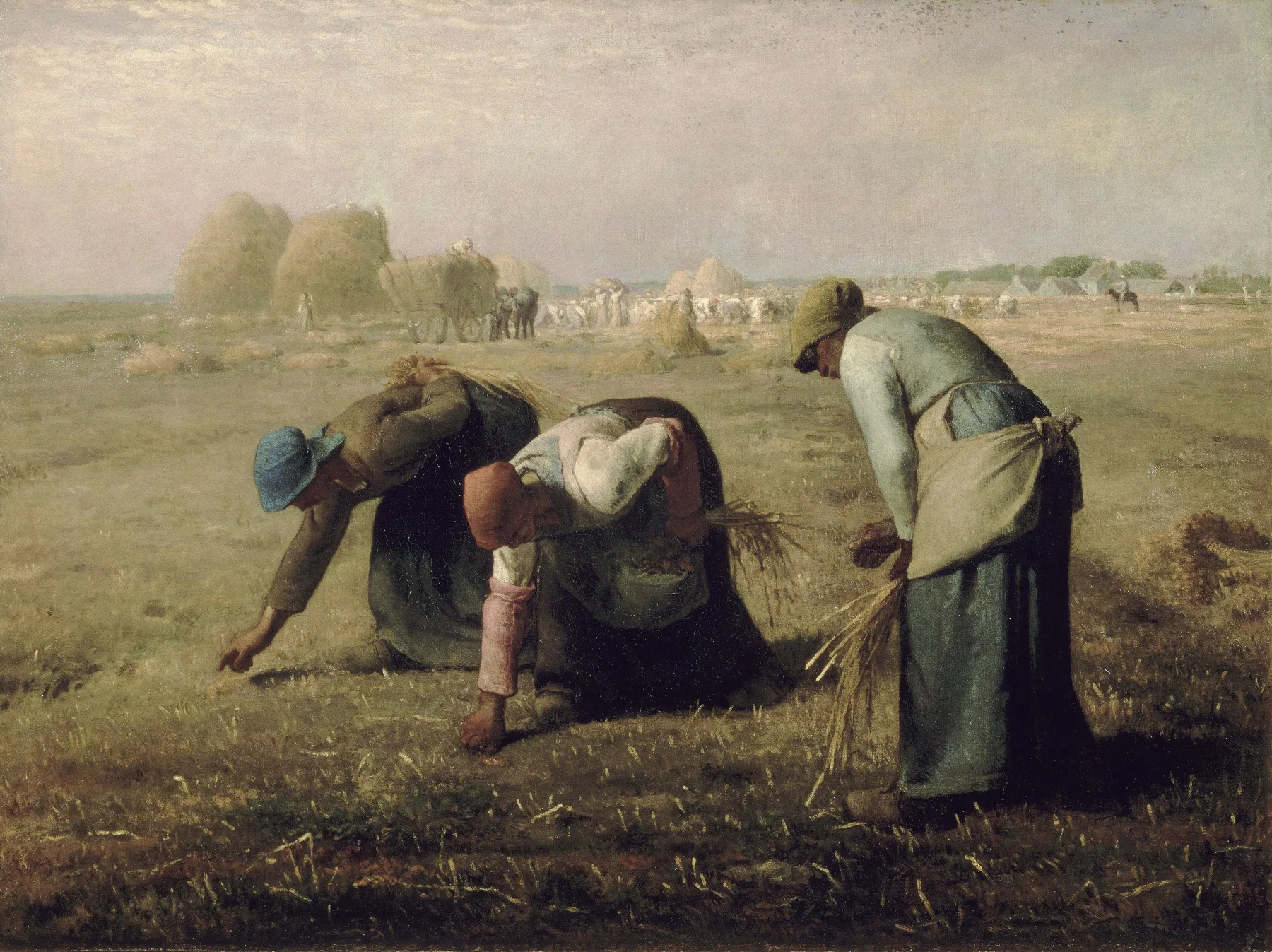
The canvas we meet is signed in French as Des glaneuses, the straightforward title that immediately places us in a rural French field. Its creator, Jean‑François Millet, painted this work for the Salon of the Palais des Champs‑Élysées, where it was shown in 1857 under catalogue number 1936. That public debut introduced the stark, sun‑lit tableau to the capital’s critics and patrons, marking the moment the modest act of gleaning entered the official art world. Though the painting would travel through private collections in the decades that followed, its first appearance at the Salon anchors its historical moment and invites us to look closely at what the canvas reveals.
At the heart of the scene stand three rural women, the very subjects of Millet’s study. They are legally authorised gleaners, bent over the late‑summer field to gather the wheat the harvesters have left behind. The setting‑sun light falls slantingly across their backs, sculpting their forms and drawing attention to the planes of their hands, necks, shoulders and backs. This illumination not only defines their volume but also brightens the muted tones of their simple clothing, giving each figure a quiet dignity. Millet’s careful rendering avoids any hint of miserabilism; instead, the women appear as resilient participants in the landscape, their posture and the light together affirming their worth.
The foreground stretches out as a sea of golden stalks, the remnants of a harvested field scattered across the earth. Millets’s brush captures the loose grain that lies between the women’s feet, a tactile reminder of the work they perform. The same slanting sun that sculpts the figures also washes the field in a warm, amber glow, emphasizing the texture of the soil and the faint shadows that ripple across it. This light, described as slanting setting‑sun illumination, accentuates the volumes of the entire scene, allowing the viewer to sense the physical labor of gathering the stray wheat under the day's fading light.
On the right edge of the canvas a solitary figure on horseback breaks the line of the women’s labor. The Musée d’Orsay identifies him as probably a steward, a representative of the estate’s ownership. His calm, elevated position introduces a note of social distance, reminding the viewer of the landlords who preside over the land. Though his presence is minimal, the rider’s horse adds a dynamic line that leads the eye outward, while his role as steward underscores the hierarchical structure that frames the gleaners’ activity. This subtle inclusion enriches the narrative, juxtaposing the quiet dignity of the women with the quiet authority of the landowner’s agent.
Beyond the immediate field, Millet renders the distant landscape as a powdery golden haze, a bucolic impression that softens the horizon and suggests the endless expanse of the French countryside. This atmospheric effect, described as a powdery golden haze, creates depth by fading the far‑off fields into a warm, almost dreamlike veil. The low horizon line grants the sky a dominant presence, while the slanting light continues to sculpt the foreground figures, linking them visually to the hazy background. The composition thus balances concrete labor with an idealized, tranquil distance, guiding the viewer’s eye from the detailed foreground, across the rider, and into the luminous, hazy expanse that frames the entire scene.
The painting’s arrangement follows a gentle diagonal, the three women positioned from left to right, each bent over in a rhythm that leads the eye across the canvas. The rider on horseback, placed at the right margin, creates a counter‑balance, while the soft horizon and hazy background stretch beyond, inviting the gaze to linger on the atmospheric glow. The slanting sun not only sculpts the figures but also unifies the whole picture, casting consistent shadows that tie foreground and distance together. This careful orchestration of light, line, and space ensures that every element—women, field, horse, and horizon—contributes to a cohesive visual narrative of rural labor bathed in evening light.
After its 1857 Salon debut, the canvas entered the private sphere, first joining the collection of Paul Tesse in 1865, then passing to Ferdinand Bischoffsheim from 1867 until his death in 1889, and subsequently to Mme Pommery, who retained it until 1890. That year she donated the work to the French State, where it was assigned to the Louvre. In 1986 the painting found a new home, entering the collection of the Musée d’Orsay, where it remains on view today. This journey from salon to private hands, to the nation’s principal museums, mirrors the painting’s enduring relevance and ensures that contemporary audiences can continue to experience Millet’s quiet, dignified vision.
In the soft glow of the setting sun, Millet invites us to pause, to see the quiet strength of those who labor, and to recognize the timeless dignity that lives on the canvas.