The story
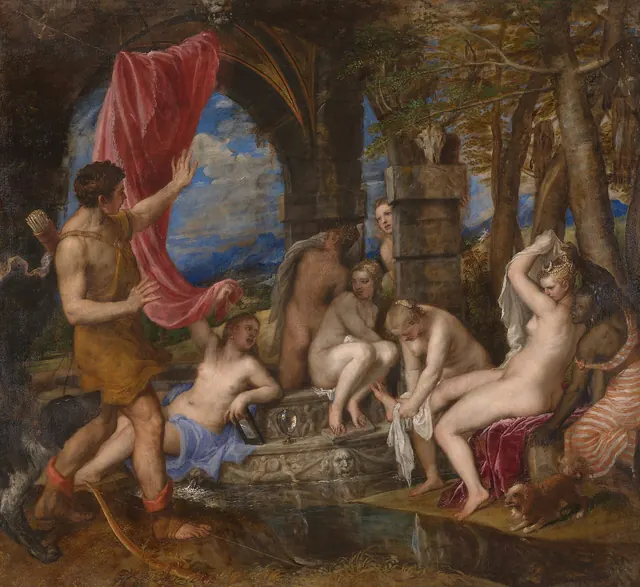
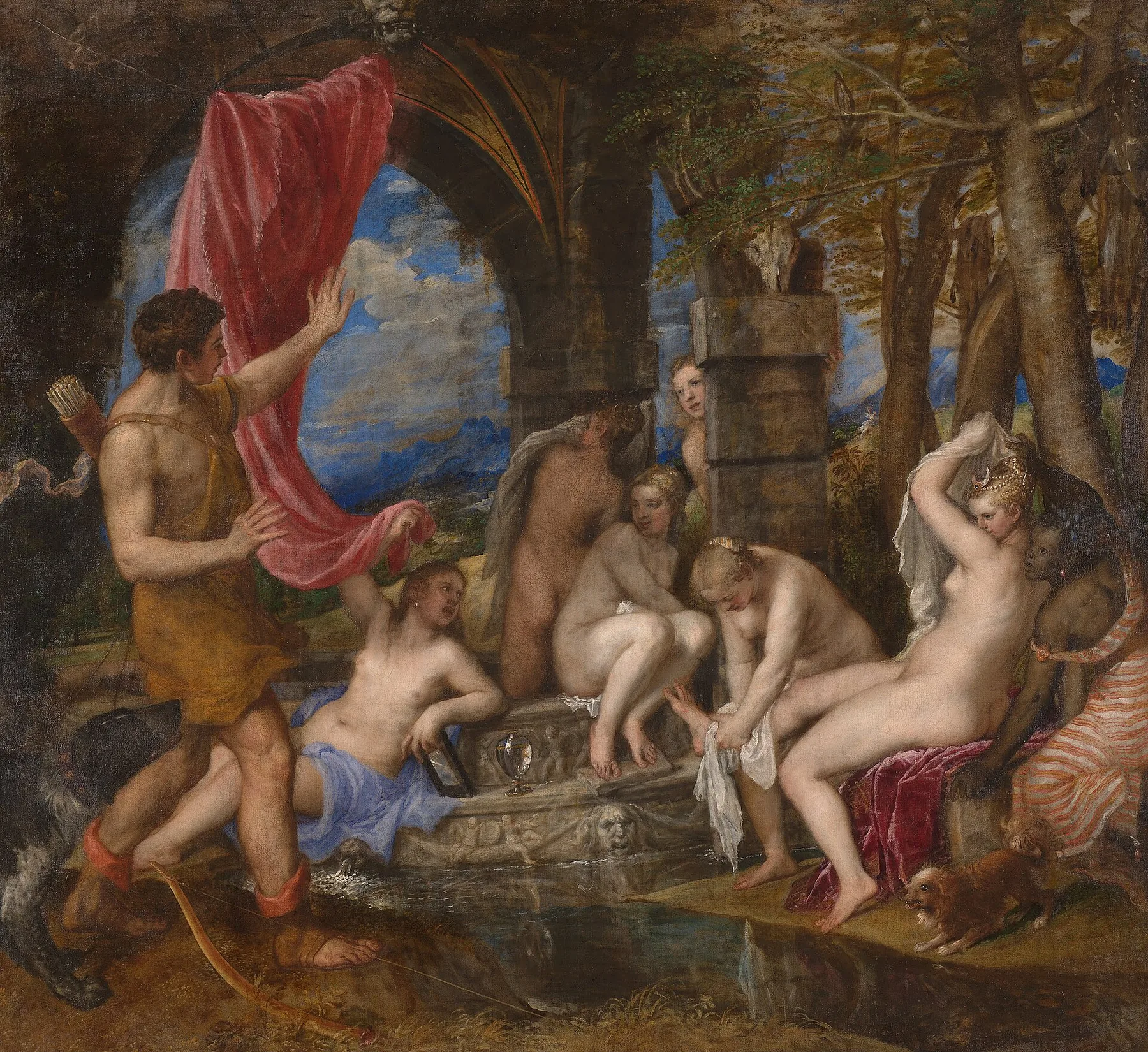
The canvas before us bears the unmistakable title “Diana and Actaeon”, a clear statement of its mythological subject.
At its heart stands the hand of Titian, the great Venetian master whose full name, Tiziano Vecellio, is now synonymous with the height of 16th‑century painting.
Recognising the title and the artist together grounds us immediately: we are looking at a work that was conceived not merely as a decorative piece but as a narrative tableau, a visual poem that would have been instantly recognizable to contemporary viewers familiar with Ovid’s tale.
This pairing of name and creator sets the stage for everything that follows.
Scholars place the execution of this monumental picture between 1556 and 1559, a period when Titian was at the zenith of his technical prowess.
He chose oil on canvas as his medium, allowing him to build luminous layers of colour that could be re‑worked with a freedom unmatched in earlier tempera works.
The oil medium also gave him the capacity to render the delicate translucency of flesh and the rich texture of foliage in a single, cohesive surface.
Understanding both the narrow window of its creation and the material choices helps us appreciate the painting as a product of a mature artist exploiting the full expressive potential of oil.
Today the painting travels between the National Gallery in London and the National Galleries of Scotland, rotating on a four‑year loan that began in 2026 and will continue through 2030.
This joint‑ownership arrangement reflects the work’s status as a national treasure, shared by the two institutions for the benefit of audiences in both capitals.
The rotation not only broadens public access but also underscores the painting’s continued relevance, allowing viewers in Edinburgh to experience the same masterful scene that Londoners have admired for decades.
Such a partnership illustrates how a 16th‑century masterpiece can still shape cultural dialogue across the United Kingdom.
The very first owner of this canvas was King Philip II of Spain.
Titian referred to his series of mythological canvases as “poesie”, a term that signals his ambition to translate the rhythm and emotion of poetry onto canvas.
In this sense, the painting was conceived as a visual poem, each figure and gesture a line of verse.
Moreover, it was designed to be paired with its pendant, “Diana and Callisto”, with a continuous landscape that bridges the two canvases and a stream that flows seamlessly from one to the other.
The central scene gathers seven nearly nude women around a shallow fountain, their bodies arranged in a semi‑circular rhythm that draws the eye toward the water’s edge.
From the left, a hunter—Actaeon—enters the clearing, his presence disrupting the tranquil ritual of the nymphs.
Behind the women, a stark stag’s skull perched on a ruined column serves as a grim reminder of the hunter’s fate, while two dogs add narrative detail: a black and grey hunting hound at Actaeon’s heel, and a small, furious spaniel crouched at the opposite corner.
Each of these elements works together to convey the moment of discovery and the impending tragedy that follows.
Titian’s palette here is dominated by the deep greens and earthy browns of the forest, the weathered stone of the ruins, and a clear blue sky that opens above the scene.
These natural tones provide a subdued backdrop that makes the luminous, near‑life‑size figures of the women pop with an almost sculptural presence.
Complementing this colour scheme, the painting’s loose swishes of paint—broad, gestural strokes that blur the edges of foliage and fabric—heighten the drama, suggesting movement and the fleeting quality of the moment captured.
Together, colour and brushwork create a visual tension that pulls the viewer into the mythic encounter.
The overall composition leaves a powerful impression, drawing the viewer into the mythic drama.
Art historians have described this canvas as a supreme example of a royal commission painted by Titian.
The painting’s scale, its sophisticated mythological subject, and the meticulous attention to narrative detail all point to a piece that was meant to impress a royal audience.
Recognising it as a benchmark of Titian’s courtly output helps us understand why it has been celebrated for centuries as a pinnacle of Renaissance artistry, embodying the fusion of political power and artistic innovation.
In the National Gallery’s catalogue, the work is listed as entry “Cat. 4: Diana and Actaeon, 1556–9 (NG 6611; NGS 2839)”, a reference that situates the painting within the museum’s scholarly framework.
This entry not only records the accepted date range for its creation but also ties the canvas to its inventory numbers, confirming its identity across the two institutions that currently share it.
Such cataloguing ensures that scholars and visitors alike can trace the painting’s provenance and scholarly documentation, reinforcing its authenticity and its place within the broader narrative of Titian’s oeuvre.
Through title, technique, and timeless myth, Titian’s Diana and Actaeon continues to speak across centuries, inviting each new generation to step into its forested drama.
Join us next time as we uncover more stories hidden in the brushstrokes of history’s greatest masterpieces.
Thank you for watching.