The story
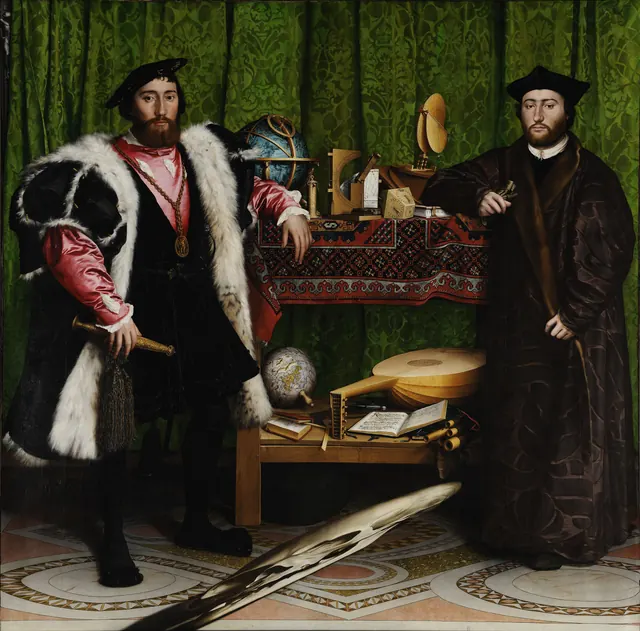
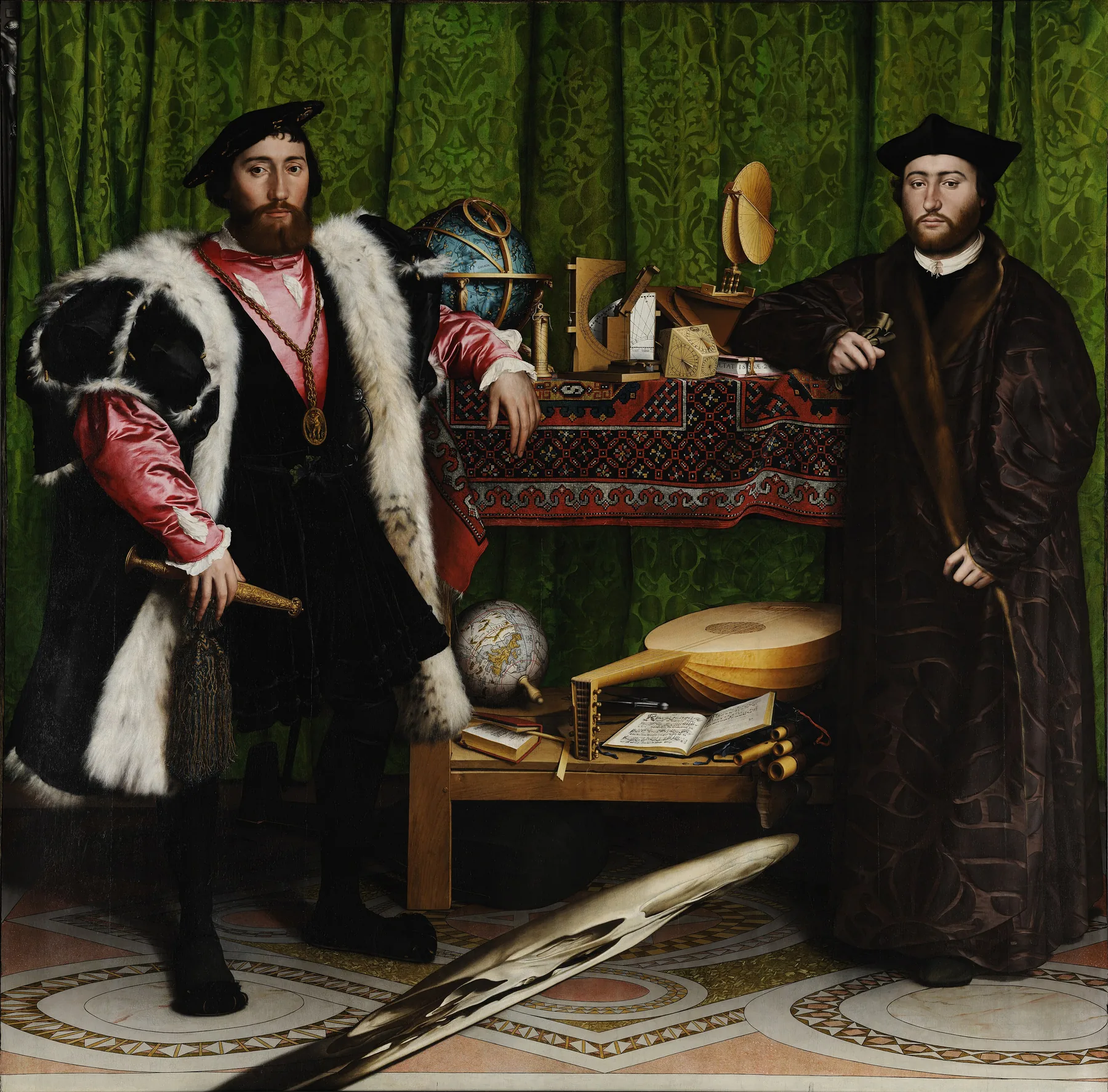
The canvas before us bears the full title “Jean de Dinteville and Georges de Selve (‘The Ambassadors’)”, a name that instantly tells us who stands before us and why the work has been known for centuries simply as The Ambassadors. Painted by the German master Hans Holbein the Younger, this portrait has become a touchstone of Renaissance art, inviting viewers to step inside a world of diplomatic splendor and hidden meaning.
Holbein completed the piece in the year 1533, using oil on a sturdy Baltic‑Polish oak panel. The work measures just over two metres square—207 centimetres high by 209.5 centimetres wide—giving it a near‑life presence that dominates the viewer’s field. The combination of a large wooden support and Holbein’s meticulous brushwork allows the colours to glow with a clarity that still feels fresh after five centuries.
The two figures are Jean de Dinteville, a French noble on his second diplomatic mission to England for Francis I, and Georges de Selve, Bishop of Lavaur and a close friend of the envoy. Their poised stances, side by side, create a quiet dialogue between secular statecraft and ecclesiastical authority, reflecting the intertwined networks of power that defined their age.
Holbein painted this portrait amid the religious upheaval that was reshaping Europe. In England, Henry VIII was on the brink of breaking with Rome—a rupture that would be sealed later in 1533 with his marriage to Anne Boleyn. The painting therefore sits at a moment when theological battles were redefining politics across the continent, a backdrop that deepens the portrait’s resonance.
Behind the ambassadors hangs a heavy green damask curtain, its deep hue catching a soft, diffused light that pushes the scene back into a velvety depth. Peeking through the curtain’s upper‑left corner, a slender silver crucifix is partially concealed, a quiet reminder of redemption that sits just out of full view, inviting the eye to search beyond the surface.
Dominating the upper shelf is a brass celestial globe, its surface engraved with a procession of constellations. The upper half lists CORONA, BOOTES, DRACO, URSA MAJOR, AGITATOR, HERCULES, VULTUR CADENS, CASSIOPEIA, GALAXIA, CEPHEUS, PERSEUS and ANDROMEDA; the lower half continues with VULTUR VOLANS, DELPHINUS, EQUUS, PEGASUS, PISCES, the number 350 and CETUS. This astronomical display underscores the Renaissance fascination with the heavens, linking the ambassadors’ worldly authority to the broader cosmic order.
The floor beneath their feet is tiled with pink and white geometric marble patterns. Scholars have linked this design to the pavement of Westminster Abbey’s sanctuary, suggesting that the earthly surface mirrors the macrocosmic order of the heavens above. In this way, the painted floor becomes a visual bridge between the terrestrial realm of the ambassadors and the divine architecture of the sky.
When the viewer steps to the right and looks from a sharp angle, an anamorphic white shape resolves into a human skull—a classic memento mori. The skull reminds us of mortality, while the way it hides in plain sight embodies the principle of “hiding by showing”, a theme echoed by the green curtain and the concealed crucifix. This visual paradox forces us to shift perspective, both literally and metaphorically.
On the lower shelf a lute rests with one string broken, and a case of flutes is missing its fifth member. The broken string has long been read as a traditional symbol of death, and some scholars extend the meaning to a reference to the Protestant split from the Roman Catholic Church. The missing flute adds a note of discord to an otherwise harmonious ensemble, reinforcing the painting’s subtle commentary on the era’s religious fractures.
The assortment of objects on the two shelves—globe, lute, flutes, mathematical instruments—has been linked to the Renaissance Quadrivium: arithmetic, geometry, music and astronomy. By arranging these symbols of learned mastery together, Holbein creates a visual catalogue of the liberal arts, underscoring the humanist ideal that a cultivated mind should command knowledge in all four disciplines.
In the lower‑left corner of the floor, the signature reads “IOANNES HOLBEIN PINGEBAT 1533”, confirming the artist’s hand and the year of execution. A brass sundial perched on the table also displays the date 11 April 1533, anchoring the work in a precise moment of 16th‑century diplomacy.
The painting entered the Main Collection in 1890, catalogued under inventory number NG1314. Since its acquisition, critics have hailed it as one of the most impressive portraits of the Renaissance, describing it as “staggeringly impressive”. Its reputation endures, inviting each new generation to unravel the visual riddles Holbein embedded within the wood and pigment.
In Holbein’s silent dialogue of wood, pigment, and hidden meaning, every glance invites another question, and every answer deepens the mystery of The Ambassadors.