The story
The Isenheim Altarpiece brings together two distinct crafts in a single devotional object. German painter Matthias Grünewald applied both oil and tempera to a series of panels, while the surrounding wooden shrine was carved by his contemporary Niclaus of Haguenau. Their collaboration unfolded between 1512 and 1516, a period when the boundaries between painting and sculpture were still fluid. This partnership produced a seamless visual heart that rests on a sculpted framework, allowing the painted scenes to emerge from a richly crafted architectural setting. The union of these media underscores the work’s ambition to engage the viewer on multiple sensory levels, marrying painterly color with tactile woodwork.
The altarpiece was commissioned for the Monastery of St. Anthony’s hospital chapel at Isenheim in Alsace, then part of the Holy Roman Empire. The monastery’s infirmary cared for victims of the plague and ergotism, conditions that afflicted many of its patients. By placing such a monumental work in this healing space, the community sought a visual focus that could speak directly to both the physical and spiritual suffering of those under its care.
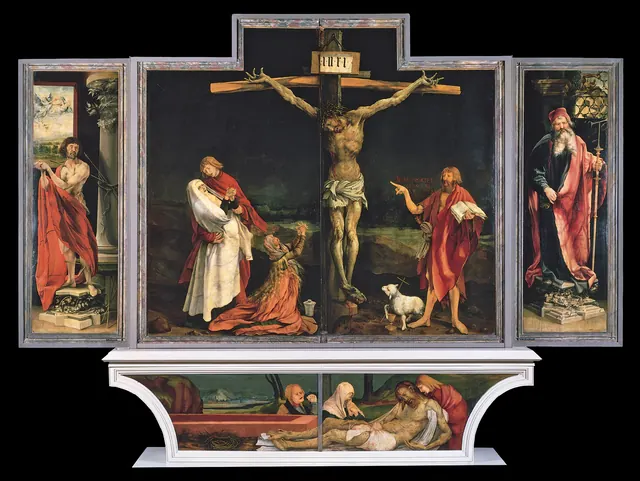
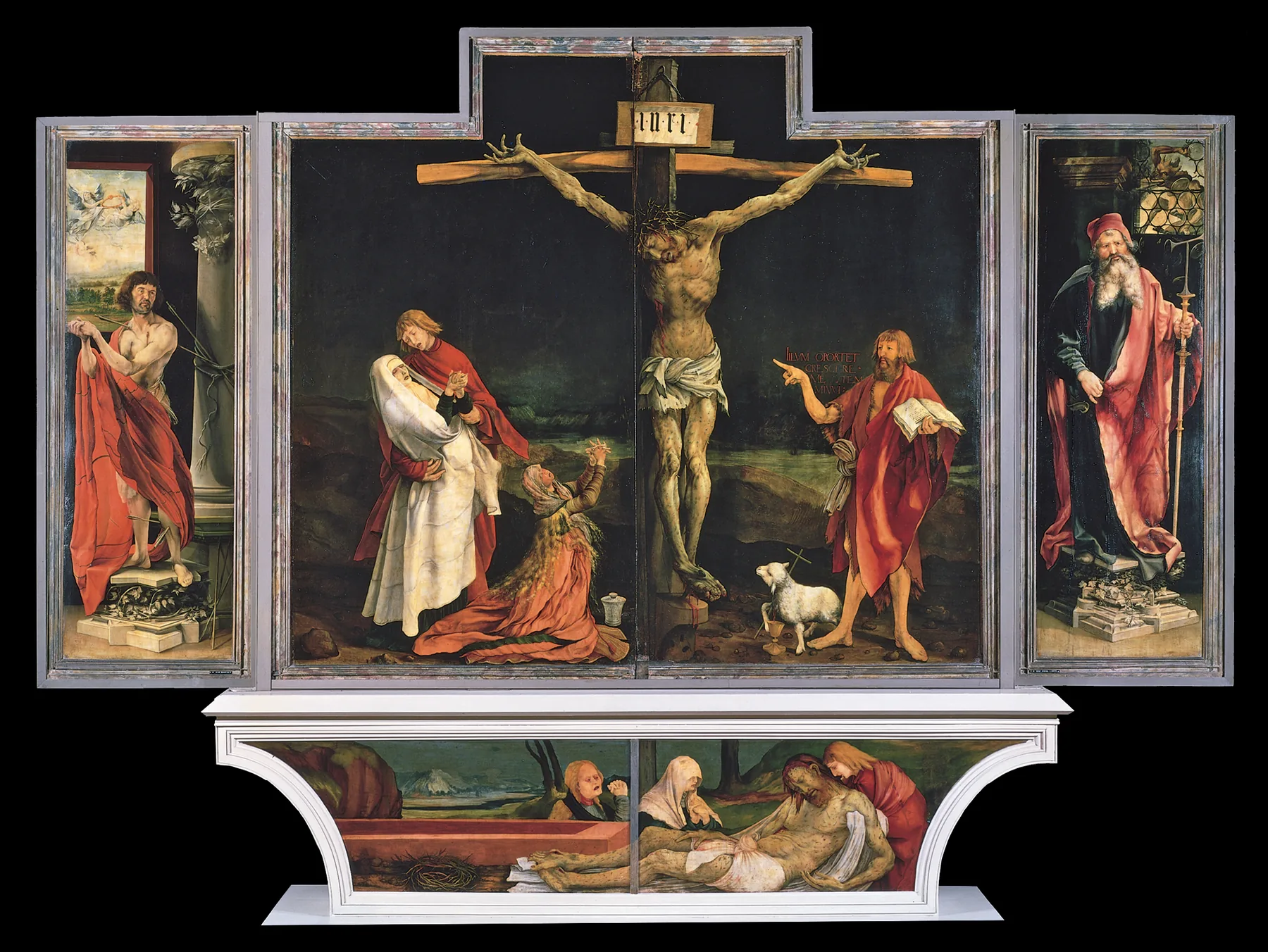
The altarpiece’s engineering is a marvel of its time. It consists of two sets of folding wings that can be opened and closed, creating three distinct visual configurations. When the outer wings are shut, the central panel presents the crucifixion. Opening the first set of wings reveals a luminous tableau of the Annunciation, an angelic choir, the Nativity, and the Resurrection. A further opening pulls back the painted layers to expose the sculpted wooden shrine, centered on a solemn St. Anthony.
In the altarpiece’s closed state, the central panel presents the harrowing crucifixion of Christ. To either side stand the saints who watch over the afflicted—St. Sebastian on the left and St. Anthony on the right—while beneath the cross the Lamentation unfolds, depicting the sorrowful mourning of Christ’s body. Their solemn gazes and the muted palette heighten the sense of grief, inviting the viewer into the depth of the suffering.
When the first set of wings is opened, the narrative shifts to hope. The left wing reveals the Annunciation, the central space bursts with the Angelic Concert alongside the Nativity, and the right wing culminates in the triumphant Resurrection, each scene bathed in luminous light that contrasts the darkness of the closed view.
Both figures of Christ in the altarpiece bear visible sores and lesions, a striking visual strategy that aligns the divine with the physical torment experienced by the monastery’s patients. By depicting the Savior with plague‑like afflictions, Grünewald creates a direct point of identification, suggesting that Christ not only understands but shares the suffering of the afflicted. This intentional choice was meant to offer solace, reassuring the sick that their pain is recognized and borne by the very source of redemption. The graphic realism of the wounds intensifies the emotional impact, turning theological doctrine into a palpable, compassionate presence.
Grünewald’s work fuses the fervent spirituality of the Gothic tradition with the emerging technical precision of the Renaissance. The altarpiece’s dramatic lighting and intense emotional expressions echo the Gothic emphasis on devotional intensity, while the careful rendering of anatomy, perspective, and natural detail demonstrates a mastery of Renaissance methods. This synthesis allows the composition to convey both an inner, mystical fervor and an outward, realistic presence, engaging the viewer’s senses and emotions in equal measure. The result is a visual experience that overwhelms, evoking grief, awe, and a hopeful anticipation of spiritual redemption.
Beyond the overt religious narrative, the altarpiece reveals Grünewald’s intimate knowledge of carpentry and horticulture. The sculpted wooden framework displays careful construction methods, suggesting the artist’s familiarity with building techniques. Likewise, the surrounding flora are rendered with botanical accuracy, each plant species identifiable and placed with deliberate intention. These details reflect an artist who observed the material world closely, integrating the language of building and gardening into a sacred narrative. By bridging practical concerns of monastic life with transcendent faith, the work underscores a holistic vision where the earthly and the divine coexist.
Through its layered structure, vivid suffering, and masterful blend of styles, the Isenheim Altarpiece remains a timeless testament to art’s power to heal, console, and elevate the human spirit.