The story
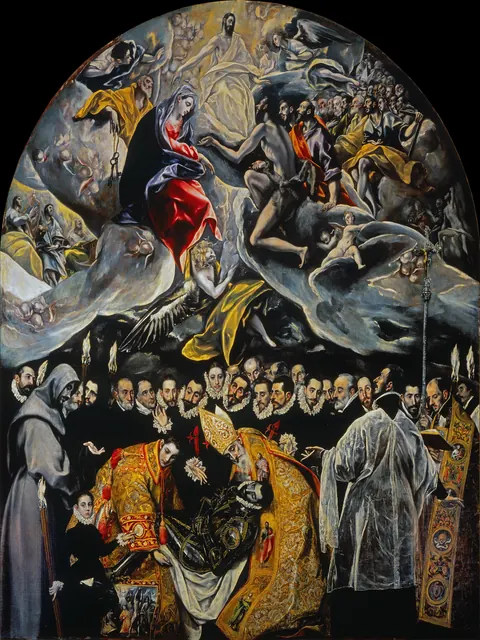
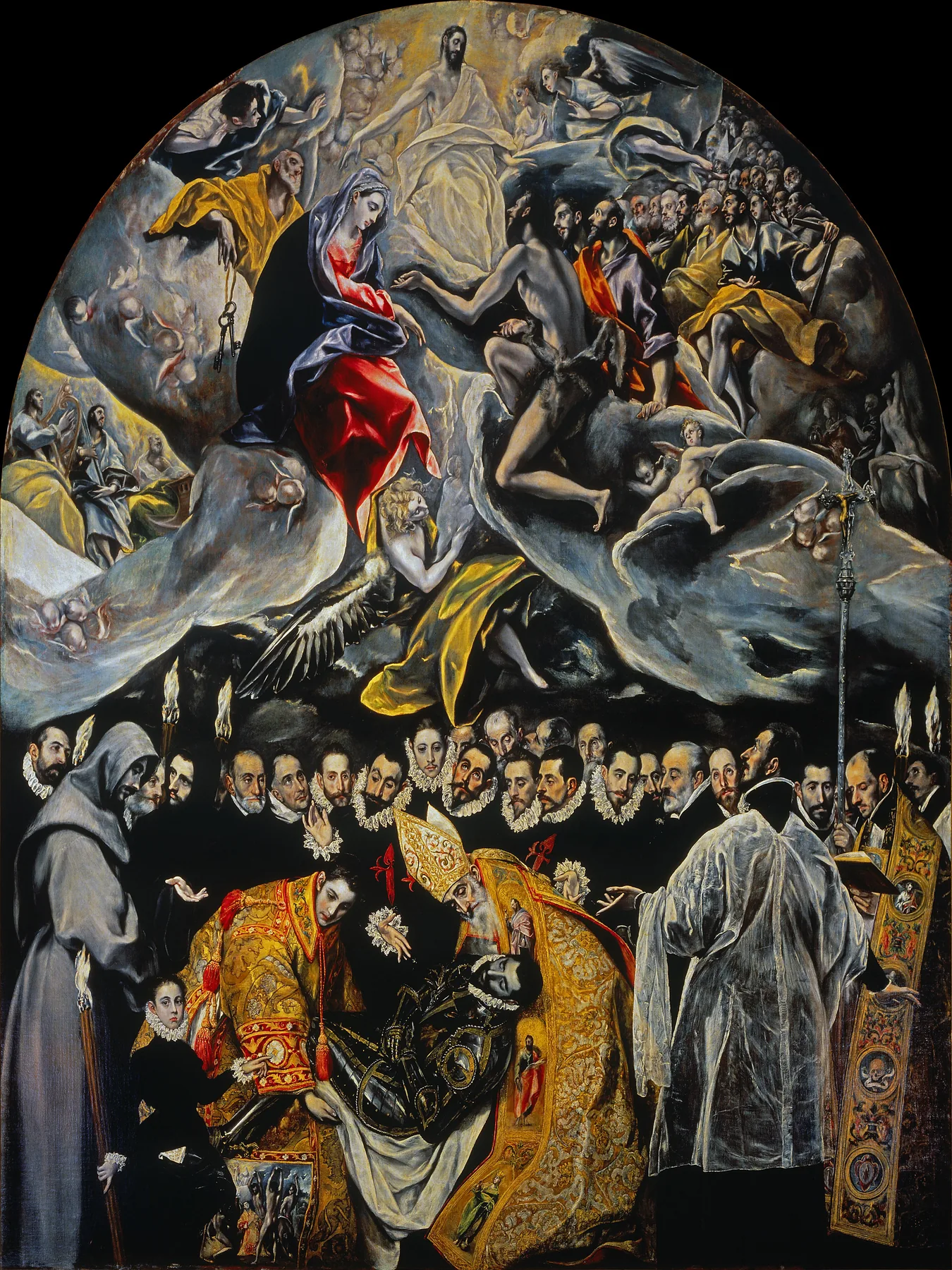
Legend tells that when Gonzalo Ruiz de Toledo died, Saint Augustine and Saint Stephen descended from heaven to lower his body into the tomb. El Greco captured this miraculous moment on canvas between 1586 and 1588. Today the painting still hangs in the funerary chapel of Santo Tomé in Toledo, exactly where it was first installed.
The work is an oil on canvas of monumental scale, roughly five meters wide by three and a half meters high, filling the modest chapel with a theatrical presence. Its luminous pigments and layered brushwork give the heavenly sphere a radiant glow that seems to emanate from within. Because the painting remains fixed above the Count’s tomb in the chapel of Santo Tomé, viewers in the 16th‑century—and today—experience the scene exactly as the original patrons intended, the composition rising directly from the altar toward the divine. The canvas hangs directly behind the altar, its upper edge disappearing into the vaulted ceiling, reinforcing the visual ascent from earth to heaven.
Although the painting belongs to the heart of Spain, its creator began life far to the east, on the island of Crete, where Domenikos Theotokopoulos—later known as El Greco—was born. This Greek origin, combined with his later training in Italy, gave him a unique visual vocabulary that blended Byzantine iconography with the coloristic brilliance of the Venetian school. Understanding his Cretan roots helps us see why the composition balances a rigid, almost sculptural arrangement of figures with a luminous, almost otherworldly palette, a synthesis that would come to define his mature style in Toledo.
At the foot of the composition, a solemn procession gathers around the lifeless Count, whose body lies draped in black plate armor with gold trim, eyes closed in eternal rest. A bishop in a gold‑embroidered cope and mitre looks down, his white beard a sign of wisdom, while a young man in a matching golden cope supports the corpse, his own ruff echoing the Count’s. A boy in a black doublet holds a tall candle, its flame flickering against the shadows. Around them, monks, priests, and a crowd of men in black doublets with white ruffs form a dense, grieving audience, each figure rendered with careful attention to the textures of fabric and flesh.
Above the mourners, the canvas opens onto a luminous sky that El Greco rendered with looser brushwork and a cooler palette of silvers and lilacs, giving the figures an ethereal quality. In this heavenly zone God presides, flanked by the Virgin Mary and Saint John, who intercede on the Count’s behalf, while Saint Peter holds the three keys to the kingdom. A figure looking out toward the viewer, often identified as a self‑portrait of the artist, stands among the saints, linking the earthly commission to the divine vision. The overall effect is a seamless bridge between the two realms, each echoing the other in gesture and light.
One striking feature is that the saints and holy figures are dressed in the contemporary fashions of 16th‑century Spain, not in ancient robes. Their doublets, ruffs, and richly embroidered mantles mirror the attire of the patrons who would have commissioned the work. This deliberate anachronism collapses historical time, allowing viewers of El Greco’s day to see themselves reflected in the sacred narrative, and inviting us to consider how the painting bridges past and present in a single visual moment.
Beyond Expressionism, the work’s daring use of color contrasts and its sinuous, elongated silhouettes point forward to later modernist experiments. The way light seems to emanate from within the figures, and the flattening of space in the heavenly zone, echo concerns that would later appear in various 20th‑century movements. In this sense, El Greco’s 1580s masterpiece can be read as an early, visionary step toward the radical re‑thinking of form and hue that reshaped Western art centuries later.
Art historians and critics alike often single out The Burial of the Count of Orgaz as El Greco’s finest achievement, praising its masterful synthesis of narrative drama, technical brilliance, and spiritual depth.
Scholars debate whether the presence of recognizable Toledo aristocrats in the lower register was mandated by the original contract or was a creative choice by El Greco. The painting’s detailed depiction of contemporary nobles—identified by their distinctive attire and heraldic symbols—suggests that the patron may have required their inclusion, yet the artist’s decision to integrate them seamlessly into the sacred scene hints at a personal ambition to honor his city’s elite within a timeless devotional context.
May the quiet power of El Greco’s vision linger with you long after the screen fades.
Thank you for joining us on this journey through El Greco’s timeless masterpiece.