The story
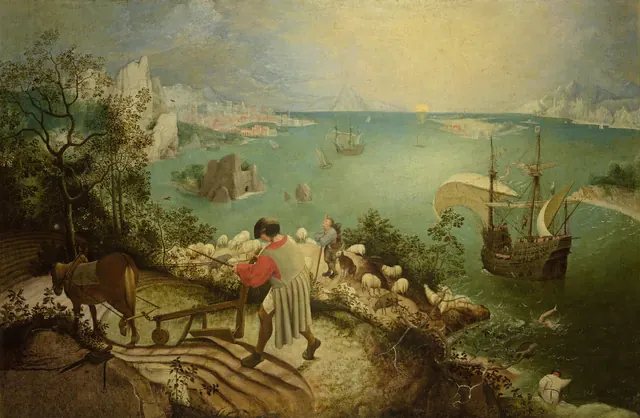
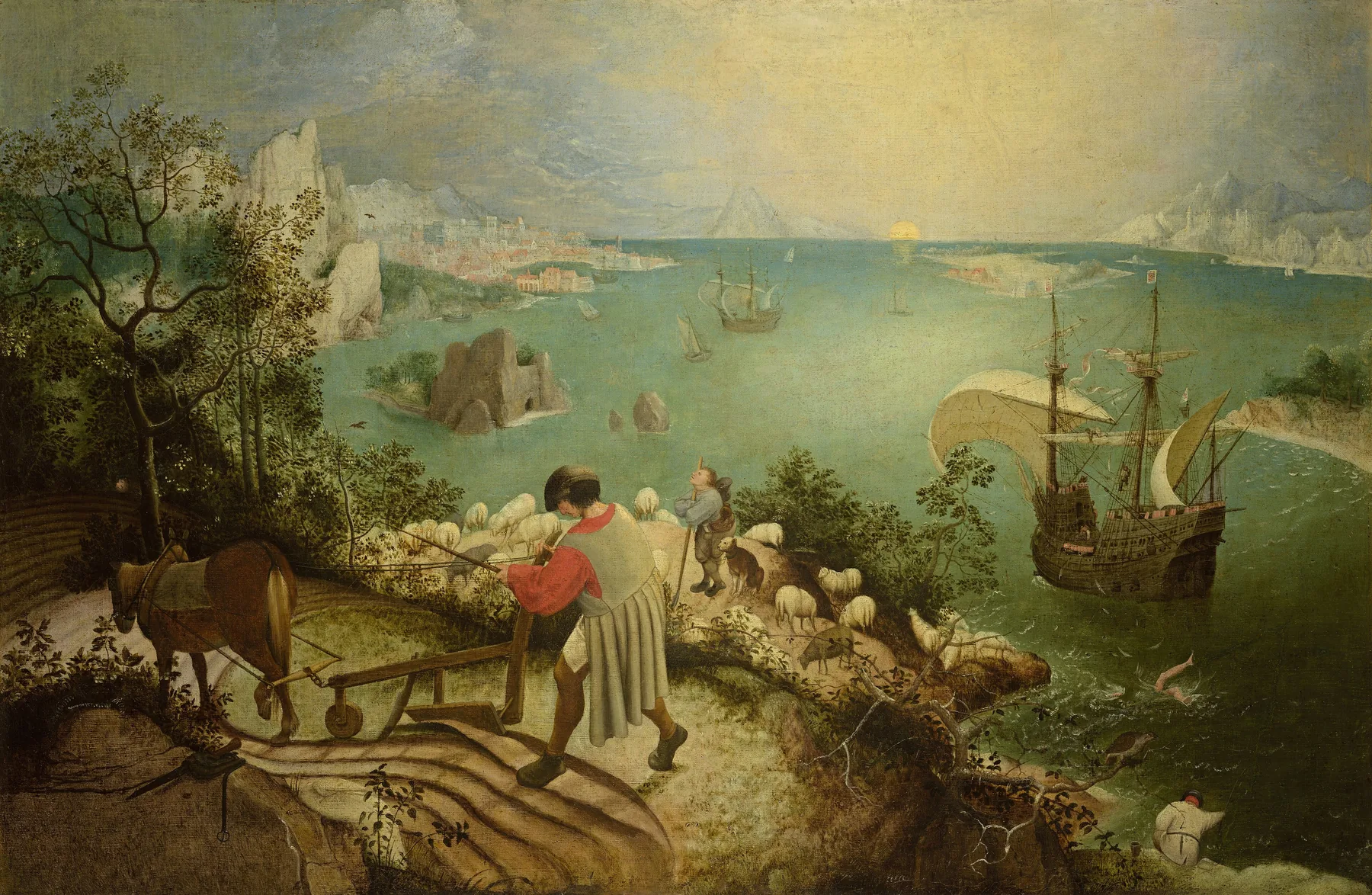
Landscape with the Fall of Icarus is presented to us as an oil painting traditionally attributed to Pieter Bruegel the Elder. While the overall design bears Bruegel’s unmistakable compositional hand, scholars note that the surviving canvas may not be the master’s own brushwork. Recent technical studies have opened the possibility that the work is a later copy, perhaps executed in the 1560s, of a lost original that Bruegel conceived around the mid‑sixteenth century. This tension between authorship and design lies at the heart of the painting’s scholarly intrigue, prompting ongoing scientific analysis to determine whose hand truly guided the paint.
The panel bears no inscribed date, leaving its chronology open to debate. Some experts have placed the work in the mid‑1500s, suggesting a circa 1555 dating based on stylistic parallels, while others point to a later execution in the 1560s, aligning it with a presumed lost original dated around 1558. These competing chronologies reflect the broader uncertainty surrounding the canvas, as the painting’s physical evidence does not lock it to a single year. Consequently, the artwork remains officially undated, its temporal setting a matter of scholarly interpretation rather than documented fact.
Looking closely, the scene unfolds across a gentle, sun‑lit countryside. In the foreground a shepherd tends his flock, his attention absorbed by the animals, while a small pouch and a blade lie on the ground, and a figure tangled in a thicket hints at a hidden death. In the lower right‑hand corner, barely a pair of legs dip into the sea, the only trace of Icarus’s tragic plunge. Scholars have linked the pouch, the blade, and the concealed figure to contemporary proverbs, reading them as visual allusions rather than literal objects. This layered visual strategy invites viewers to search for meaning beyond the immediate landscape.
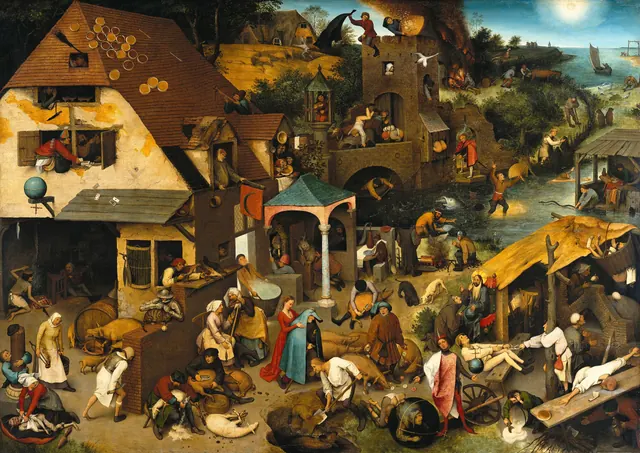
Early in his career Bruegel was employed by a thriving publisher and print‑seller, producing designs for popular proverbial engravings. This print‑making background honed his ability to distill moral lessons into compact, emblematic scenes. The demand for such images encouraged him to transpose these allegorical subjects from the small scale of prints to full‑sized canvases, as we see in this landscape where a classical myth is woven into everyday labor. Understanding this professional trajectory clarifies why the painting balances a timeless story with the concrete details of rural life, reflecting the artist’s roots in the vibrant print culture of the Low Countries.
One dominant reading of the work emphasizes a moral about human ambition: the figure of Icarus, representing lofty aspiration, is ignored by the surrounding peasants who continue their ordinary tasks. The shepherd, the plowman, and the distant ship all turn away, embodying an indifference that renders the boy’s disaster almost invisible. This interpretation underscores a timeless observation—that personal tragedy can be eclipsed by the relentless flow of daily existence. By placing the mythic fall at the edge of the composition, the painting visualizes how ambition may be unnoticed amid the ordinary rhythms of life.
Another layer of interpretation reads the canvas as a warning against the folly of pride. Icarus’s overreaching flight, ending in a silent plunge, serves as a visual parable that unchecked ambition can lead to downfall. The surrounding figures, absorbed in their work, embody a grounded humility that contrasts sharply with the mythic hubris. This moral about the dangers of overreaching resonates with the proverb‑laden details scattered across the scene, reinforcing the idea that lofty aspirations, when divorced from practical reality, may be swiftly undone by the ordinary world.
The painting’s quiet moral power reached beyond the visual arts, inspiring two twentieth‑century poets. In 1938 W. H. Auden wrote a poem that reads the canvas as a meditation on how everything turns away from disaster, highlighting ordinary people’s indifference. Later, in 1960, William Carlos Williams offered his own poetic response, reimagining the surrounding figures and their unawareness of Icarus’s fall. These literary engagements demonstrate how the painting’s subtle narrative continues to provoke reflection, bridging a sixteenth‑century Netherlandish oil with modern verse and confirming its enduring influence on the imagination.
Finally, the question of whether the canvas is an original Bruegel or a later copy remains central to its scholarly profile. While the overall composition is undeniably Bruegel’s, many experts now view the surviving oil as a 1560s replica of a lost original conceived around 1558. This view aligns with the notion that the painting’s design was valuable enough to be reproduced for a broader audience, a practice common in the workshop culture of the period. Ongoing technical analysis—infrared reflectography, pigment testing, and brushstroke examination—continues to probe the layers of paint, seeking clues that might finally resolve the mystery of its true hand.
In the quiet corners of Bruegel’s landscape, the fall of Icarus whispers a timeless lesson—ambition may soar, but the world around us keeps moving, inviting each viewer to pause, look deeper, and remember the stories that hide in plain sight.