The story
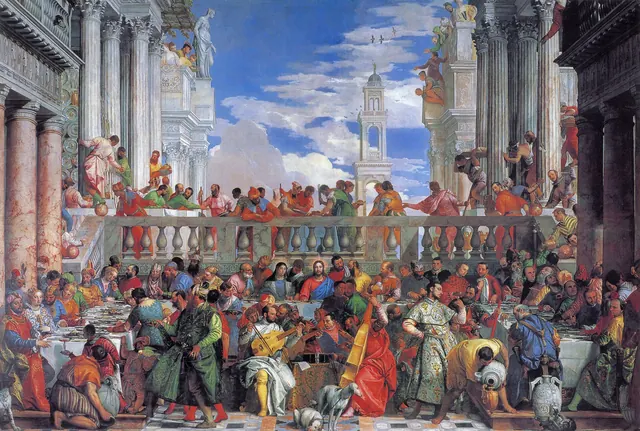
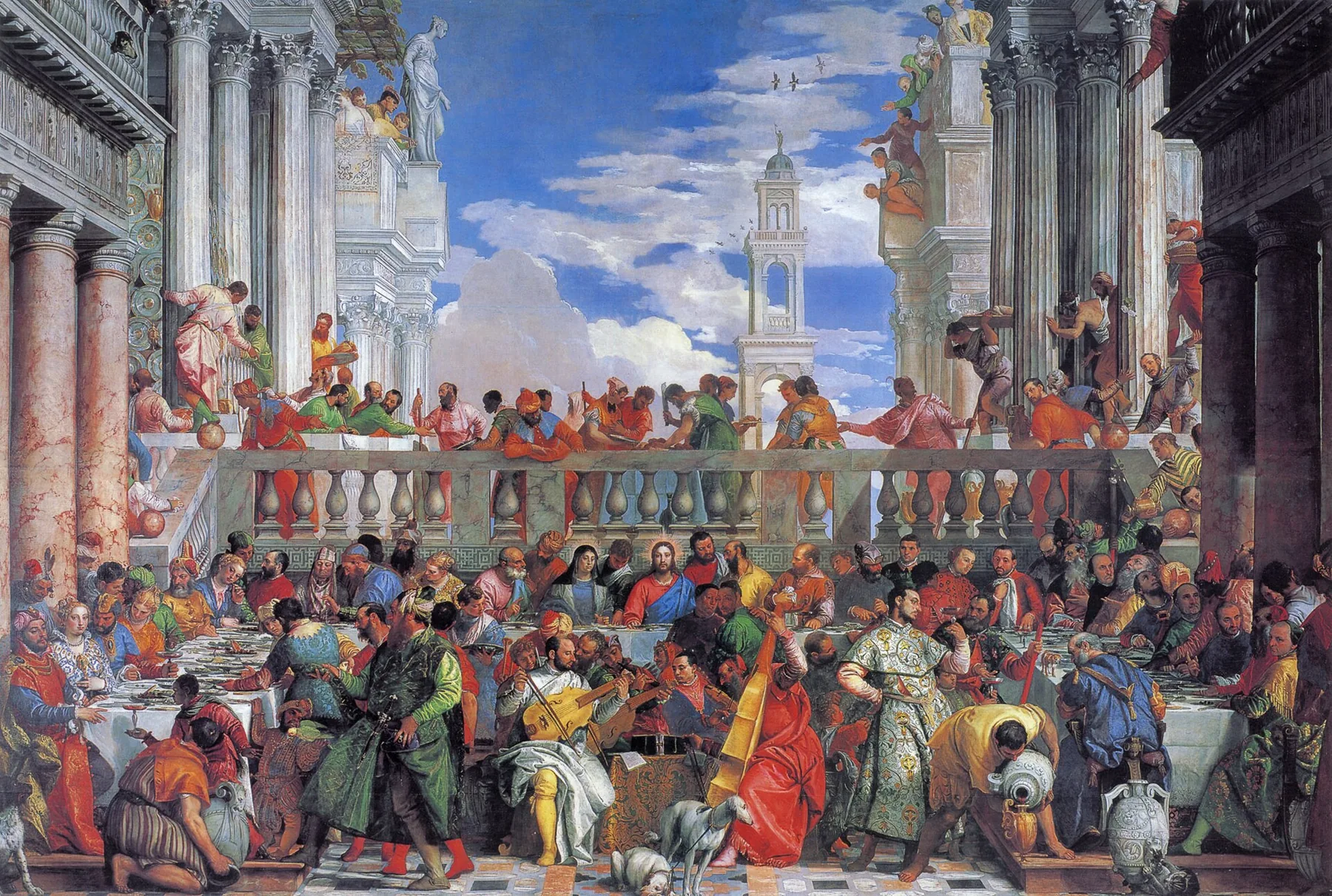
The canvas before us bears the French title “Les Noces de Cana,” which translates directly to The Wedding at Cana. A title is more than a label; it immediately situates the viewer within the biblical feast Veronese chose to depict, hinting at the narrative drama that will unfold across the vast surface.
Measuring roughly 6.8 metres in height and 9.9 metres in width, the work dominates the wall it inhabits. Such a monumental scale forces the viewer to step back to grasp the full banquet, then move forward to trace the delicate brushstrokes that populate the scene. The sheer size creates an immersive arena, turning the biblical feast into a visual experience that surrounds and engages the spectator, shaping the rhythm of the gallery space itself.
Veronese executed the work in oil on canvas, a medium that permits deep, saturated colours and subtle tonal transitions across a surface of this magnitude. Oil adheres well to the flexible support, allowing both broad washes of colour and fine detailing. This combination gives the artist the capacity to render the luminous atmosphere of a banquet hall, to model the play of light on silverware and fabrics, and to sustain visual richness even when the viewer steps back to take in the whole scene.
The painting was created between 1562 and 1563, placing it firmly within the sixteenth‑century flourishing of Venetian art. Those years locate the canvas at a moment when Venice was a hub of artistic innovation, where large narrative commissions were prized for their ability to convey both religious devotion and civic pride. Knowing the precise years helps us understand the work as a product of its time, reflecting the technical confidence and compositional ambition that characterized the city’s artistic output in the mid‑1500s.
Originally, the canvas was painted for the refectory of the Benedictine monks of San Giorgio Maggiore in Venice. A refectory served as the communal dining hall for the monastic community, and a banquet scene such as the Wedding at Cana was an apt visual accompaniment to meals. By placing this grand depiction of a biblical feast in the monks’ eating space, the commission linked the act of communal dining with a sacred narrative, encouraging reflection on fellowship and abundance each time the monks gathered for their daily sustenance.
In 1797 the painting was removed from its original Venetian setting, and the following year it was transported to Paris. Moving a canvas of this size required careful handling and a logistical effort that matched the work’s grandeur. The relocation shifted the piece from a monastic dining hall to a secular museum environment, altering the way viewers encounter the scene and opening the work to an international audience far beyond its initial devotional context.
In 1798 the canvas entered the Louvre’s collection as a result of a military conquest. This acquisition placed Veronese’s monumental banquet among the prized works seized during the French Revolutionary campaigns, transferring a piece of Venetian cultural heritage into the French national collection. Its arrival in the Louvre marked a new chapter, reshaping the painting’s identity from a monastic commission to a public treasure displayed for scholars and visitors alike.
The painting is owned by the French State and is held by the Musée du Louvre’s Department of Paintings. State ownership guarantees that the work remains part of the public domain, accessible to scholars, students and visitors. The department’s responsibility for conservation, research and exhibition ensures that the canvas receives professional care, that its condition is monitored, and that future generations can continue to experience its visual power.
The canvas hangs in the Denon wing, Salle 711 – the Salle de la Joconde – of the Louvre. Positioned in this prominent gallery, it shares space with other celebrated masterpieces, creating a dialogue between works of different periods and styles. The high‑traffic setting ensures that a broad audience encounters the monumental scene, reinforcing its status as a highlight of the collection and inviting viewers to compare Veronese’s 16th‑century vision with later artistic achievements displayed nearby.
The museum records the work under its official inventory numbers, a part of the Louvre’s rigorous documentation system that enables precise tracking of the painting’s provenance, condition and exhibition history. While visitors may not see these numbers on the wall, they are essential tools for scholars conducting research, ensuring that every aspect of the canvas’s journey—from its Venetian origins to its current home—is meticulously recorded and preserved.
Veronese’s Wedding at Cana stands as a testament to artistic ambition, technical mastery, and the ever‑shifting paths that great works travel through history. Its monumental scale, luminous colour, and rich narrative continue to captivate viewers, reminding us how a single canvas can bridge centuries, cultures, and continents, inviting each generation to pause at the banquet and share in its timeless feast.
Thank you for joining us on this journey through Veronese’s grand banquet.