The story
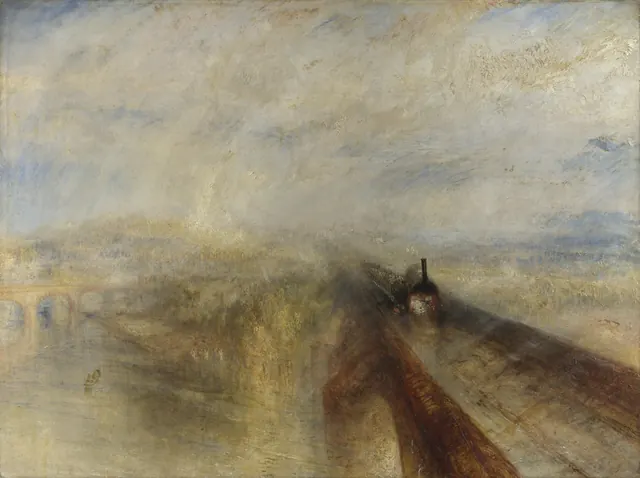
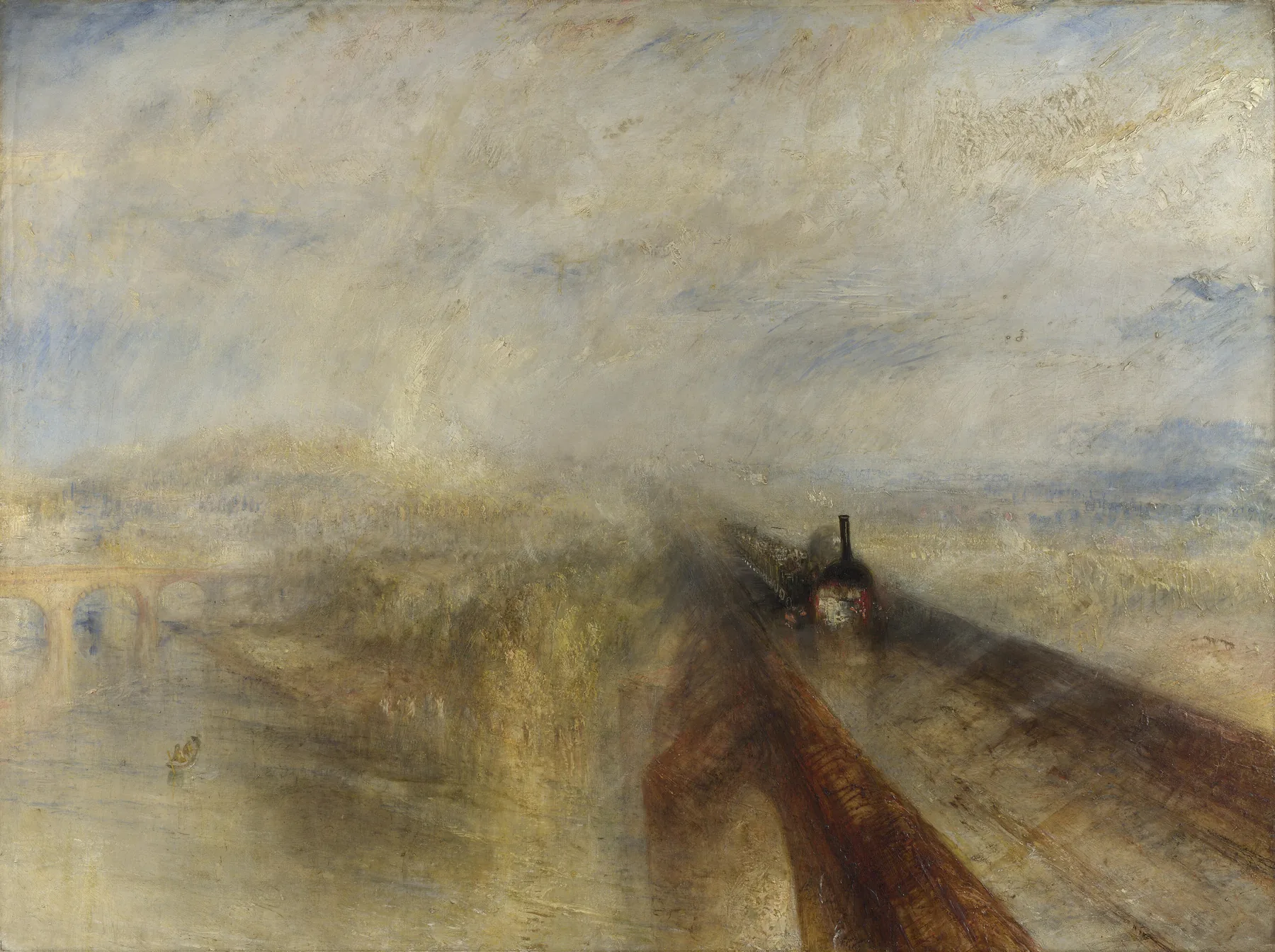
In 1844 the artist Joseph Mallord William Turner completed an oil‑on‑canvas work whose full title reads “Rain, Steam, and Speed – The Great Western Railway.” The painting bears Turner’s signature hand, marking it as a product of his mature period. By naming rain, steam and speed together, the title already hints at the dramatic clash of weather and technology that the canvas will unleash. Though the canvas is now over a century and a half old, the original medium of oil on canvas remains the vehicle through which Turner captures that fleeting, kinetic moment.
From the first glance, a veil of rain and steam sweeps across the picture, softening edges and diffusing the light that falls on the river and the distant sky. Turner’s palette leans toward muted grays, silvery blues and warm ochres, allowing the atmospheric haze to melt the horizon into a seamless wash of colour. The droplets catch the faint glow of the locomotive’s headlamp, while the mist swirls around the arches, creating the impression that the whole world is caught in a single breath of weather. This atmospheric veil unifies sky, water and rail, amplifying the sensation of motion as if the viewer stands on a wet bank, waiting for the train to burst through.
Dominating the middle ground, the twin arches of Maidenhead Railway Bridge stretch across the Thames. Designed by the engineer Isambard Kingdom Brunel and completed in 1838, the stone structure is rendered with an exaggerated, abrupt foreshortening that compresses distance and thrusts the bridge forward. This visual trick makes the viaduct appear to surge out of the canvas, reinforcing the painting’s sense of speed. The solidity of the bridge anchors the composition, while its angled perspective invites the eye to follow the line of the tracks straight into the heart of the scene, where the locomotive waits to cross.
At the focal point, a steam locomotive barrels across the bridge, its massive form caught mid‑stride. Thick plumes of smoke mingle with the rain, blurring the distinction between water vapor and coal fire. Turner captures the gleam of metal as it catches the diffused light, a flash of brass against the muted background. The locomotive’s forward thrust is emphasized by the converging lines of the tracks and the steeply foreshortened arches, creating a visual vortex that pulls the viewer’s gaze into the motion. Though rendered with just enough detail to be recognizable, the surrounding haze suggests a speed that outpaces the eye, a fleeting glimpse of industrial power racing through nature.
Hidden midway along the tracks, Turner painted a small hare to symbolize natural speed. Over the centuries the paint has become increasingly transparent, rendering the animal virtually invisible on the canvas today. Yet an engraving produced by Robert Brandard in 1859, first published in The Turner Gallery, clearly shows the hare in its original position, confirming Turner’s intention. The juxtaposition of this timid creature with the roaring locomotive creates a quiet counterpoint, reminding viewers that even in an age of steam, the wild still races alongside technology. The hare’s near‑invisibility today adds a layer of mystery, inviting the eye to search for what has faded.
Turner was no recluse shunning the new age; rather, he frequently turned his brush toward contemporary industrial scenes, fascinated by the emerging forms of transport that reshaped Britain. Scholars note that it is unlikely this painting represents a rejection of modernity. Instead, it reflects an artist eager to explore the visual possibilities offered by steam trains, bridges, and the shifting play of light on metal and water. By choosing the railway as a subject, Turner treats the machine not as an intrusion but as a fresh field for his atmospheric imagination, demonstrating his willingness to engage with the technological marvels of his time.
When the canvas was first shown at the Royal Academy in 1844, it sparked immediate public interest. The Times remarked that the railways “have furnished Turner with a new field for the exhibition of his eccentric style,” highlighting how critics saw the railway as a novel arena for his distinctive approach to light and movement. This contemporary comment underscores the painting’s role as a bridge between traditional landscape tradition and the modern industrial world, positioning Turner at the forefront of artists daring to capture the speed and steam of the new age.
The painting entered the National Gallery’s collection through the Turner Bequest of 1856, ensuring that future generations could stand before this vivid encounter between rain, steam and speed. The bequest, a generous legacy left by Turner himself, brought the work into public ownership shortly after its creation, allowing it to be displayed alongside other masterpieces of the British landscape tradition. Its presence in the gallery has made it a touchstone for viewers seeking to understand how the forces of nature and industry can coexist on a single canvas, a testament to Turner’s visionary eye.
So the next time you watch a train thunder across a rainy landscape, remember Turner’s canvas, where the rush of iron and the whisper of rain were forever captured in light. The painting invites us to feel the pulse of the industrial age while still hearing the quiet heartbeat of the natural world, a balance that continues to resonate more than a century and a half later.
Thank you for joining us on this visual journey through Turner’s masterpiece.